Attend our in-person Robotics & Math


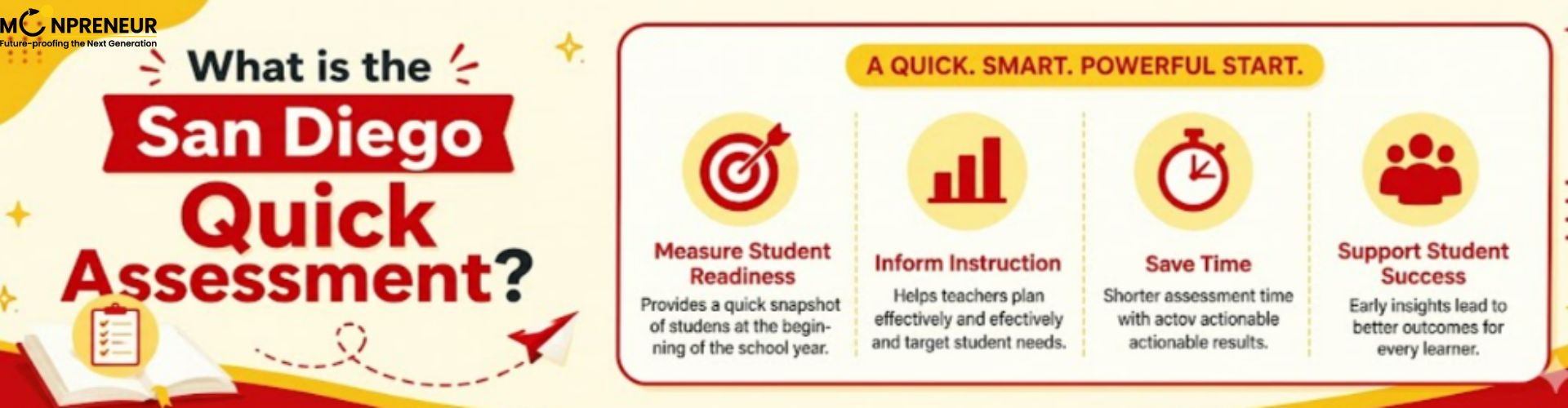
Every child deserves the opportunity to become a confident, capable reader. But before effective support can begin, educators and parents need to know where a child actually stands. That is where the San Diego Quick Assessment, one of the most widely used reading screening tools in the world, comes in.
Whether you are a classroom teacher trying to identify students who need extra support, a tutor looking for a reliable starting point, a parent concerned about your child's reading progress, or a specialist conducting early screenings, the San Diego Quick Assessment of Reading Ability is an indispensable tool. It is fast, free, research-backed, and remarkably accurate for its simplicity.
In this comprehensive guide, we will walk you through everything you need to know about the San Diego Quick Assessment, what it is, where it came from, how to administer it, how to interpret results, and what to do next.
What Is the San Diego Quick Assessment?
The San Diego Quick Assessment (commonly abbreviated as SDQA) is a norm-referenced, graded word list test used to quickly determine a student’s reading level. It measures a student’s ability to recognize and decode words presented in isolation — that is, without any surrounding context or sentence clues.
The assessment consists of 13 graded word lists, each containing exactly 10 words, spanning from Pre-Primer (Kindergarten level) all the way to Grade 11. By having students read words out of context, the test reveals their true decoding and word recognition abilities, unmasked by contextual guessing.
The San Diego reading assessment is designed to be administered one-on-one in just 5 to 10 minutes, making it one of the most efficient reading screening tools available. Results identify three key reading levels for each student: independent, instructional, and frustration levels — each carrying specific implications for instruction and material selection.
Key facts at a glance:
- Full name: San Diego Quick Assessment of Reading Ability (SDQARA)
- Also known as: SDQA, Grade-Level Reading Assessment
- Grade coverage: Pre-Primer through Grade 11
- Words per list: 10
- Time required: 5–10 minutes per student
- Cost: Free (public domain)
- Format: Individual, oral administration
- Primary use: Reading level screening and instructional planning
History and Background of the San Diego Quick Assessment
The San Diego Quick Assessment has a surprisingly long and respected history in the field of literacy education.
Origins (1969): The assessment was originally created by Margaret La Pray and Ramon Ross and published in the Journal of Reading in January 1969, under the title “The Graded Word List: Quick Gauge of Reading Ability.” The words used in each list were carefully drawn from the glossaries of basic readers and the 1931 Teacher’s Word Book of 20,000 Words by E. L. Thorndike, a seminal reference in vocabulary research.
In their original article, La Pray and Ross described two primary uses for their graded word list: (1) to determine a student’s reading level, and (2) to detect errors in word analysis. They noted the list could help group students for corrective practice and select appropriate reading materials, goals that remain perfectly relevant today.
Enduring validity: Despite being over five decades old, the San Diego Quick Assessment has stood the test of time. Research has repeatedly confirmed that it provides a fairly accurate estimate of a child’s ability to read grade-level material. In their 2003 book Assessment for Reading Instruction, literacy researchers Michael C. McKenna and Steven A. Stahl described the SDQA as “one of the most popular graded word lists in the public domain.”
“The graded word list has two uses: (1) to determine a reading level; (2) to detect errors in word analysis.” — La Pray & Ross, Journal of Reading, 1969
Today, the San Diego reading assessment is freely available in the public domain, used by teachers, tutors, speech-language pathologists, parents, and literacy specialists across the English-speaking world.
The Graded Word Lists: What Do They Look Like?
Each of the 13 word lists targets a specific grade level, with vocabulary carefully selected to reflect the complexity and phonetic patterns typical of that grade. The words increase progressively in difficulty, from simple sight words in the Pre-Primer list to highly sophisticated vocabulary in the Grade 11 list.
Here is a sample overview of the grade-level word lists:
| Grade Level | Sample Words | Focus Skills |
|---|---|---|
| Pre-Primer (K) | see, me, at, run, go, look, can, and, here | Basic sight words, short vowels |
| Primer | you, not, with, jump, help, is, are, this, work | Common sight words, CVC patterns |
| Grade 1 | road, come, when, bigger, how, always, night, spring, live | Digraphs, blends, and long vowels |
| Grade 2 | our, city, please, myself, town, early, send, wide, quietly | Multi-syllable words, vowel teams |
| Grade 3 | decided, served, amazed, silent, wrecked, improved, certainly, entered, realized | Prefixes, suffixes, complex vowels |
| Grade 4 | scanty, business, develop, considered, discussed, behaved, acquainted, escaped, grim | Multisyllabic, less common words |
| Grade 5 | bridge, commercial, abolish, trucker, apparatus, elementary, blight, comment, wrest | Academic vocabulary |
| Grade 6–11 | dominion, capillary, capacious, pretext, delusion, exonerate, luxuriate, piebald | Advanced academic & literary words |
An important design feature: words are presented in isolation — without any sentence or paragraph context. This is deliberate. It prevents students from using contextual clues to guess words they might not actually be able to decode, giving educators a truer picture of phonics and decoding skills.
Who Should Use the San Diego Quick Assessment?
The San Diego Quick Assessment of reading ability is a versatile tool appropriate for a wide range of users and settings:
- Classroom teachers: Quickly screen all students at the beginning of the school year to inform reading groups and material selection.
- Reading specialists & literacy coaches: Use as a first-step screening tool before conducting more comprehensive reading assessments.
- Special education teachers: Identify students who may be reading significantly below grade level and need IEP support.
- Speech-language pathologists: Use as part of a broader language and literacy evaluation.
- Tutors and homeschool educators: Establish a reliable baseline for customized instruction.
- Parents: Gain an objective, data-driven sense of where their child stands in reading relative to grade-level expectations.
- Adult literacy programs: The assessment can also be used with adult learners to quickly determine starting points for instruction.
The SDQA is most commonly and effectively used with students in Grades 1 through 8, though it covers the full range from Kindergarten through Grade 11.
How to Administer the San Diego Quick Assessment
One of the greatest strengths of the San Diego Quick Assessment is how simple it is to administer. No special training is required. Here is a step-by-step guide:
Step 1: Gather Your Materials
- Print or display two copies of the word lists: one for the student (the Student Copy) and one for you to record errors on (the Teacher/Record Copy).
- Have a pencil ready to mark incorrect responses on your record form.
Step 2: Determine Your Starting Point
Begin testing 2 to 3 grade levels below the student’s current grade level. For example, if a student is in Grade 4, start at Grade 1 or Grade 2. This approach builds confidence and ensures you capture the full picture of the student’s reading range.
For Kindergarten students or very emergent readers, begin at the Pre-Primer list.
Step 3: Present the Word List
- Show the student one list at a time. Use a piece of paper or card to cover the unused lists to minimize distraction.
- Ask the student to read each word aloud.
- Allow no more than 4 to 5 seconds per word. If the student self-corrects within that time, count it as correct.
- If the student hesitates for longer than 5 seconds, move on to the next word and count it as an error.
Step 4: Record Errors
- Mark every word the student misreads or skips on your record copy.
- Write down mispronunciations exactly as the student said them — this gives you valuable data about specific phonics patterns the student struggles with.
Step 5: Know When to Stop
Continue moving up grade levels until the student makes 3 or more errors on a single list. That is the stopping point. The student has reached their frustration level.
Tip: Encourage the student to attempt every word, even ones they are unsure about. Seeing how they attempt to decode an unknown word reveals which word-attack strategies they are using.
How to Score and Interpret Results
After administering the San Diego Quick Assessment of reading ability, scoring is straightforward. Each word list is scored based on the number of errors made:
| Errors Per List | Reading Level | What It Means |
|---|---|---|
| 0–1 error | Independent Level | Student can read this material comfortably on their own without support. |
| 2 errors | Instructional Level | Students can read this material with teacher guidance and scaffolding. |
| 3+ errors | Frustration Level | The material is too challenging; reading may be labored, and comprehension may break down. |
Determining the overall reading level: The student’s reading level is defined as the last grade-level word list on which the student reads 8 or more words correctly (i.e., makes 0–2 errors).
What Do the Three Levels Mean for Instruction?
Independent Level: Use books and reading materials at this level for independent, pleasure reading. Students should be able to read these comfortably with strong comprehension.
Instructional Level: This is the sweet spot for guided reading and small-group instruction. The material is challenging enough to promote growth, but not so hard that the student becomes frustrated, provided the teacher offers appropriate scaffolding.
Frustration Level: Avoid assigning independent reading at this level. However, the teacher can still read aloud at this level with rich discussion to support comprehension and vocabulary growth.
Identifying Decoding Patterns from Errors
One underutilized strength of the San Diego reading assessment is its power to reveal specific phonics and decoding weaknesses, if you take careful notes on how students mispronounce words.
For example:
- In the Pre-Primer list, three words contain long e vowel patterns — errors on these may signal difficulty with vowel sounds.
- In the Grade 3 list, several words contain r-blend consonant clusters. Consistent errors on these words may indicate difficulty with consonant blends.
- Patterns of dropping endings (such as -ing or -ed) may signal morphological awareness gaps.
- Consistent vowel substitutions may point to specific phonics gaps that can be addressed through targeted phonics instruction.
This error analysis can be especially valuable in the primary grades and can directly guide your phonics, spelling, and decoding instruction. While the SDQA was not designed as a comprehensive phonics inventory, it can serve as a useful flag for which areas need deeper investigation.
Pro Tip: After administering the SDQA, consider following up with a more detailed phonics inventory to pinpoint exactly which letter-sound relationships, syllable types, or morpheme patterns need explicit instruction.
Advantages of the San Diego Quick Assessment
The enduring popularity of the San Diego Quick Assessment is no accident. It offers a remarkable combination of simplicity, accuracy, and practical utility:
- Speed: Takes only 5 to 10 minutes per student, making it feasible to screen entire classrooms in a short period.
- Ease of administration: No specialized training is required. Teachers, parents, and tutors can all administer it with minimal preparation.
- Free and publicly available: The SDQA is in the public domain. No licensing, no fees, just print and go.
- Provides three reading levels: Unlike many screeners that give a single score, the SDQA identifies independent, instructional, and frustration levels — nuanced information that directly informs material selection and instruction.
- Useful for instructional planning: Results can immediately guide which texts to assign, which reading groups to form, and where to focus phonics instruction.
- Research-backed accuracy: Despite its simplicity, researchers confirm the SDQA provides a fairly accurate estimate of overall reading grade level.
- Decoding error analysis: Careful recording of errors can reveal phonics pattern weaknesses for targeted instruction.
- Wide age range: Suitable for Kindergarten through Grade 11, and can even be used with adult learners.
Limitations of the San Diego Quick Assessment
Like any assessment, the San Diego Quick Assessment of reading ability has limitations that educators should be aware of:
- Not a diagnostic tool: The SDQA is a screener, not a diagnostic assessment. It cannot identify the cause of reading difficulty, whether that is dyslexia, a language disorder, limited vocabulary exposure, or another factor.
- Does not assess comprehension: Word recognition in isolation is not the same as reading comprehension. A student may score well on the SDQA but still struggle to understand connected text.
- Does not assess fluency: Reading speed and prosody, key components of reading fluency, are not captured by this assessment.
- No contextual reading: While words in isolation provide important data, reading in context involves additional skills (like inference and vocabulary in context) that the SDQA does not measure.
- Vocabulary shifts over time: The word lists were developed in 1969 using vocabulary standards of that era. Some words may feel dated or culturally unfamiliar to today’s students, though researchers note the lists remain reasonably accurate.
- Not a substitute for comprehensive evaluation: If a student scores below grade level on the SDQA, this should be treated as a red flag that prompts further, more comprehensive assessment, not a final conclusion about the student’s abilities.
The key takeaway: use the San Diego Quick Assessment as a valuable first step, a quick, reliable flag, and follow up with a deeper assessment and professional consultation when needed.
SDQA vs. Other Reading Assessments
How does the San Diego Quick Assessment compare with other common reading assessment tools?
| Assessment | Type | Time | Grade Range | Measures |
|---|---|---|---|---|
| San Diego Quick Assessment | Screener | 5–10 min | K–11 | Word recognition, decoding |
| Dolch Word Lists | Sight word list | 5–10 min | Pre-K–Grade 3 | Sight word fluency |
| Informal Reading Inventory (IRI) | Diagnostic | 30–60 min | K–12 | Comprehension, fluency, word ID |
| DIBELS (Dynamic Indicators) | Screener/diagnostic | 10–20 min | K–8 | Fluency, phonemic awareness |
| Fountas & Pinnell Benchmark | Diagnostic | 20–40 min | K–8 | Comprehension, fluency, accuracy |
As this comparison shows, the San Diego Quick Assessment occupies a unique niche: it is one of the fastest, simplest, and most cost-effective screening tools available, making it ideal as a first-pass screener before deploying more time-intensive diagnostic assessments.
When Should You Be Concerned About SDQA Results?
Not every student who scores below grade level on the San Diego reading assessment will have a serious reading difficulty. Reading development involves many variables, including exposure to books at home, quality of instruction, English language proficiency, and more.
However, there are patterns of SDQA results that should prompt immediate follow-up:
- A student reading significantly below grade level (more than 2 years behind) despite adequate instruction should be referred for a comprehensive reading evaluation.
- A student whose independent reading level is Pre-Primer or Primer by the end of Grade 2 warrants urgent attention.
- A student who consistently confuses vowels, omits word endings, or shows no sound-symbol correspondence should be evaluated for potential dyslexia.
- A student who shows a sudden, unexpected drop in reading level on re-administration of the SDQA should be referred to appropriate specialists.
Research consistently shows that decoding deficits — the kind the SDQA helps identify — do not improve significantly without focused, explicit intervention. Early identification and early action produce the best outcomes for struggling readers.
Key Insight: The earlier reading difficulties are identified and addressed, the better the long-term outcomes. The San Diego Quick Assessment is an excellent first step in that early identification process.
Expand Your Knowledge With These Readings
- 25 Ways Robots Are Helping Humans in Daily Life, Work, and Healthcare
- How Automation and Robotics Are Transforming Airline Operations
- 25 Ways Robots Are Helping Humans in Daily Life, Work, and Healthcare
- The Unspoken Rules of Interacting with AI for Safer, Smarter Conversations
- How AI is Disrupting Education: A Black Swan Moment
- AI as Your Second Brain: Revolutionizing Decision-Making in the Digital Age
- The Unspoken Rules of Interacting with AI for Safer, Smarter Conversations
- AI Agents: Turning Clicks, Carts, and Conversions into a Trillion-Dollar Empire
- The Good, the Bad & the Unknown of AI
Conclusion
The San Diego Quick Assessment has earned its place as one of the most enduring, trusted, and widely used reading screening tools in education, and for good reason. In just a few minutes, it provides educators, parents, and specialists with a reliable snapshot of where a child stands in their reading development, across the full spectrum from independent to frustration levels.
Its simplicity is its superpower. In a world full of complex, expensive, time-consuming educational assessments, the San Diego Quick Assessment of reading ability offers something rare: a fast, free, accurate, and actionable tool that genuinely works.
Whether you are screening a whole classroom, supporting a struggling reader at home, or conducting early intervention work, the San Diego reading assessment is an invaluable first step in understanding and supporting every reader’s journey.
Use it as your starting point. Follow up with a deeper assessment when needed. And most importantly, act on what you find. Every child who struggles to decode words deserves early, targeted support. The San Diego Quick Assessment helps you find them — and help them — faster.
Moonpreneur is on a mission to disrupt traditional education and future-proof the next generation with holistic learning solutions. Its Innovator Program is building tomorrow’s workforce by training students in AI/ML, Robotics, Coding, IoT, and Apps, enabling entrepreneurship through experiential learning.
FAQs
Q1: Is the San Diego Quick Assessment the same as the San Diego Quick Assessment of Reading Ability?
Yes. “San Diego Quick Assessment” and “San Diego Quick Assessment of Reading Ability” (SDQARA or SDQA) refer to the same tool. The formal name includes “of reading ability,” but it is commonly shortened in practice.
Q2: How often should the SDQA be administered?
Most educators administer the SDQA at the beginning of the school year to establish a baseline, and again mid-year or at the end of the year to monitor progress. Tutors may administer it more frequently to track growth over shorter intervals.
Q3: Can parents administer the San Diego Quick Assessment at home?
Absolutely. The SDQA is simple enough for parents to administer at home. The word lists are freely available online. The main requirement is a quiet, one-on-one setting where the child can focus without distractions.
Q4: Can the SDQA diagnose dyslexia?
No. The SDQA is a screening tool, not a diagnostic instrument. It can flag potential reading difficulties that warrant further investigation, but a formal dyslexia diagnosis requires a comprehensive evaluation conducted by a qualified professional (such as a psychologist or speech-language pathologist).
Q5: What if a student scores above Grade 11 on the SDQA?
The SDQA tops out at Grade 11. If a student reads all 11th-grade words correctly, they are reading at or above an 11th-grade word recognition level. Further assessment with more advanced materials may be warranted to fully characterize their abilities.
Q6: Is the SDQA available in languages other than English?
The original SDQA was developed specifically for English language reading. Adapted versions and translations exist in some contexts, but educators should seek validated, language-specific tools when assessing reading in languages other than English.