Attend our in-person Robotics & Math


Imagine This...
A teacher walks into a classroom with 40 students. Some students need help with math, others have science questions, and a few are struggling to complete assignments. The teacher wants to help everyone, but there simply isn't enough time.
Now imagine another assistant in the classroom—one that never gets tired, answers questions instantly, provides personalized support, and is available 24/7.
That assistant represents the growing role of AI as teaching assistants in modern classrooms.
As schools and educational institutions continue adopting technology, AI-powered teaching assistants are becoming increasingly common. They help teachers manage workloads, support students, and address challenges caused by growing class sizes and teacher shortages.
But can AI completely replace human teaching assistants?
Let's explore the key differences between AI teaching assistants vs human teaching assistants and understand where each excels.
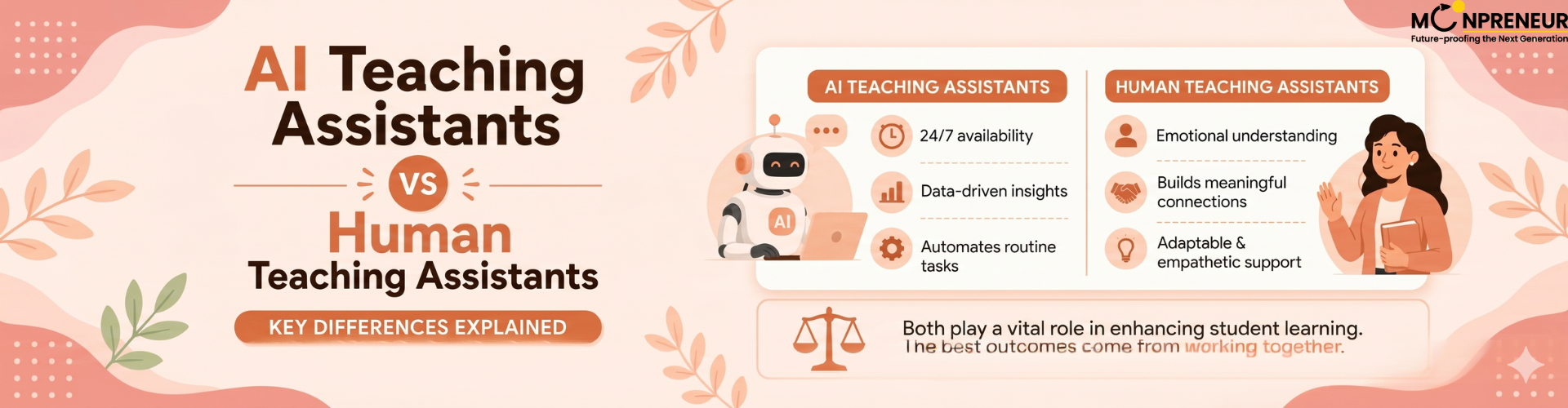
𝖠𝖨 𝖳𝖾𝖺𝖼𝗁𝗂𝗇𝗀 𝖠𝗌𝗌𝗂𝗌𝗍𝖺𝗇𝗍𝗌 𝗏𝗌 𝖧𝗎𝗆𝖺𝗇 𝖳𝖾𝖺𝖼𝗁𝗂𝗇𝗀 𝖠𝗌𝗌𝗂𝗌𝗍𝖺𝗇𝗍𝗌 𝖺𝗍 𝖺 𝖦𝗅𝖺𝗇𝖼𝖾
| Feature | AI Teaching Assistants | Human Teaching Assistants |
|---|---|---|
| Availability | 24/7 Support | Limited Working Hours |
| Response Time | Instant | May Take Time |
| Emotional Support | Limited | Excellent |
| Personalized Learning | Data-Driven Personalization | Experience-Based Personalization |
| Cost | Lower Long-Term Cost | Higher Ongoing Cost |
| Critical Thinking Guidance | Moderate | Strong |
What Are AI Teaching Assistants?
AI teaching assistants are software systems that use artificial intelligence to help educators manage classroom activities and support students’ learning.
These tools can:
- Answer students questions
- Grade assignments
- Provide personalized feedback
- Create quizzes and study materials
- Track learning progress
- Offer round-the-clock assistance
Many schools now use AI virtual teaching assistants to supplement classroom instruction and improve learning efficiency.
Why Are Schools Turning to AI Teaching Assistants?
One major reason is the growing teacher shortage.
Across many religions, schools face challenges in hiring enough qualified educators. Larger classrooms mean teachers have less time to provide individual attention.
This is where teacher shortages and AI teaching assistants intersect.
AI helps by:
- Reducing administrative workload
- Automating repetitive tasks
- Providing instant student support
- Helping teachers focus on instruction
Rather than replacing teachers, AI often serves as an additional support system.
Real-Life Example: Sarah’s Science Class
Sarah teaches middle-school science.
She spends an hour every week:
- Grading assignments
- Answering repetitive questions
- Creative practice quizzes
- Tracking student performances
After implementing an AI-powered teaching assistant, she noticed:
📈 Faster grading
📈 More personalized learning recommendations
📈 Increased student engagement
📈 More time for hands-on teaching
The AI handled routine tasks while Sarah focused on mentoring students
Key Difference Between AI and Human Teaching Assistant
1. Availability and Accessibility
AI Teaching Assistants
AI systems are available 24/7
Students can ask questions:
- Late at night
- During weekends
- During holidays
- The system responds instantly.
Human Teaching Assistants
Human assistants generally work within specific schedules and may not always be available when students need help.
| Scenario | AI Assistant | Human Assistant |
|---|---|---|
| Question at 11 PM | Available | Usually Unavailable |
| Weekend Support | Available | Limited |
2. Emotional Intelligence
Humans excel at understanding emotions.
A student who feels:
- Anxious
- Frustrated
- overwhelmed
- Unmotivated
Often benefits from human encouragement and empathy.
While AI as teaching assistants can detect patterns and provide motivational responses, they cannot truly understand emotions the way humans do.
3. Personalization of Learning
AI analyzes large amounts of student data quickly.
It can identify:
- Learning gaps
- Strenghs
- Weak areas
- Preferred learning styles
This enables highly personalized recommendations.
Example
If two students struggle with fractions:
- Student A receives visual lessons.
- Student B receives interactive learning pathways
4. Classroom Management
Human assistants are better equipped to:
- Handle classroom behaviour
- Resolve conflicts
- Encourage collaboration
- Maintain discipline
AI can monitor progress, but cannot physically manage the classroom.
5. Speed and Efficiency
One of the greatest strengths of AI-powered teaching assistants is speed.
Tasks AI Can Complete Quickly
| Task | AI Assistant | Human Assistant |
|---|---|---|
| Quiz Generation | Seconds | 30–60 Minutes |
| Assignment Grading | Minutes | Hours |
| Performance Reports | Instant | Manual Process |
6. Creativity and Critical Thinking
Human teaching assistants bring:
✔️Creativity
✔️Real-life experiences
✔️Contextual understanding
✔️Flexible problem-solving
These qualities help students develop critical thinking skills that AI currently struggles to replicate fully.
Can AI Replace Human Teaching Assistants?
The simple answer is:
No – at least not entirely.
The future of education is likely to involve collaboration between humans and AI. Think of it this way:
| Human Strengths | AI Strengths |
|---|---|
| Empathy | Speed |
| Motivation | Data Analysis |
| Creativity | Personalization |
| Communication | 24/7 Support |
| Classroom Leadership | Automation |
The future of AI in Education
Experts believe that AI virtual teaching assistants will continue evolving.
Future systems may offer:
- Advanced tutoring capabilities
- Real-time language translation
- Improved accessibility features
- Enhanced personalized learning experiences.
As educational institutions address teacher shortages, AI will likely become an essential classroom companion rather than a replacement for educators.
Expand Your Knowledge With These Readings
- 25 Ways Robots Are Helping Humans in Daily Life, Work, and Healthcare
- How Automation and Robotics Are Transforming Airline Operations
- 25 Ways Robots Are Helping Humans in Daily Life, Work, and Healthcare
- The Unspoken Rules of Interacting with AI for Safer, Smarter Conversations
- How AI is Disrupting Education: A Black Swan Moment
- AI as Your Second Brain: Revolutionizing Decision-Making in the Digital Age
- The Unspoken Rules of Interacting with AI for Safer, Smarter Conversations
- AI Agents: Turning Clicks, Carts, and Conversions into a Trillion-Dollar Empire
- The Good, the Bad & the Unknown of AI
Final Thought
The debate between AI teaching assistants vs human teaching assistants isn’t about choosing one over the other. Instead, it’s about understanding how each contributes to student success.
While AI teaching assistants offer speed, scalability, and personalized learning support, human teaching assistants provide empathy, creativity, and meaningful human interaction.
The most effective classrooms of the future will likely combine both- allowing AI-powered teaching assistants to handle repetitive tasks while educators focus on inspiring, mentoring, and guiding students toward lifelong learning.
By leveraging the strengths of both humans and AI, schools can create smarter, more engaging, and more inclusive learning environments for every student.
Moonpreneur is on a mission to disrupt traditional education and future-proof the next generation with holistic learning solutions. Its Innovator Program is building tomorrow’s workforce by training students in AI/ML, Robotics, Coding, IoT, and Apps, enabling entrepreneurship through experiential learning.
FAQs
AI teaching assistants are smart software tools built to automate grading, answer student queries instantly, and optimize administrative workflows.
Deploying ai as teaching assistants ensures students get instant 24/7 support while drastically cutting down manual work for human educators.
Balancing teacher shortages and ai teaching assistants helps schools manage heavy course loads without overwhelming existing staff layouts.
Cloud-based ai virtual teaching assistants stay online round-the-clock, resolving student roadblocks even in late-night study hours.
Modern ai-powered teaching assistants use data-driven algorithms to customize explanations dynamically based on how fast a student learns.