Attend our in-person Robotics & Math




Have you ever thought about whether that one “great” teacher you had in 3rd or 4th grade really changed the course of your life?
According to groundbreaking research by Raj Chetty, John N. Friedman, and Jonah E. Rockoff, the answer is a resounding yes, and the effects can be seen in the millions of dollars.
The researchers of the huge study Measuring the Impacts of Teachers followed 2.5 million kids for 20 years to find out exactly how much a good teacher is worth. The results changed the way people around the world talk about education policy and the real worth of “Value-Added” metrics.
What does “Value-Added” (VA) mean?
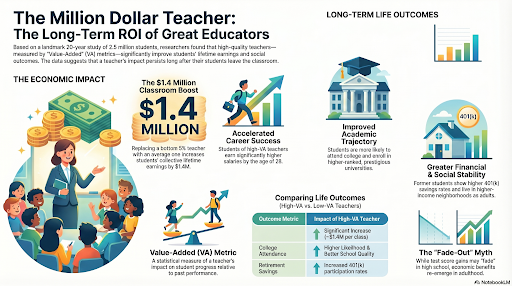
Before looking at the results, it’s important to know what the metric is. Value-Added (VA) is a way to use statistics to guess how good a teacher is at their job. It doesn’t just look at raw test scores; it also looks at how much a teacher helps a student do better than they were expected to based on their past results.
Some people used to say that these metrics were “noisy” or biased, but Chetty’s research showed that VA is a very good way to guess how well a student will do in the future.
Key Findings: The Long-Term “Chetty Effect”
The study linked school district data (grades 3–8) with federal income tax records to see what happened to these students as adults. Here is what they found:
- The Big Money Windfall
The “Million Dollar” Effect is the most interesting thing that came out of the study. The study found that if you replaced a teacher in the bottom 5% of VA with a “average” teacher for just one year, the students in that one classroom would make about $1.4 million more over their lifetimes.
- More money and a better job
Students who were assigned to high-VA teachers saw a direct link to their paychecks. These students were making a lot more money than their peers by the time they turned 28. A “high-quality” teacher doesn’t just help a student pass a test; they teach them skills that are useful in the workplace, both cognitive and non-cognitive.
- Going to college and the quality of it
It wasn’t just about the cash. Students who had the best elementary school teachers were:
- More likely to go to college.
- More likely to get into top-ranked, well-known colleges and universities.
- Better Outcomes in Life
A great teacher has an effect that goes beyond the classroom and the bank account. The research discovered that students taught by high-VA teachers exhibited:
- Higher Savings Rates: They were more likely to put money into 401(k) plans for retirement.
- Better social outcomes: Teenage girls were less likely to have kids.
- Better Neighborhoods: As adults, they usually lived in zip codes with higher incomes.
Why “Fade-Out” Doesn’t Mean “Failure”
One of the most talked-about issues in education is the “fade-out” effect. This is when the benefits of having a great teacher seem to go away by high school.
Chetty’s research, on the other hand, showed an important truth: the effect on the person doesn’t go away even if the test scores do. The benefits come back in adulthood as higher pay and better life choices, which suggests that great teachers teach more than what’s on the syllabus.
Conclusion: Investing in Educators
This study has clear effects on policy. If one great teacher can add more than $1 million to the economy through the success of their students, then finding, training, and keeping the best teachers isn’t just an educational goal—it’s a business necessity.
Raj Chetty and his team showed that a great teacher’s worth isn’t just in their grades; it’s also in the successful lives of the adults they helped shape.
At Moonpreneur, we aren’t just looking at where schools are today—we’re looking at how they are preparing students for the world of tomorrow.
Moonpreneur is on a mission to disrupt traditional education and future-proof the next generation with holistic learning solutions. Its Innovator Program is building tomorrow’s workforce by training students in AI/ML, Robotics, Coding, IoT, and Apps, enabling entrepreneurship through experiential learning.