Attend our in-person Robotics & Math


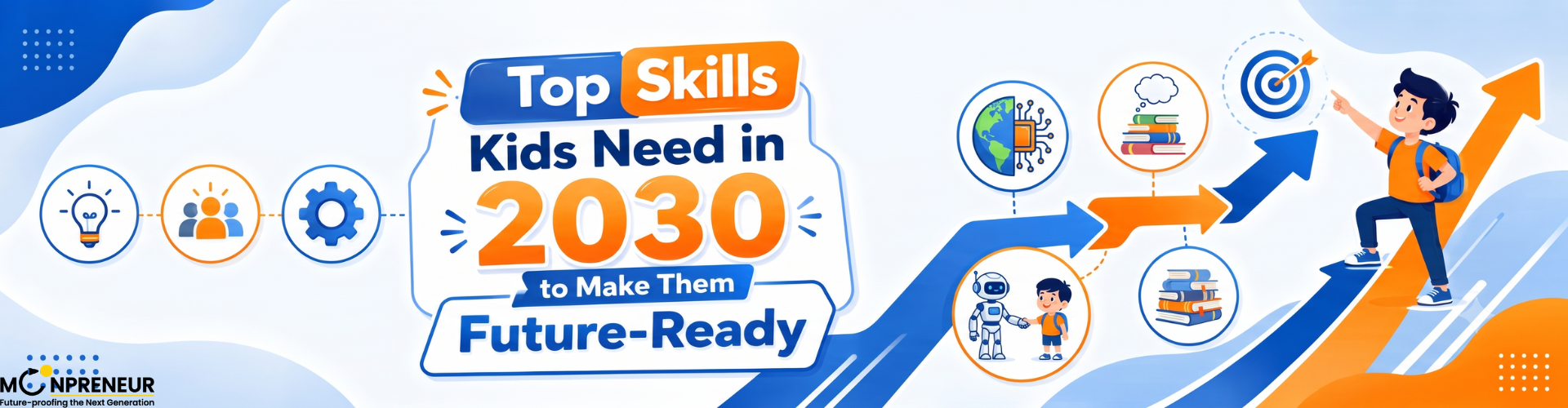
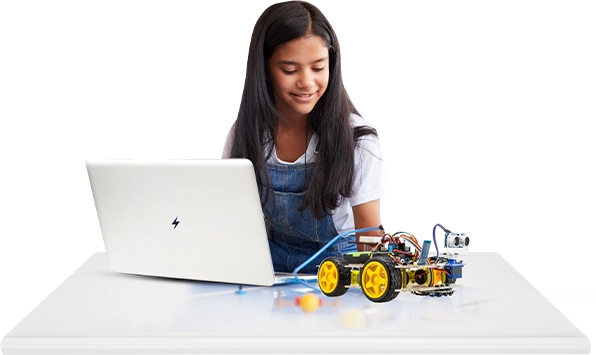
The future is uncertain, but one thing is undeniable: the skills for kids today will determine their success tomorrow. As we hurtle toward 2030, the landscape of education and career development is shifting dramatically. Traditional academic knowledge alone isn’t enough anymore. Instead, children need a diverse toolkit of competencies that enable them to adapt, thrive, and lead in an increasingly complex world.
In this comprehensive guide, we’ll explore the essential skills that every child needs to develop to become truly future-ready by 2030. From social skills for kids to executive functioning skills for kids, we’ll examine what experts believe matters most.
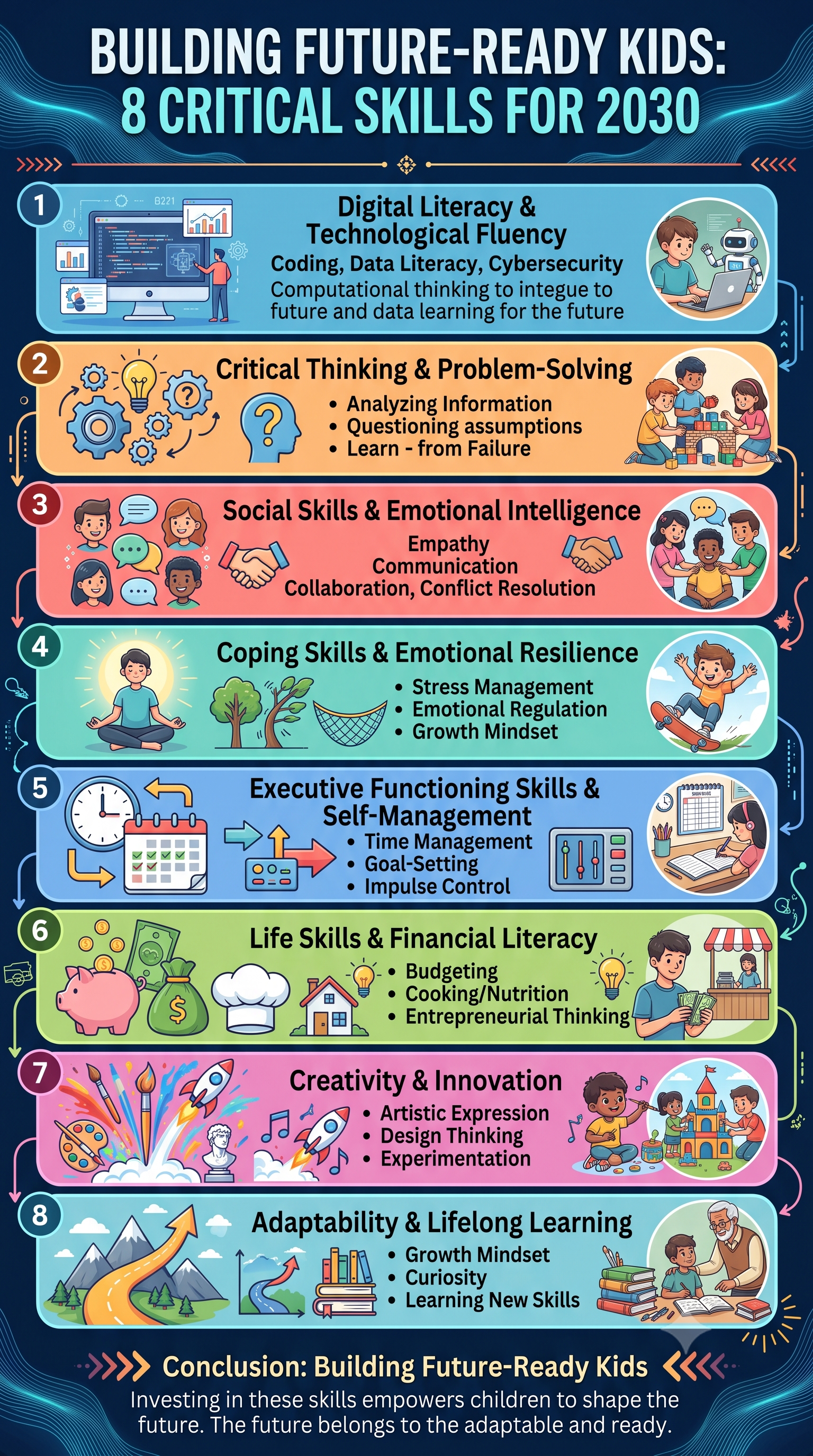
1. Digital Literacy & Technological Fluency
Gone are the days when computer skills were optional. By 2030, digital literacy won’t just be an advantage—it will be fundamental. Kids need to understand not just how to use technology, but how it works and how to use it responsibly.
This includes:
Coding and computational thinking
Data literacy and AI awareness
Cybersecurity and digital citizenship
Children who master these skills for kids will have significant competitive advantages in virtually every field, from healthcare to finance to creative industries.
2. Critical Thinking & Problem-Solving
In a world drowning in information, the ability to think critically is more valuable than ever. Children need to learn how to question assumptions, evaluate sources, and solve complex problems from multiple angles.
Critical thinking and problem-solving skills for kids enable them to:
Analyze information with skepticism and discernment
Approach challenges creatively and systematically
Learn from failure and iterate on solutions
These are foundational skills for kids that employers across every industry will demand in 2030.
3. Social Skills & Emotional Intelligence
Despite technological advancement, human connection remains irreplaceable. Social skills for kids are more critical than ever, especially as remote work and virtual collaboration become the norm.
Strong social skills for kids include:
Empathy and perspective-taking
Effective communication and active listening
Collaboration and teamwork across diverse groups
Conflict resolution and negotiation
Children who develop strong social skills for kids will excel in leadership roles, team environments, and customer-facing positions—essentially, anywhere humans interact.
4. Coping Skills & Emotional Resilience
The world of 2030 will inevitably bring stress, uncertainty, and setbacks. Coping skills for kids are essential for maintaining mental health and bouncing back from adversity.
Effective coping skills for kids encompass:
Stress management and mindfulness techniques
Emotional regulation and self-awareness
Resilience and growth mindset development
Seeking help and support when needed
By nurturing coping skills for kids early, parents and educators give children the psychological tools they need to thrive despite challenges. Children with strong emotional resilience aren’t derailed by setbacks; they use them as learning opportunities.
5. Executive Functioning Skills & Self-Management
Executive functioning skills for kids are the cognitive processes that help us plan, organize, manage time, and control impulses. These “life skills for kids” are the backbone of academic success and professional achievement.
Critical executive functioning skills for kids include:
Time management and prioritization
Goal-setting and action planning
Organization and attention to detail
Working memory and cognitive flexibility
Impulse control and self-regulation
These executive functioning skills for kids are especially important in 2030, when self-directed learning and autonomous work will be increasingly common. Children must be able to manage their own schedules, track progress, and maintain focus without constant supervision.
6. Life Skills & Financial Literacy
Life skills for kids encompass the practical abilities needed to navigate adulthood independently. These often-overlooked skills for kids are just as important as academic knowledge.
Essential life skills for kids include:
Financial literacy and budgeting
Basic cooking, nutrition, and health management
Personal safety and responsibility
Entrepreneurial thinking and independence
Life skills for kids prepare them for the unexpected challenges of adult life. A teenager who can manage money, cook a meal, and take care of their health is infinitely more prepared for 2030 than one who can’t.
7. Creativity & Innovation
As artificial intelligence handles routine tasks, creativity becomes a distinctly human advantage. Children who can think creatively, imagine new possibilities, and innovate will lead industries in 2030.
Fostering creativity and innovation skills for kids means encouraging:
Artistic and creative expression
Design thinking and prototyping
Cross-disciplinary thinking and synthesis
Experimentation and risk-taking
These skills for kids unlock pathways to fields that don’t yet exist, giving them flexibility and adaptability in an unpredictable future.
8. Adaptability & Lifelong Learning
Perhaps the most crucial skill for kids to develop is the ability to adapt and learn continuously. By 2030, the career landscape will have transformed so dramatically that the specific skills children learn today may become obsolete.
Adaptability includes:
Growth mindset and comfort with change
Curiosity and intellectual humility
Ability to learn new skills independently
Comfort navigating uncertainty
Children who embrace learning as a lifelong process will navigate the future far more successfully than those who rely on a fixed set of skills for kids acquired in school.
Conclusion
Preparing children for 2030 requires a fundamental shift in how we think about skills for kids. The traditional focus on academic subjects alone is insufficient. Instead, we need to cultivate a comprehensive skill set that combines technical abilities with emotional intelligence, practical knowledge with creative thinking.
The skills for kids we’ve outlined, from digital literacy and critical thinking to social skills for kids, coping skills for kids, life skills for kids, and executive functioning skills for kids, work together synergistically. A child strong in executive functioning skills for kids will better manage their coping skills for kids. Strong social skills for kids enable better collaboration and learning. Life skills for kids build independence and confidence.
As educators and parents, our challenge is to move beyond standardized testing and traditional curricula to nurture the whole child. By investing in these skills for kids now, we’re not just preparing them for 2030, we’re empowering them to shape it.
The future belongs to children who are adaptable, emotionally intelligent, digitally savvy, and truly ready for anything. That’s our mission.
Want to make your child future-ready with Robotics? Moonpreneur offers a tailor-made program. Reserve a spot in our free 60-minute workshop today and introduce them to the amazing world of robotics and innovations!