Attend our in-person Robotics & Math


Making friends is an important part of childhood. Friendships help children to build confidence, to communicate, and to create memories that will last. But many children struggle to connect with their peers in the traditional classroom setting. Some kids are shy, and some just need the environment to connect over shared interests.
This is where a STEM program can be truly beneficial. STEM activities don’t just teach science, technology, engineering, and mathematics; they encourage teamwork, creativity, and problem-solving. Kids working together on exciting projects naturally make friends that extend beyond the classroom.
In this article, we will discuss what is the STEM program is, how it helps kids socialize, and why enrolling your child in one can help them grow both academically and personally.
What Is a STEM Program?
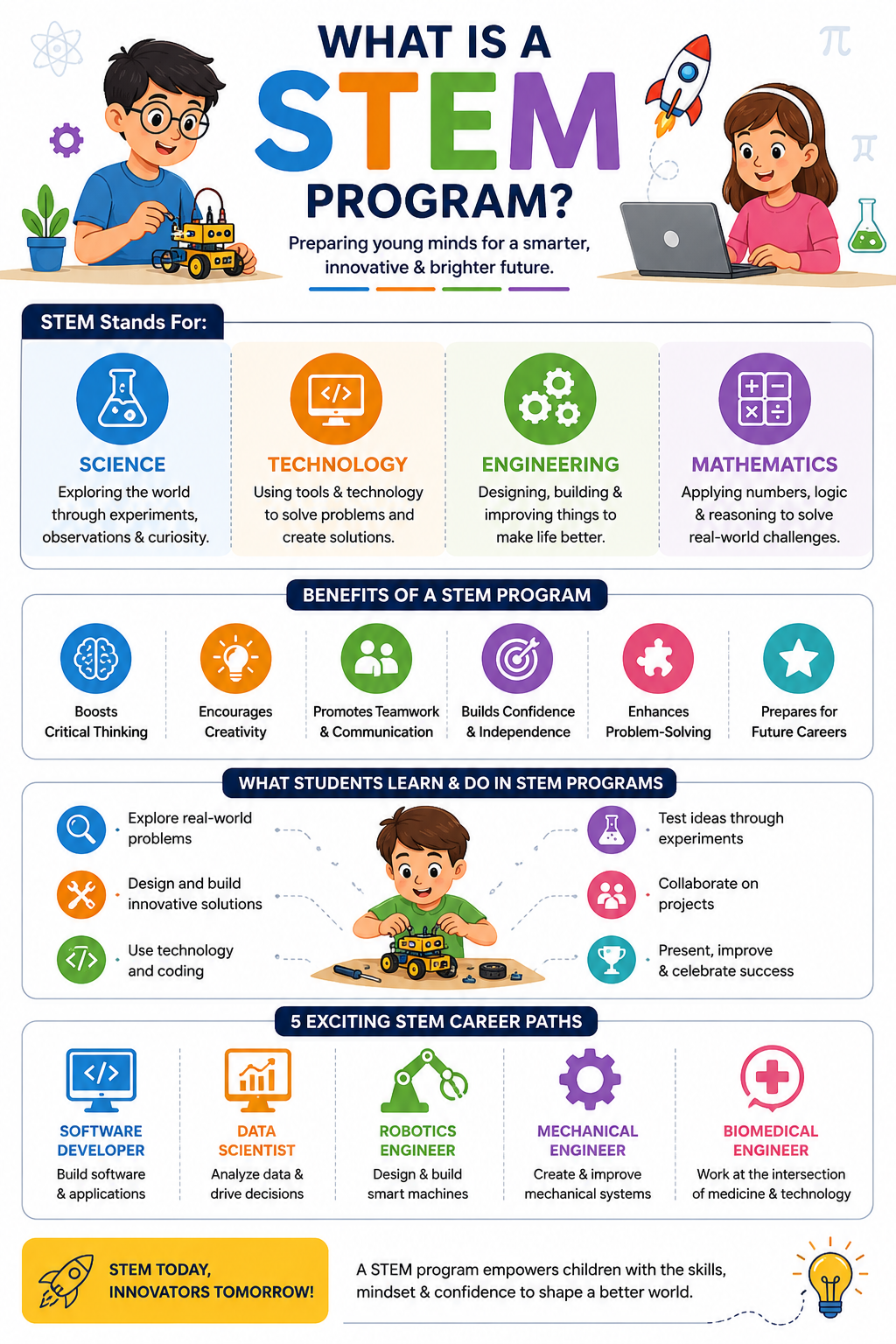
Many parents ask,What is a STEM Program? A STEM Program is an educational initiative that integrates four important disciplines:
STEM programs are not just about textbooks and lectures; they are about hands-on learning. Children design, build, experiment, code, and test their ideas to solve real-world challenges. .
Students may be programming robots, building simple machines, or designing bridges, but regardless, they learn through collaboration and creative thinking.
What Is the STEM Program Designed to Teach?
Another common question from parents is, what is the STEM program intended to accomplish? The goal is much more than just academics. A quality STEM program helps children to:
These skills will help children not only in their future careers but also in developing healthy relationships with classmates and teammates.
Why Social Skills Matter During Childhood?
Friendships are important to all aspects of a child's development.
Children with positive friendships may have:
Cooperative activities naturally provide opportunities for children to meet new friends and develop meaningful relationships.
How a STEM Program helps Kids make Friends
1. Team Projects Encourage Collaboration
Most STEM activities are designed for small groups.
Children may work together to:
Each team member brings different ideas, so children learn to listen, share responsibilities, and respect others' views.
Friendships come easily when people work for a common goal.
2. Shared Interests Forge Strong Bonds
Many children have a hard time finding other children with similar hobbies.
A STEM program for kids brings together kids who love:
People have interests in common, and it is easier to talk. Friendships are formed more naturally. Instead of worrying about what to say, kids have exciting projects to talk about immediately.
3. Communication Is Easy
During STEM challenges, kids are always communicating.
They ask questions such as:
The conversations are a great way to improve speaking and listening skills without the feeling of formal lessons.
Children learn to speak confidently about their ideas, and at the same time respect the ideas of others.
4. Everybody Has a Role
STEM classrooms are one of the greatest strengths of all classrooms in that each child contributes differently.
These examples are:
This helps children to appreciate each other’s strengths rather than compete with each other.
When children feel valued, it helps them to make friends that last.
5. Kids connect through problem-solving
There are challenges facing every STEM project.
Children brainstorm solutions together rather than working individually.
Facing obstacles together creates trust and fosters friendships.
6. Reduce social pressure with STEM activities
Shy children often feel uncomfortable with traditional classroom activities.
A STEM activity shifts the focus away from merely socializing to engaging in a fun project.
Children naturally work together so conversations flow more easily.
It fosters an inclusive environment where even the quieter students feel welcome.
7. Children Learn Leadership and Teamwork
Organization is critical to any successful STEM project.
Responsibilities are often rotated among children such as:
This allows everyone to lead while learning to support teammates.
Such experiences lead to respect and improved friendships.
Benefits of a STEM Program for Kids Outside the Classroom
Enhanced Confidence
Children get a sense of achievement from completing projects.
Confident children are often more likely to start conversations and make new friends.
Improved Communication
STEM teaches children to respond respectfully to others’ ideas, to ask questions, and to explain their own ideas.
These communication skills contribute to stronger friendships in and outside of the classroom.
More Creativity
Creative projects spark children’s imaginations to imagine new possibilities together.
Collaborative creativity tends to produce stronger social ties.
More Empathy
Working in teams, children learn to understand different viewpoints and appreciate each person’s contributions.
Empathy is very important to develop healthy friendships.
Better Emotional Resilience
Not every STEM experiment works out the first time.
Kids learn to turn mistakes into a positive and get their teammates to keep trying.
Such experiences promote resilience and emotional maturity.
STEM Activities That Build Friendships
Many fun STEM activities are naturally collaborative.
Some common examples are:
- Robotics competitions
- Computer programming clubs
- LEGO building challenges
- Science experiments
- Bridge-building races
- 3D print projects
- Electronics workshop
- Dev stuff game
- Simulations of space exploration
- Environmental science project ideas
All activities encourage children to communicate, co-operate and celebrate their joint achievements.
Why Parents Opt for STEM Programs?
STEM education is enrolling children in increasing numbers because it confers technical knowledge and life skills.
Quality STEM programming offers children opportunities to:
- Connect with fellow enthusiasts
- Teamwork training
- Feel more confident
- Improve communication
- Leadership skills improvement
- Problem-solving work
- Get ready for future careers
These benefits last long after the projects are finished.
Selecting the Best Kids STEM Program
STEM programs aren’t all the same.
When selecting a STEM program for kids, parents should consider whether it offers.
- ✓ Experiential learning opportunities
- ✓ Small Group Collaborative
- ✓ Activities of project-based
- ✓ Certified instructors
- ✓ Curriculum for the age group
- ✓ Opportunities to be creative
- ✓ Robotics and coding choices
- ✓ Regular teamwork exercises
Children learn comfortably in a welcoming environment and make real friends.
Conclusion
By knowing what is a STEM program is, parents can understand that STEM education is about so much more than science and technology. What is the STEM program really meant to accomplish? It ignites children’s curiosity and builds their confidence, communication skills, and great friendships.
A well-designed STEM program provides a setting where children learn to collaborate, problem-solve, and celebrate success as a team. A STEM program for kids offers a plethora of opportunities to form lifelong friendships through fun hands-on projects that encourage teamwork and creativity.
Want to make your child future-ready with Robotics? Moonpreneur offers a tailor-made program. Reserve a spot in our free 60-minute workshop today and introduce them to the amazing world of robotics and innovations!
What is a STEM program?
A STEM program combines Science, Technology, Engineering, and Mathematics into practical, project-based learning. It encourages students to think critically, solve real-world problems, and develop creativity through hands-on activities.
Who can join a STEM program?
STEM programs are available for learners of different ages, from elementary school children to college students and working professionals. Eligibility depends on the course level and the organization offering the program.
What does STEM mean in Class 12?
For Class 12 students, STEM generally refers to subjects such as Physics, Chemistry, Mathematics, Computer Science, and Engineering-related studies that prepare learners for technical and scientific careers.
What is included in a STEM course?
A STEM course may cover coding, robotics, artificial intelligence, engineering design, electronics, mathematics, and scientific experiments. Many courses also include collaborative projects and innovation challenges.
Why is STEM education beneficial for children?
STEM learning helps children improve logical reasoning, creativity, teamwork, communication, and problem-solving while building confidence through interactive, hands-on experiences.
What are five popular careers in STEM?
Some of the most sought-after STEM careers include Software Developer, Data Scientist, Mechanical Engineer, Robotics Engineer, and Biomedical Engineer.
Why are STEM programs popular in the USA?
STEM programs in the USA focus on innovation, research, and practical learning. Many schools and organizations offer STEM education to prepare students for future careers in technology and engineering.
Are there STEM courses for teachers?
Yes. Professional development STEM courses help educators learn modern teaching methods, classroom technology, project-based learning strategies, and ways to engage students in STEM subjects.
What is a STEM education kit?
A STEM education kit contains tools, components, and activity guides that allow students to build models, conduct experiments, and learn engineering or coding concepts through hands-on practice.
How does the upEducators STEM program support learning?
The upEducators STEM program is designed to promote innovation by providing structured activities, practical projects, and skill-building opportunities that help students apply STEM concepts in real-life situations.