Imagine Garry, a student preparing for her math exam. He enters different numbers into his calculator and notices that every input produces exactly one output. This simple rule is the foundation of functions.
As he explores the types of functions, she discovers that not all functions behave the sme way—some create straight lines, while others form curves or patterns.
Understanding the different types of functions helps her solve real-world problems in mathematics, coding, data analysis, and even artificial intelligence(AI) . Functions are everywhere, making them one of the most important concepts in mathematics.
𝐖𝐡𝐚𝐭 𝐀𝐫𝐞 𝐅𝐮𝐧𝐜𝐭𝐢𝐨𝐧𝐬?
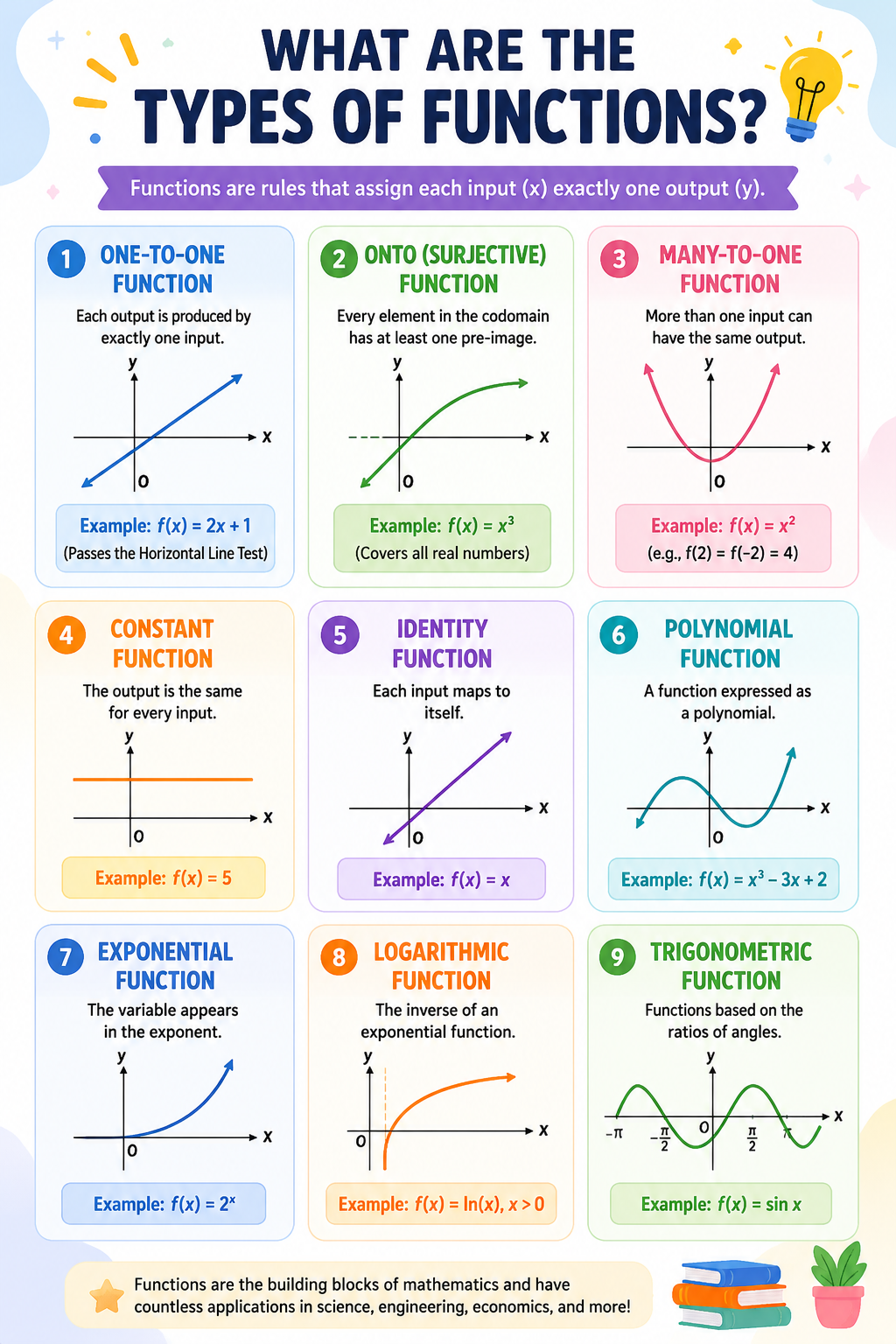
A function is a relationship between two sets where each input has exactly one output.
Mathematically:
𝒚 = 𝒇(𝒙)
- 𝒙 → 𝑰𝒏𝒑𝒖𝒕 (𝑰𝒏𝒅𝒆𝒑𝒆𝒏𝒅𝒆𝒏𝒕 𝑽𝒂𝒓𝒊𝒂𝒃𝒍𝒆)
- 𝒚 → 𝑶𝒖𝒕𝒑𝒖𝒕 (𝑫𝒆𝒑𝒆𝒏𝒅𝒆𝒏𝒕 𝑽𝒂𝒓𝒊𝒂𝒃𝒍𝒆)
𝑰𝒇 𝒇 : 𝑨 → 𝑩, 𝒕𝒉𝒆𝒏:
- 𝑨 = 𝑫𝒐𝒎𝒂𝒊𝒏
- 𝑩 = 𝑪𝒐𝒅𝒐𝒎𝒂𝒊𝒏
- 𝑹𝒂𝒏𝒈𝒆 = 𝑨𝒄𝒕𝒖𝒂𝒍 𝑶𝒖𝒕𝒑𝒖𝒕𝒔 𝒇𝒓𝒐𝒎 𝒕𝒉𝒆 𝑫𝒐𝒎𝒂𝒊𝒏
𝐃𝐨𝐦𝐚𝐢𝐧, 𝐂𝐨𝐝𝐨𝐦𝐚𝐢𝐧, 𝐚𝐧𝐝 𝐑𝐚𝐧𝐠𝐞 (𝐕𝐢𝐬𝐮𝐚𝐥 𝐔𝐧𝐝𝐞𝐫𝐬𝐭𝐚𝐧𝐝𝐢𝐧𝐠)
- 𝑫𝒐𝒎𝒂𝒊𝒏 → 𝑨𝒍𝒍 𝑷𝒐𝒔𝒔𝒊𝒃𝒍𝒆 𝑰𝒏𝒑𝒖𝒕𝒔
- 𝑪𝒐𝒅𝒐𝒎𝒂𝒊𝒏 → 𝑨𝒍𝒍 𝑷𝒐𝒔𝒔𝒊𝒃𝒍𝒆 𝑶𝒖𝒕𝒑𝒖𝒕𝒔
- 𝑹𝒂𝒏𝒈𝒆 → 𝑶𝒖𝒕𝒑𝒖𝒕𝒔 𝒕𝒉𝒂𝒕 𝑨𝒄𝒕𝒖𝒂𝒍𝒍𝒚 𝑶𝒄𝒄𝒖𝒓
𝑬𝒙𝒂𝒎𝒑𝒍𝒆:
- 𝑫𝒐𝒎𝒂𝒊𝒏 = {𝒂, 𝒃, 𝒄}
- 𝑪𝒐𝒅𝒐𝒎𝒂𝒊𝒏 = {𝟏, 𝟐, 𝟑, 𝟒, 𝟓}
- 𝑹𝒂𝒏𝒈𝒆 = {𝟏, 𝟐, 𝟑}
𝐑𝐞𝐩𝐫𝐞𝐬𝐞𝐧𝐭𝐚𝐭𝐢𝐨𝐧 𝐨𝐟 𝐅𝐮𝐧𝐜𝐭𝐢𝐨𝐧s
Functions can be shown in multiple ways:
- Algebraic Form
𝒇(𝒙) = 𝟐𝒙 + 𝟑
- Graphical Form
Helps visualize increasing/decreasing behavior
- Roaster Form
{(𝟏, 𝟐), (𝟐, 𝟒), (𝟑, 𝟔)}
𝗩𝗲𝗿𝘁𝗶𝗰𝗮𝗹 𝗟𝗶𝗻𝗲 𝗧𝗲𝘀𝘁
A curve is a function only if a vertical line cuts it at one point.
𝗗𝗶𝗳𝗳𝗲𝗿𝗲𝗻𝘁 𝗧𝘆𝗽𝗲𝘀 𝗼𝗳 𝗙𝘂𝗻𝗰𝘁𝗶𝗼𝗻𝘀
Now, let’s explore the core Types of Functions that every student must master.
| Type of Function | Definition | Formula / Condition | Example | Key Point |
|---|---|---|---|---|
| 1. One-to-One (Injective) Function | A function is injective when different inputs produce different outputs. | f(x₁) = f(x₂) ⇒ x₁ = x₂ | f(x) = 2x + 3 | Each input has a unique output. |
| 2. Many-to-One Function | Two or more inputs can map to the same output. | Multiple inputs → Same output |
f(x) = x² f(2) = 4 f(-2) = 4 |
Different inputs may share one output. |
| 3. Onto (Surjective) Function | A function is onto if every element of the codomain has a corresponding pre-image. | Range = Codomain | f(x) = x³ | Every possible output is covered. |
| 4. Into Function | A function is into if some elements of the codomain are not mapped by any input. | Range ⊂ Codomain | f(x) = eˣ | Some outputs in the codomain remain unused. |
𝐏𝐨𝐥𝐲𝐧𝐨𝐦𝐢𝐚𝐥-𝐁𝐚𝐬𝐞𝐝 𝐓𝐲𝐩𝐞𝐬 𝐨𝐟 𝐅𝐮𝐧𝐜𝐭𝐢𝐨𝐧𝐬
| Function Type | Formula | Graph Shape | Example |
|---|---|---|---|
| General Polynomial Function | f(x) = anxn + ... + a0 | Varies by degree | f(x) = 2x4 − 3x2 + 1 |
| Linear Function | f(x) = mx + c | Straight Line | f(x) = 2x + 1 |
| Quadratic Function | f(x) = ax2 + bx + c | Parabola | f(x) = x2 |
| Cubic Function | f(x) = ax3 + bx2 + cx + d | S-shaped Curve | f(x) = x3 |
➤ 𝙎𝙥𝙚𝙘𝙞𝙖𝙡 𝙏𝙮𝙥𝙚𝙨 𝙤𝙛 𝙁𝙪𝙣𝙘𝙩𝙞𝙤𝙣𝙨
| Function Type | Formula | Description / Example |
|---|---|---|
| Modulus Function | f(x) = |x| | Returns the absolute value of x. |
| Signum Function | f(x)= ⎩ ⎨ ⎧ 1, 0, −1, x>0 x=0 | Indicates the sign of a number. |
| Greatest Integer Function | f(x) = [x] | Returns the greatest integer less than or equal to x. Example: [4.5] = 4 |
| Fractional Function | {x} = x − [x] | Returns the fractional part of a number. |
| Even Function | f(x) = f(−x) | Symmetric about the y-axis. |
| Odd Function | f(x) = −f(−x) | Symmetric about the origin. |
| Composite Function | (g∘f)(x)=g(f(x))) |
Example: f(x) = x² g(x) = 2x g(f(x)) = 2x² |
| Constant Function | f(x) = c | Output remains the same for all values of x. |
| Identity Function | f(x) = x | Output is exactly equal to the input. |
➤ 𝙎𝙤𝙡𝙫𝙚𝙙 𝙀𝙭𝙖𝙢𝙥𝙡𝙚𝙨
| Example | Function | Verification | Result |
|---|---|---|---|
| Example 1 | f(x) = 3x − 2 | f(x₁) = f(x₂) ⇒ 3x₁ = 3x₂ ⇒ x₁ = x₂ | One-to-One |
| Example 2 | f(x) = x² + 3 | x₁² = x₂² | Not One-to-One |
| Example 3 | f(x) = 2x + 1 | x = (y − 1) / 2 | Onto Function |
| Example 4 | f(x) = x² | f(1) = 1, f(−1) = 1 | Many-to-One |
Read more related articles:
✅Horizontal Asymptote: Rules, Formula, and Easy Examples
✅How to Find the Radius of a Circle: Easy Formulas and Examples
✅What is the Integration of Cosec X?
✅The Wallis Formula: Integrating Powers of Sine and Cosine Instantly
✅How to Use King’s Rule in Definite Integrals: Formulas & Solved Examples
✅What is the Long Division Method? Step-by-Step Guide for Kids
✅How to Use the Cosine Formula to Find Missing Sides and Angles
𝐅𝐢𝐧𝐚𝐥 𝐓𝐡𝐨𝐮𝐠𝐡𝐭𝐬
Understanding types of functions is not just about solving math problems; it builds the foundation for:
- Coding
- AI& Machine Learning
- Data Science
- Game Development
From simple linear equations to complex composite functions, mastering different types of functions will give you a strong mathematical edge.
Want to excite your child about math and sharpen their math skills? Moonpreneur’s online math curriculum is unique in that it helps children understand math skills through hands-on lessons, builds real-life applications, and excites them to learn math.
You can opt for our Advanced Math or Vedic Math+Mental Math courses. Our Math Quiz for grades 3rd, 4th, 5th, and 6th helps in further exciting and engaging in mathematics with hands-on lessons.
FAQS
Ans. The polynomial function of degree one is called a Linear Function. The polynomial function of degree two is called a Quadratic Function. The polynomial function of degree three is a Cubic Function.
Ans. A one-to-one function basically denotes the mapping of two sets. A function g is one-to-one if every element of the range of g corresponds to exactly one element of the domain of g. One-to-one is also written as 1-1.
Ans.
Linear Function:
f(x)=mx+c
Quadratic Function:
f(x)=ax2+bx+c
Square Root Function:
f(x)=x
Absolute Value Function:
f(x)=∣x∣
Trigonometric Function:
f(x)=sinx,cosx,tanx
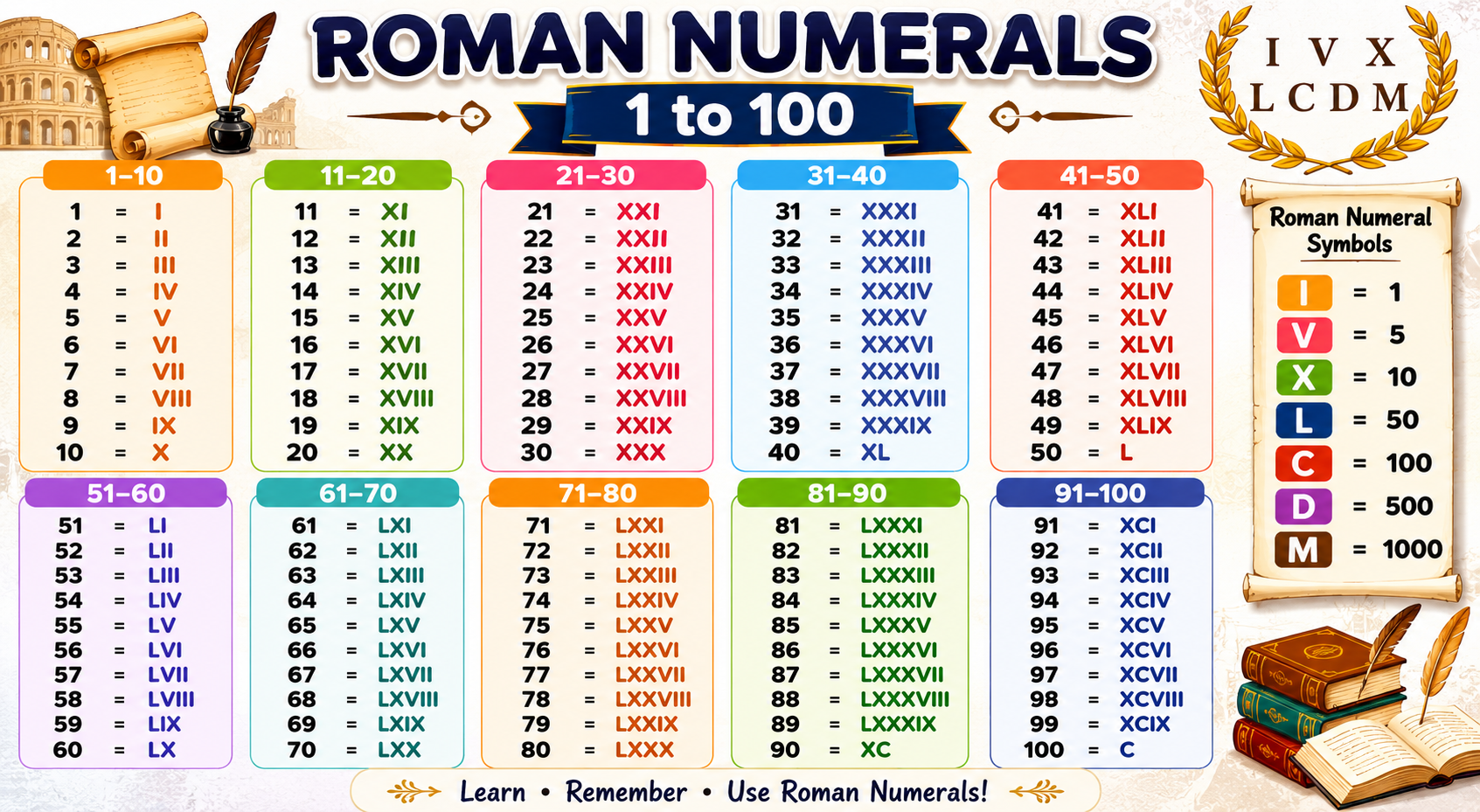
Ans.
- 60: LX
- 70: LXX
- 80: LXXX
- 90: XC
- 100: C
Ans. Here is the breakdown:
- D = 500
- CC = 200
- L = 50
- XX = 20
- VII = 7
Added together (500 + 200 + 50 + 20 + 7), this gives you 777.
Ans. The number 9999 is written in Roman numerals as 9999 = I̅X̅CMXCIX.
iXAns. The number 69 in Roman numerals is LXIX
Ans. The digit 0 was not needed in the Roman numeral system because this is not a positional system. The only case when it was used was when the number was actually zero, which they called nulla.
Ans. Whether 69 is considered a lucky number depends entirely on the context. In mathematics, it is a formal “lucky number”. In spiritual and cultural contexts, it carries distinct meanings ranging from profound harmony to popular humor.
Ans. Number 6 is considered lucky primarily due to Chinese culture, where it translates to “smooth” or “well-off” (representing flowing wealth and blessings). In Numerology, it symbolizes harmony and Venus, while in religion/nature, it reflects creation and perfect geometric balance.