Attend our in-person Robotics & Math


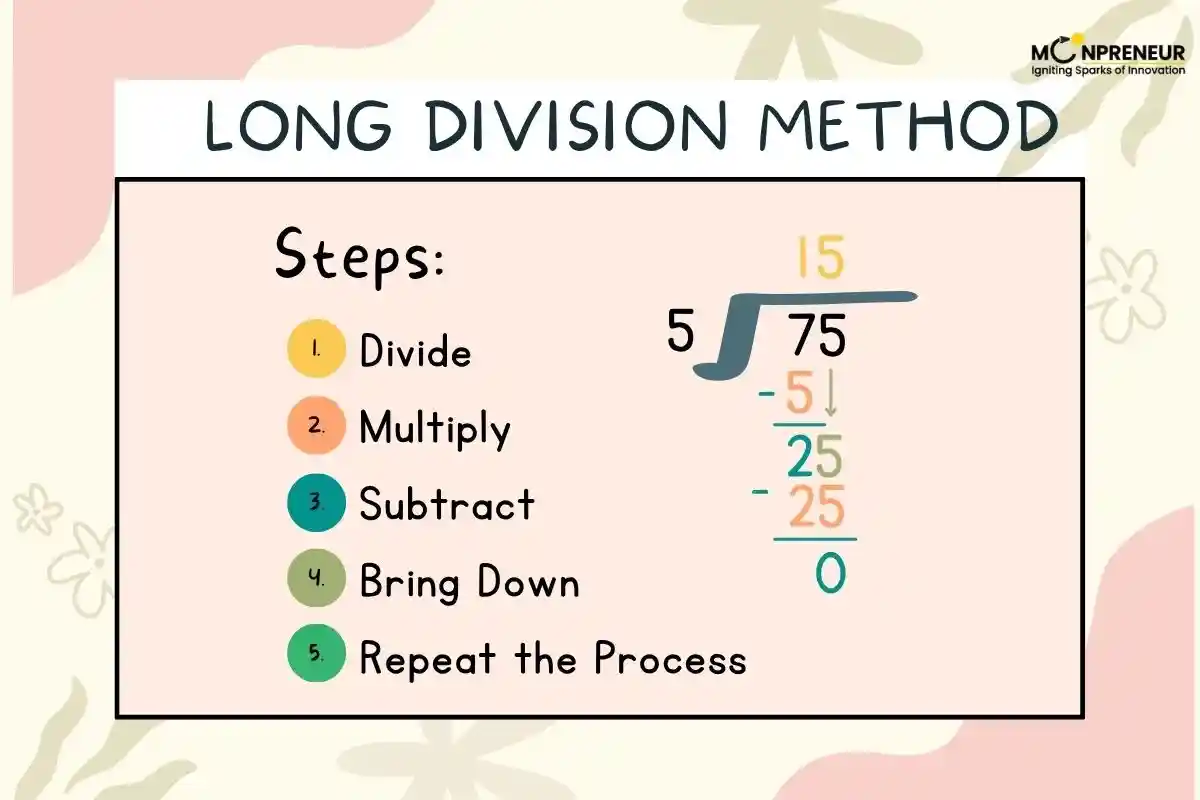
The long division method is a mathematical technique used to divide large numbers into smaller parts. It breaks down the division problem into a series of easier steps. Instead of solving everything at once, you solve one digit at a time. This method is especially helpful when dividing numbers that don’t go evenly.
Long division is an important math skill that helps students solve complex division problems. It lays the foundation for advanced math concepts like algebra, fractions, and decimals. Understanding this method also builds confidence in handling large numbers. Mastering the Long division steps helps students break down problems easily and solve them with accuracy.
Here are the 5 main long division steps for kids. You can remember them using the acronym DMSBR (Divide, Multiply, Subtract, Bring down, Repeat).
1. Divide
Check how many times the divisor fits into the leftmost digits of the dividend.
Example: How many times does 4 go into 8? The answer is 2.
2. Multiply
Multiply the divisor by the quotient found in the first step.
4 × 2 = 8
3. Subtract
Subtract the result of multiplication from the selected digits of the dividend.
8 − 8 = 0
4. Bring Down
Bring down the next digit of the dividend and repeat the steps.
If the dividend is 84, bring down the 4.
5. Repeat or Remainder
Continue dividing until all digits are used. If there are no more digits and you can’t divide further, the number left is called the remainder.
How to do long division method – Let’s understand it with simple step-by-step examples:
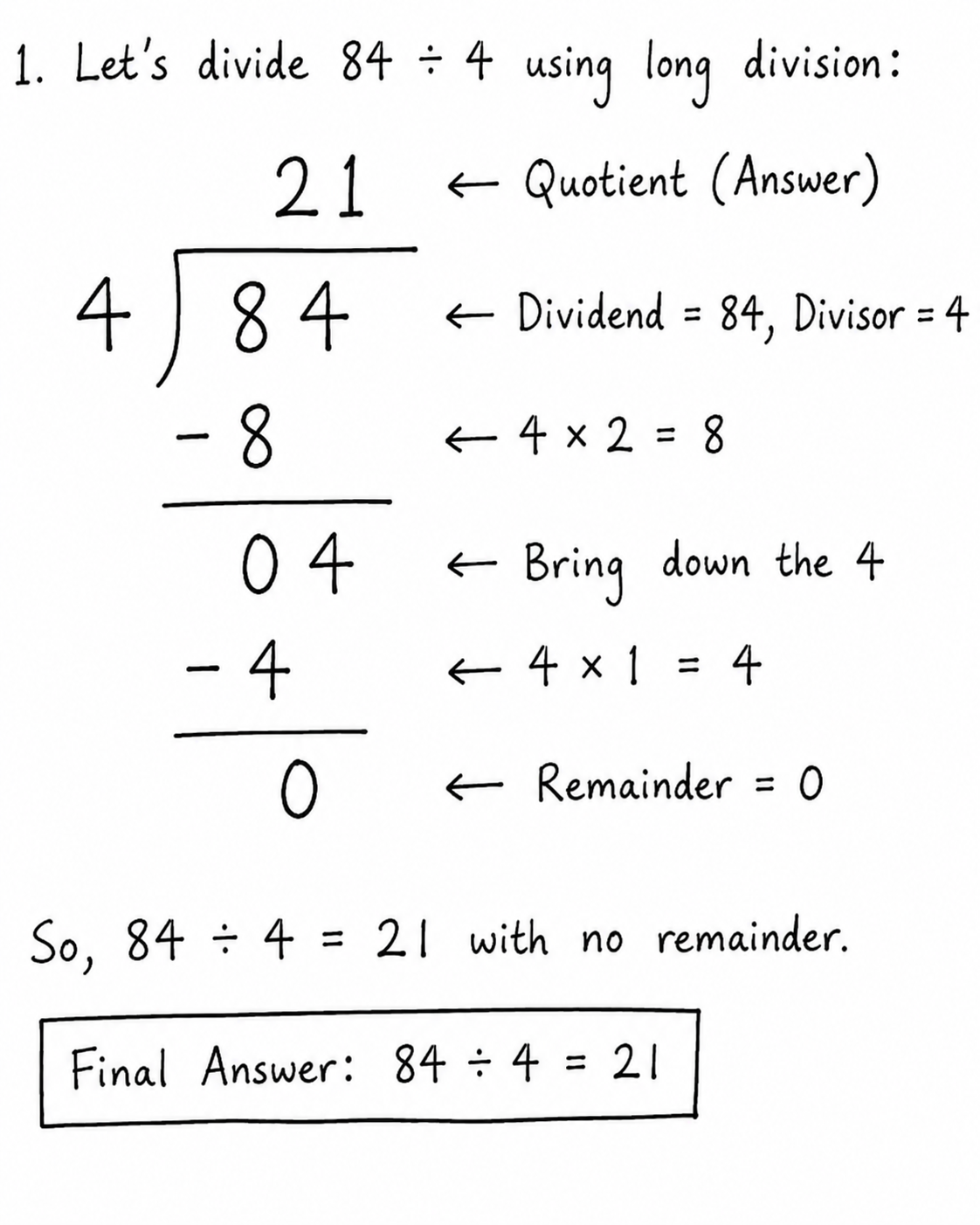
1. Let’s divide 84 ÷ 4 using long division:
     21           ← Quotient (Answer)
    ____
4 ⟌ 84           ← Dividend = 84, Divisor = 4
  - 8            ← 4 × 2 = 8
  ----
    04           ← Bring down the 4
  - 4            ← 4 × 1 = 4
  ---
    0            ← Remainder = 0
So, 84 ÷ 4 = 21 with no remainder.
Final Answer: 84 ÷ 4 = 21
Let me break down the steps for long division step-by-step
- Divide: 4 goes into 8 two times. Write 2 on top.
- Multiply: 2 × 4 = 8
- Subtract: 8 − 8 = 0
- Bring Down: Bring down the next digit (4).
- Divide Again: 4 goes into 4 one time. Write 1 on top.
- Multiply: 1 × 4 = 4
- Subtract: 4 − 4 = 0
No remainder is left. So the final answer is 21
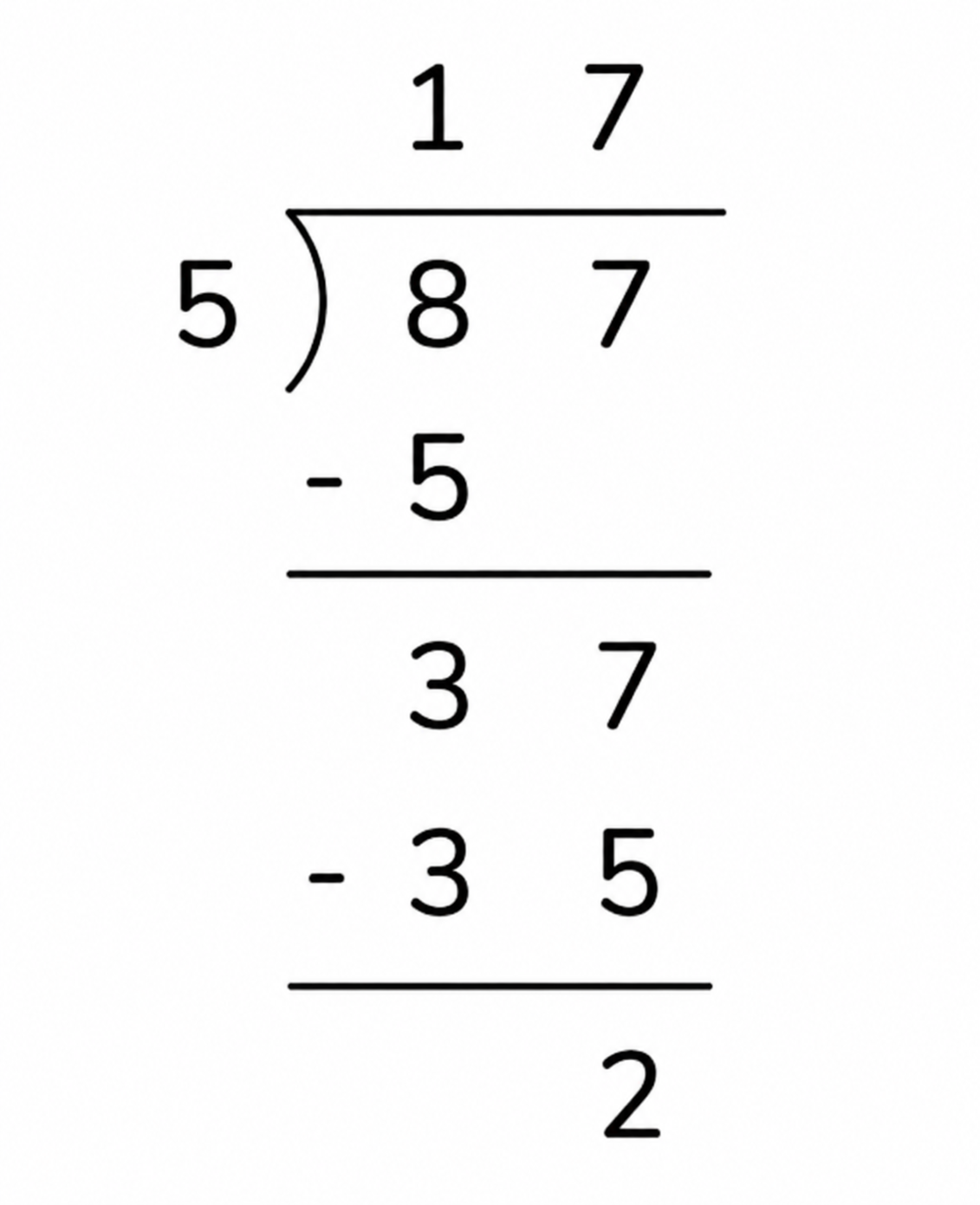
We are dividing 87 by 5:
    1 7           ← Quotient (Answer so far)
  ______
5 ) 8 7
  - 5           ← 5 × 1 = 5
  ----
     3 7        ← 8 - 5 = 3; bring down the 7
   - 35         ← 5 × 7 = 35
  -----
      2         ← 37 - 35 = 2 (Remainder)
Final Answer: 87 ÷ 5 = 17 R2
✍️ Step-by-Step Breakdown:
- Divide: 5 goes into 8 once. Write 1 on top.
- Multiply: 1 × 5 = 5
- Subtract: 8 − 5 = 3
- Bring Down: Bring down the next digit (7), making it 37.
- Divide Again: 5 goes into 37 seven times. Write 7 on top.
- Multiply: 7 × 5 = 35
- Subtract: 37 − 35 = 2
So, 2 is the remainder.
Final Answer:
87 ÷ 5 = 17 remainder 2
or
87 ÷ 5 = 17 Reminder:2
- Use real-life examples like sharing candies or toys.
- Practice with simple numbers first.
- Use visual aids or long division charts.
- Break the problem into small steps.
- Forgetting to bring down the next digit.
- Incorrect multiplication in steps.
- Misplacing the quotient digits.
- Not checking the remainder.
Practice makes perfect! The more you practice, the easier long division becomes.
The long division method is a powerful tool for solving big division problems in a simple, step-by-step manner. Once mastered, it opens doors to advanced math concepts and real-world applications. In this article, we have explained how to perform long division step by step, helping your child learn and practice long division with fun exercises and real-life examples!
Want to spark your child’s interest in math and boost their skills? Moonpreneur’s online math curriculum stands out because it engages kids with hands-on lessons, helps them apply math in real-life situations, and makes learning math exciting!
You can opt for our Advanced Math or Vedic Math+Mental Math courses. Our Math Quiz for grades 3rd, 4th, 5th, and 6th helps in further exciting and engaging in mathematics with hands-on lessons.
Update: This article was last updated on 22nd May 2026 to reflect the accuracy and up-to-date information on the page.
FAQS
Ans. Problem #5: They Can’t Do Long Division
- They forget when and how to bring down the next digit.
- They get confused about which number to divide by at each step.
- They get lost in the divide, multiply, subtract, and bring down sequence.
- They can do the steps, but they don’t know what the answer means.”
Ans. What Is Long Division? Made Easy for Elementary School. Long division was not invented by a single person. It didn’t just happen. It evolved over centuries. The modern long division algorithm taught in schools today was formalized around 1600 by English mathematician Henry Briggs, though early techniques were developed in China and the Middle East.
Ans. If you are a beginner, start with a 2-digit dividend and a 1-digit divisor and go up from there. Repeat the same steps as long division: divide, multiply, subtract, bring down. Solve, and say each step aloud.
Ans. 48 divided by 6 is 8, so the answer is 8.
Ans. Short division is good for dividing larger numbers by one-digit numbers. Long division is a method of dividing big numbers by numbers with 2 or more digits.