Attend our in-person Robotics & Math


For those working on algebra or graphing functions, chances are you have come across all kinds of material about horizontal asymptotes. A good understanding of a horizontal asymptote will provide an understanding of how to evaluate the behavior of a graph as approach very small or very large positive integer values of x.
In this guide, you will cover the following:
What exactly is a horizontal asymptote?
Rules regarding horizontal asymptote(s).
How to determine the horizontal asymptote.
Examples of horizontal asymptotes broken down step-by-step.
Common errors associated with horizontal asymptotes.
Let’s get started with the basics.
Horizontal Asymptotes
A horizontal asymptote is a horizontal line that a graph approaches when x goes to either positive infinity and negative infinity.
In other words, the graph will eventually get near but will not reach a certain value and this is exactly why these asymptotes exist.
Common examples of horizontal asymptotes can be found in:
- Rational Functions
- Exponential Functions
- Graphs from calculus
For example, in many of the graphs, there is a curved line that becomes level with a horizontal line.
Horizontal Asymptote Formula
Rational Functions will typically have one or more horizontal asymptotes.
Rational functions take the form shown below:
- P(x) = numerator polynomial
- Q(x) = denominator polynomial
To determine whether a rational function has a horizontal asymptote, compare the degree of the numerator with the degree of the denominator.
Horizontal Asymptote Formula
There are three important horizontal asymptote rules.
Rule 1: Numerator Degree Is Smaller
If the degree of the numerator is smaller than the degree of the denominator, the horizontal asymptote is:
Example
Rule 1: Numerator Degree Smaller
| Function | f(x) = 3 / (x² + 1) |
|---|---|
| Numerator Degree | 0 |
| Denominator Degree | 2 |
| Horizontal Asymptote | y = 0 |
- Numerator degree = 0
- Denominator degree = 2
Since the numerator degree is smaller:
Horizontal asymptote = y = 0
Rule 2: Degrees Are Equal
If the numerator and denominator have the same degree, divide the leading coefficients.
Formula
-
Where:
- a = leading coefficient of numerator
- b = leading coefficient of denominator
Rule 2: Equal Degrees
| Function | f(x) = (4x² + 1)/(2x² − 3) |
|---|---|
| Leading Coefficients | 4 ÷ 2 |
| Horizontal Asymptote | y = 2 |
Leading coefficients:
- Numerator = 4
- Denominator = 2
So:
The horizontal asymptote is y = 2.
Rule 3: Numerator Degree Is Larger
If the numerator degree is greater than the denominator degree, there is no horizontal asymptote.
Example
Rule 3: Numerator Degree Larger
| Function | f(x) = (x³ + 1)/(x² + 2) |
|---|---|
| Numerator Degree | 3 |
| Denominator Degree | 2 |
| Result | No Horizontal Asymptote |
How to Find the Horizontal Asymptote
Step 1: Identify the Rational Function
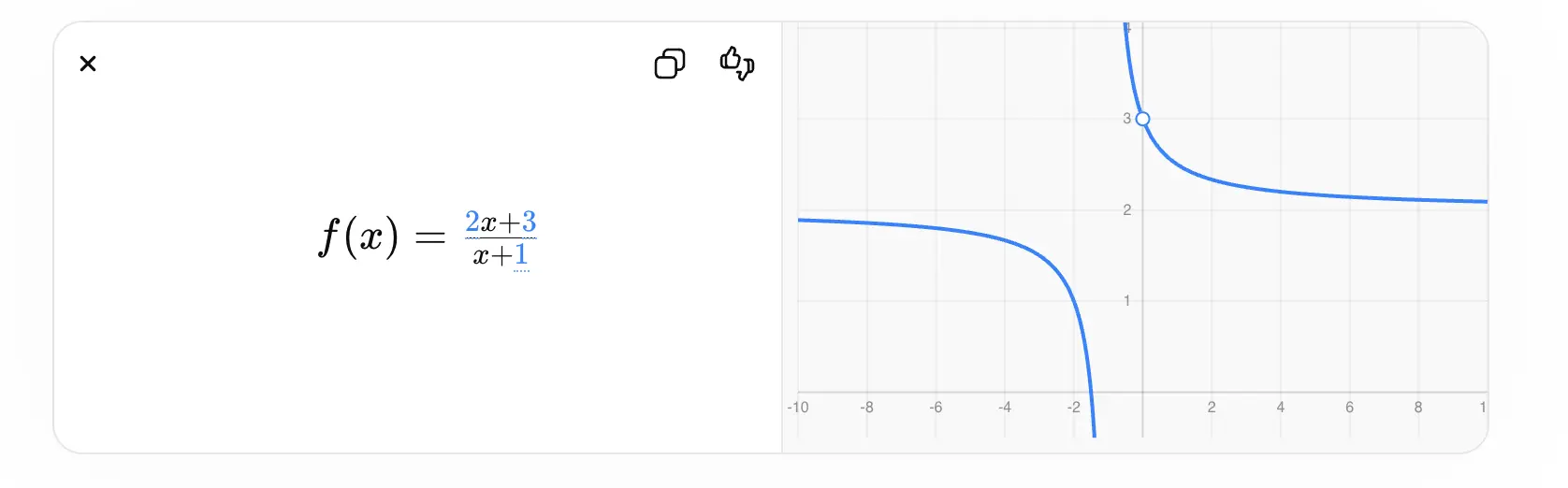
Step 2: Find the Degree
The degree is the highest exponent.
Examples:
- x² has degree 2
- x³ has degree 3
For the function above:
- Numerator degree = 1
- Denominator degree = 1
Recommended Reading: How to Find the Radius of a Circle: Easy Formulas and Examples
Step 3: Apply the Correct Rule
Since the degrees are equal, divide the leading coefficients.
- Leading coefficient of numerator = 2
- Leading coefficient of denominator = 1
So:
y=2
The horizontal asymptote is y = 2.
Recommended Reading: Easiest Way to Learn Tables 1 to 20 | Simple Multiplication Tricks
Horizontal Asymptote vs Vertical Asymptote
Horizontal vs Vertical Asymptote
| Horizontal Asymptote | y = number |
|---|---|
| Vertical Asymptote | x = number |
| Purpose | Shows graph behavior |
Horizontal Asymptote | Vertical Asymptote |
Written as y = number | Written as x = number |
Shows end behavior | Shows undefined points |
Found using degrees | Found using denominator zeros |
Can a Graph Cross a Horizontal Asymptote?
Yes.
- Sometimes a graph will cross a horizontal asymptote.
- A horizontal asymptote only describes the behavior of the graph when the x-values are very large or very small.
Common Mistakes to Avoid
1. Always compare the highest powers first.
Using wrong coefficients
2. When degrees are the same, use only the leading coefficients.
Vertical and Horizontal Asymptotes Confused
3. Keep in mind:
- Horizontal Asymptotes Use Y Vertical Asymptotes Use X Think Graph Never Touches Asymptote
- Some graphs may cross horizontal asymptotes.
4. Real World Applications of Horizontal Asymptotes
Horizontal asymptotes are used for:
- Models of Population Growth
- Physics formulas
- Graphs of economics
- Mathematics for Engineering
- Higher Mathematics and Calculus
They help predict behaviour long term in graphs and equations.
A graph has a horizontal asymptote when the graph approaches a horizontal line as x becomes very large or very small.
Compare the degree of the numerator and the degree of the denominator and use the proper rule.
Smaller numerator degree → y = 0
Equal degrees → divide leading coefficients
Larger numerator degree → no horizontal asymptote
Yes, some graphs cross horizontal asymptotes.
Horizontal asymptotes describe what happens at the ends of a graph, while vertical asymptotes indicate where a function is undefined.
Conclusion
Once you know the basic rules, it’s easy to understand the horizontal asymptote. By comparing the degrees of the numerator and denominator, you can readily determine whether a function has a horizontal asymptote and what its equation is.
Practice recognizing and graphing various rational functions.
Want to excite your child about math and sharpen their math skills? Moonpreneur’s online math curriculum is unique as it helps children understand math skills through hands-on lessons, assists them in building real-life applications, and excites them to learn math.
You can opt for our Advanced Math or Vedic Math+Mental Math courses. Our Math Quiz for grades 3rd, 4th, 5th, and 6th helps in further exciting and engaging in mathematics with hands-on lessons.