Ever looked at a clock and thought, “Why is 4 written as IV and not 4??”
Well, welcome to the world of Romans—where numbers wear togas and follow rules stricter than your math teacher!
If you’re here to learn roman number 1 to 100, you’re in the right place. This guide is fun, simple, and packed with examples, formulas, and tricks to help you master Roman numbers from 1 to 100 like a pro.
What Are Roman Numerals? (Roman Numerals 1 to 100 Explained)
Roman numerals 1 to 100 are numbers written using letters from the Latin alphabet. This system was created in ancient Rome and is still used today in clocks, books, movie sequels, events like the Olympics, and more.
Instead of digits like 1,2,3… Romans used such symbols as: I, V, X, L, C
So when you write roman number 1 to 100, you’re simply combining these letters using specific rules.
Basic Symbols in Roman Counting 1 to 100
Before learning the full Roman numbers 1 to 100, you must remeber these key symbols:
- I = 1
- V = 5
- X = 10
- L = 50
- C = 100
These are the building blocks of Roman numerals 1-100
How to Remember Roman Numerals Easily
Here’s a fun trick to memorize:
“I value Xylopbones Like Crazy.”
- I = 1
- V = 5
- X = 10
- L = 50
- C = 100
Simple right? You can even create your own funny sentence!
How to Write roman number from 1 to 100 (With Formula & Logic)
Roman numerals follow two simple math rules:
| Addition Rule |
When a smaller or equal number comes after a bigger one, you add them.
Formula:
Value = Sum of symbols
Examples:
XXV = 10 + 10 + 5 = 25 LX = 50 + 10 = 60 |
| Subtraction Rule |
When a smaller number comes before a larger one, you subtract.
Formula:
Value = Larger − Smaller
Examples:
IV = 5 − 1 = 4 IX = 10 − 1 = 9 XL = 50 − 10 = 40 |
Examples of Roman Numerals (1 to 100 Roman Number with Name)
Let’s quickly understand with an example:
Roman Numeral Examples
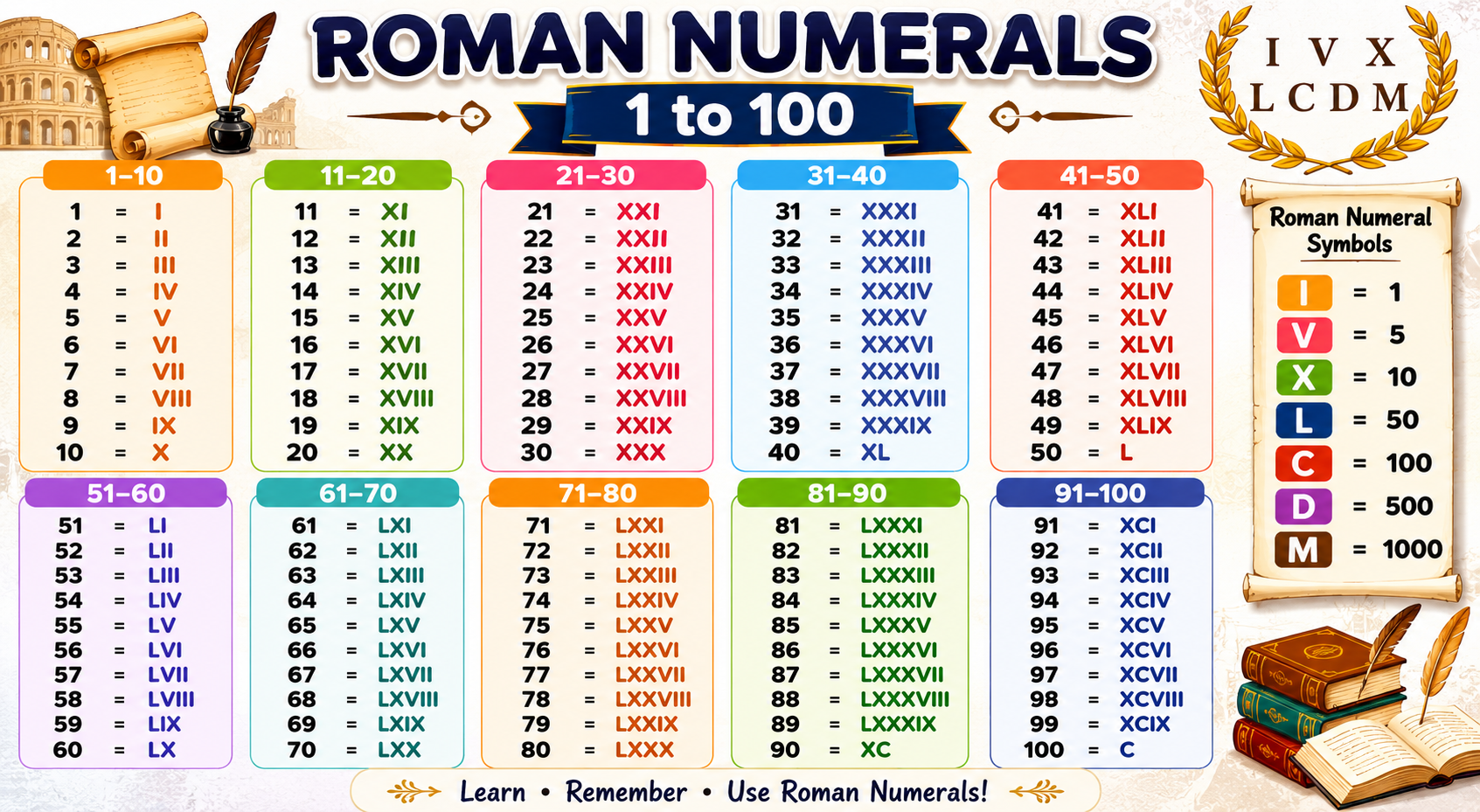
Complete List: Roman Number 1 to 100
Here is the full roman number from 1 to 100:
Roman Numbers 1 to 100
Rules for Roman Counting 1 to 100
To master Roman counting 1 to 100, remember these rules:
Important Roman Numerals Rules
- No symbol for zero
- Always read from left to right
- A symbol can repeat only 3 times (XXX = 30, not XXXX)
- Add when a bigger number comes first (VI = 6)
- Subtract when a smaller number comes first (IV = 4)
Why Learning Roman Numerals 1 to 100 is Useful
You might think, “Why learn in 2026”?
But you’ll still see Roman numerals 1-100 everywhere:
- Book chapters
- Movie sequels (like Rocky IV)
- Events (Super Bowl, Olympics)
- Clock Faces
Read more related articles:
✅Horizontal Asymptote: Rules, Formula, and Easy Examples
✅How to Find the Radius of a Circle: Easy Formulas and Examples
✅What is the Integration of Cosec X?
✅The Wallis Formula: Integrating Powers of Sine and Cosine Instantly
✅How to Use King’s Rule in Definite Integrals: Formulas & Solved Examples
✅What is the Long Division Method? Step-by-Step Guide for Kids
✅How to Use the Cosine Formula to Find Missing Sides and Angles
Final Thoughts on Roman Number 1 to 100.
And there you have it-the complete, easy guide to roman number 1 to 100! Once you understand the symbols and rules, everything becomes super logical. Practice a few numbers daily, and soon you’ll read Roman numerals faster than normal numbers
Want to excite your child about math and sharpen their math skills? Moonpreneur’s online math curriculum is unique in that it helps children understand math skills through hands-on lessons, builds real-life applications, and excites them to learn math.
You can opt for our Advanced Math or Vedic Math+Mental Math courses. Our Math Quiz for grades 3rd, 4th, 5th, and 6th helps in further exciting and engaging in mathematics with hands-on lessons.
FAQS
Ans.
- 60: LX
- 70: LXX
- 80: LXXX
- 90: XC
- 100: C
Ans. Here is the breakdown:
- D = 500
- CC = 200
- L = 50
- XX = 20
- VII = 7
Added together (500 + 200 + 50 + 20 + 7), this gives you 777.
Ans. The number 9999 is written in Roman numerals as 9999 = I̅X̅CMXCIX.
iXAns. The number 69 in Roman numerals is LXIX
Ans. The digit 0 was not needed in the Roman numeral system because this is not a positional system. The only case when it was used was when the number was actually zero, which they called nulla.
Ans. Whether 69 is considered a lucky number depends entirely on the context. In mathematics, it is a formal “lucky number”. In spiritual and cultural contexts, it carries distinct meanings ranging from profound harmony to popular humor.
Ans. Number 6 is considered lucky primarily due to Chinese culture, where it translates to “smooth” or “well-off” (representing flowing wealth and blessings). In Numerology, it symbolizes harmony and Venus, while in religion/nature, it reflects creation and perfect geometric balance.