
Emma, a student in London, is organising a global online art competition. As registration begins pouring in from different countries, she notices that the number of participants follows a mathematical pattern represented by:
To predict participation trends, estimate future registrations, and plan resources effectively, Emma needs a simpler way to analyze the expression. This is where the factored form becomes powerful. Instead of working with the entire quadratic expression, she rewrites it as:
Now Emma can easily analyze the values of x that make the expression equal to zero(x = 3 and x =4). These values help her understand key points in the participation pattern, making it easier to interpret the data and make informed decisions. By converting the expression into factored form, a complex equation becomes much simpler to analyze and solve.
What Is Factored form?
The factored form is a way of expressing a number or algebraic expression as a product of its factors.
In simple words:
Factored Form = Product of simpler expressions
Example:
This is a factored form polynomial
Understanding Factored Form with Numbers
Consider:
𝟣𝟦𝟦 = 𝟣𝟤 × 𝟣𝟤 = 𝟥² × 𝟦²
This shows how a number can be written in factored form.
Factored Form of Polynomial
A factored form polynomial expresses a polynomial as a product of its factors.
Example:
Factored Form of Quadratic Equation
Methods to Find Facored Form
1. Using GCD( Greatest Common Divisor)
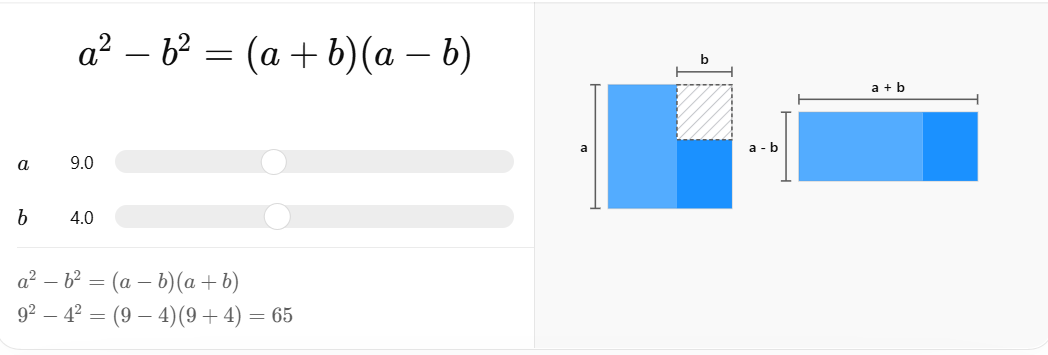
2. Using Identity a2−b2
3. Splitting the Middle Term
Factors Form Parabola
Example:
𝑦 = (𝑥 − 2)(𝑥 − 5)
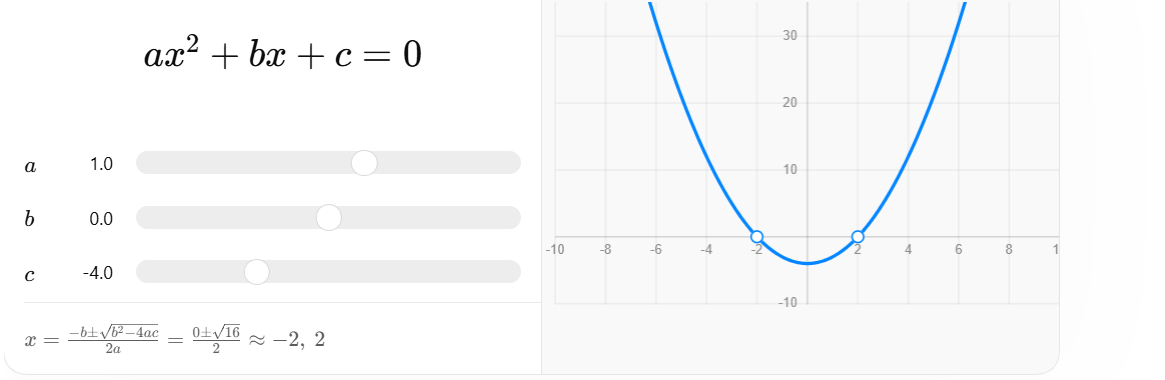
Roots: 𝑥 = 2, 5
This means the parabola intersects the x-axis at 2 and 5.
Example for better understanding:
Lucas, a baker in Paris, models his daily cake sales:
Factoring:
This tells him that sales stabilize at 𝑥 = 5, helping him optimize production.
Solved Examples on Factored Form Example
Factored Form Examples
Example 1: Find Factored Form
𝑥² − 6𝑥 + 8
= (𝑥 − 2)(𝑥 − 4)
Example 2: Using GCD
15𝑦² − 30𝑦
= 15𝑦(𝑦 − 2)
Example 3: Difference of Squares
4𝑎² − 81
= (2𝑎 + 9)(2𝑎 − 9)
Example 4: Finding Roots
𝑥² − 11𝑥 + 30
= (𝑥 − 5)(𝑥 − 6)
𝑥 = 5, 6
Factored Form Calculator
A factored form calculator helps:
- Break expressions into factors
- Find roots instantly
- Graph factored form parabola
Tips & Tricks on Factored Form
- Always check for common factors
- Look for identities like:
𝑎² − 𝑏²
(𝑥 + 𝑎)(𝑥 + 𝑏)
- Verify by multiplying back
- keep simplifying until no further factoring is possible
🧠 Thinking Out of the Box
What is the factored form of:
𝑥² − 16
Answer:
(𝑥 − 4)(𝑥 + 4)
What are the roots?
𝑥 = 4, −4
Interactive Questions on Factored Form
Try solving:
- 𝑥² − 13𝑥 + 40
- 9𝑦² − 25
- 2𝑥² + 10𝑥
Read more related articles:
✅How to Write Roman Number 1 to 100?
✅How to Find the Radius of a Circle: Easy Formulas and Examples
✅What is the Integration of Cosec X?
✅The Wallis Formula: Integrating Powers of Sine and Cosine Instantly
✅How to Use King’s Rule in Definite Integrals: Formulas & Solved Examples
✅What is the Long Division Method? Step-by-Step Guide for Kids
✅How to Use the Cosine Formula to Find Missing Sides and Angles
✅Horizontal Asymptote: Rules, Formula, and Easy Examples
✅Formulas for (a^3 – b^3) and (a^3 + b^3)
Final Thought:
Let’s Summarize
- The factored form simplifies expressions.
- The factored form of a quadratic equation helps find roots
- A factored form polynomial breaks into simpler parts
- The factored form parabola shows intercepts clearly
- A factored form calculator speeds up solving
Mastering what is factored form will make algebra easier, faster, and more intuitive.
You can opt for our Advanced Math or Vedic Math+Mental Math courses. Our Math Quiz for grades 3rd, 4th, 5th, and 6th helps in further exciting and engaging in mathematics with hands-on lessons.
FAQS
Ans. The factored form of an algebraic expression, like a quadratic or polynomial, rewrites it as a product of simpler terms (factors) rather than as a sum or difference. This makes it incredibly easy to identify the roots, \(x\)-intercepts, and behavior of the graph.
Ans. the factored form of 3x + 24y? is 3(x+8y)
is an arithmetic sequence (also known as an arithmetic progression)
Ans. The factored form of a polynomial expresses it as a product of simpler polynomials (factors), typically linear terms or irreducible quadratics. It highlights key graphical and algebraic properties, like roots, directly from the equation.
Ans. This is an arithmetic sequence because each term increases by a constant difference.
Ans. 73 is the 15th term of the given progression.
Ans.
Ans. Approximately 2π is equal to 6.28
2π means 2× π (pi)
Since × π ≈ 3.14:
2π =2×3.14 =6.28
Ans. The most common and basic parts of a circle are the Center, Radius, diameter, circumference, chord, Arc and Tangent.
Ans. A semicircle is half a circle. When you divide a circle into two equal parts along its diameter, the two parts are called semicircles.
Key features:
- It is made by cutting a circle through its diameter
- It has:
-One curved side (half of a circle)
-One line straight (the diameter). Simple example:
Imagine:
🍕 Pizza (half) and🌙 Moon (half) are real instances of a semicircle!
Important Formulas
Area of a semicircle = half of the area of a circle. Area = 21πr2
A semicircle is just half of a circle, but it still has all the same rules and formulas; just remember to divide by 2!