
UNLOCK YOUR CHILD'S
POTENTIAL AND CREATIVITY
WITH A FREE TRIAL CLASS
DEVELOP TECHNICAL, SOFT, &
ENTREPRENEURIAL SKILLS
AGE 7-16 YEARS
CLAIM YOUR $10 ROBLOX/AMAZON/MINECRAFT GIFT
CARD BY ATTENDING A FREE TRIAL CLASS
BOOK A FREE TRIAL
Select Your Subject of Choice

    Please enter name

    Please enter email


    Existing knowledge in the chosen stream

    *No credit card required.

    What are Parallel Lines?

    |

    Have you ever noticed railway tracks stretching into the distance or the lines on a notebook page? Even though they seem to get closer when viewed from far away, they never actually meet. These are perfect examples of parallel lines, one of the most important concepts in geometry.

    Understanding what are parallel lines helps students build a strong foundation for topics such as angles, transversals, coordinate geometry, and more. and more. In this article, we will explore the definition of parallel lines, their properties, formulas, examples, and how they differ from perpendicular lines.

    What Are Parallel Lines?

    Parallel lines are two or more lines that lie in the same plane and never intersect, no matter how far they are extended. They always remain the sme distance apart.

    Mathematically, if two lines have the same slope and different y-intercepts, they are parallel.

    For example:

    𝑳𝒊𝒏𝒆 𝟏: 𝑦 = 2𝑥 + 3
    𝑳𝒊𝒏𝒆 𝟐: 𝑦 = 2𝑥 − 1

    Symbol of Parallel Lines

    If line AB is parallel to line CD, it is written as:

    AB ∥ CD

    Key Properties of Parallel Lines

    Parallel lines have several unique properties:

    • They never intersect.
    • They never remain equidistant at every point.
    • They lie in the same plane.
    • They have equal slopes in coordinate geometry.
    • When crossed by another line, specific angle relationships are formed.

    Formula for Parallel Lines:

    Formula for Parallel Lines
    General Form For two lines:

    y = m₁x + b₁

    and

    y = m₂x + b₂
    Condition for Parallel Lines The lines are parallel if:

    m₁ = m₂
    Where m₁ = slope of the first line
    m₂ = slope of the second line
    Example
    Given Lines y = 4x + 7

    y = 4x − 5
    Slopes First line slope = 4
    Second line slope = 4

    4 = 4
    Conclusion Since both lines have the same slope, the lines are parallel.

    Types of Angles Formed

    1. Corresponding Angles

    These angles occupy the same relative position at each intersection.

    Property:

    Corresponding angles are equal.

    Example: If one corresponding angle measures 70°, the other corresponding angle is also 70°.

    2. Alternate Interior Angles

    These angles lie between the parallel lines on opposite sides of the transversal.

    property:

    Alternative interior angles are equal.

    3. Alternate Exterior Angles

    These angles lie outside the parallel lines and on opposite sides of the transversal.

    Property:

    Alternate Exterior angles are equal

    4. Same-Side Interior Angles

    These angles lie between the parallel lines on the same side of the transversal.

    Property:

    They are supplementary.

    Formula:

    Angle 1+ Angle 2 = 180°

    Example:

    If one angle is 110°:

    110° + Angle 2 = 180°

    Angle 2 = 70°

    Example of Parallel Lines Cut by a Transversal

    Suppose a transversal intersects two parallel lines.

    If one corresponding angle is 65°, then:

    • – Alternate interior angle = 65°
    • – Alternate exterior angle = 65°
    • – Same-side interior angle = 115°

    This is because :

    65° + 115° = 180°

    Parallel and perpendicular Lines

    Student often confuse parallel and perpendicular lines, but they are very different.

    Parallel Lines

    • Never Intersect
    • Equal slopes
    • Stay the same distance apart

    Example:

    𝑦 = 3𝑥 + 2

    𝑦 = 3𝑥 − 4

    Perpendicular Lines

    • Intersect at 90°
    • Slopes are negative reciprocals

    Formula :

    Perpendicular Lines Formula
    m₁ × m₂ = −1
    Example:

    Line 1: y = 2x + 1
    Line 2: y = −½x + 4

    Since:
    2 × (−½) = −1

    Therefore: The lines are perpendicular.

    Diffrence Between Parallel and perpendicular Lines 

    Feature Parallel Lines Perpendicular Lines
    Intersection Never meet Meet at one point
    Angle Formed No angle formed 90° angle
    Slope Relationship Equal slopes Negative reciprocal slopes
    Symbol

    Real-Life Examples of parallel Lines

    Parallel lines can be seen everywhre:

    • Railway tracks
    • Notebook lines
    • Zebra crossings
    • Opposite sides of a rectagualr table
    • Electtric power lines
    • Road lane makings

    These examples help us understand how geometry is used in everyday life.

    Solved Examples

    Example Question Solution
    Example 1 Determine whether the following lines are parallel:

    y = 5x + 8
    y = 5x − 2
    Slope of first line = 5
    Slope of second line = 5

    Since the slopes are equal, the lines are parallel.
    Example 2 Two parallel lines are cut by a transversal. One corresponding angle is 125°. Find the alternate interior angle. Corresponding angles and alternate interior angles are equal.

    Therefore:
    Alternate interior angle = 125°
    Example 3 Find the missing same-side interior angle if the other angle is 95°. Same-side interior angles are supplementary.

    95° + x = 180°
    x = 180° − 95°
    x = 85°

    Answer: 85°

    Why Are Parallel Lines Important?

    Parallel lines are used in:

    • Architecture and construction
    • Engineering design
    • Computer graphics
    • Road planning
    • Navigating system
    • Geometric proofs

    Understanding parallel lines also helps students learn advanced geometry concepts more easily.

    Final Thoughts 

    Parallel lines are lines that remain the same distance apart and never intersect. Knowing what are parallel lines, understanding how parallel lines are cut by a transversal, and distinguishing between parallel and perpendicular lines are essential skills in geometry. With their clear properties, formulas, and real-world applications, parallel lines provide a strong foundation for mathematical learning and problem-solving.

    Want to excite your child about math and sharpen their math skills? Moonpreneur’s online math curriculum is unique in that it helps children understand math skills through hands-on lessons, builds real-life applications, and excites them to learn math. 

    You can opt for our Advanced Math or Vedic Math+Mental Math courses. Our Math Quiz for grades 3rd, 4th, 5th, and 6th helps in further exciting and engaging in mathematics with hands-on lessons.

    FAQS

    Ans. Parallel lines are lines that are in the same flat surface, called a plane, and always stay the same distance apart, which means they never cross or touch, no matter how far they extend. As long as they never meet, no matter how far we extend them, parallel lines can be horizontal, vertical, or slanted.

    Ans. In basic geometry and design, the four primary types of lines are horizontal, vertical, parallel, and perpendicular. Each type is defined by its orientation or its mathematical relationship to other lines


    Ans. Lines of latitude, also called parallels, are imaginary lines that divide the Earth. They run east to west, but measure your distance north or south. The equator is the most well-known parallel. At 0 degrees latitude, it equally divides the Earth into the Northern and Southern hemispheres.
    Ans.

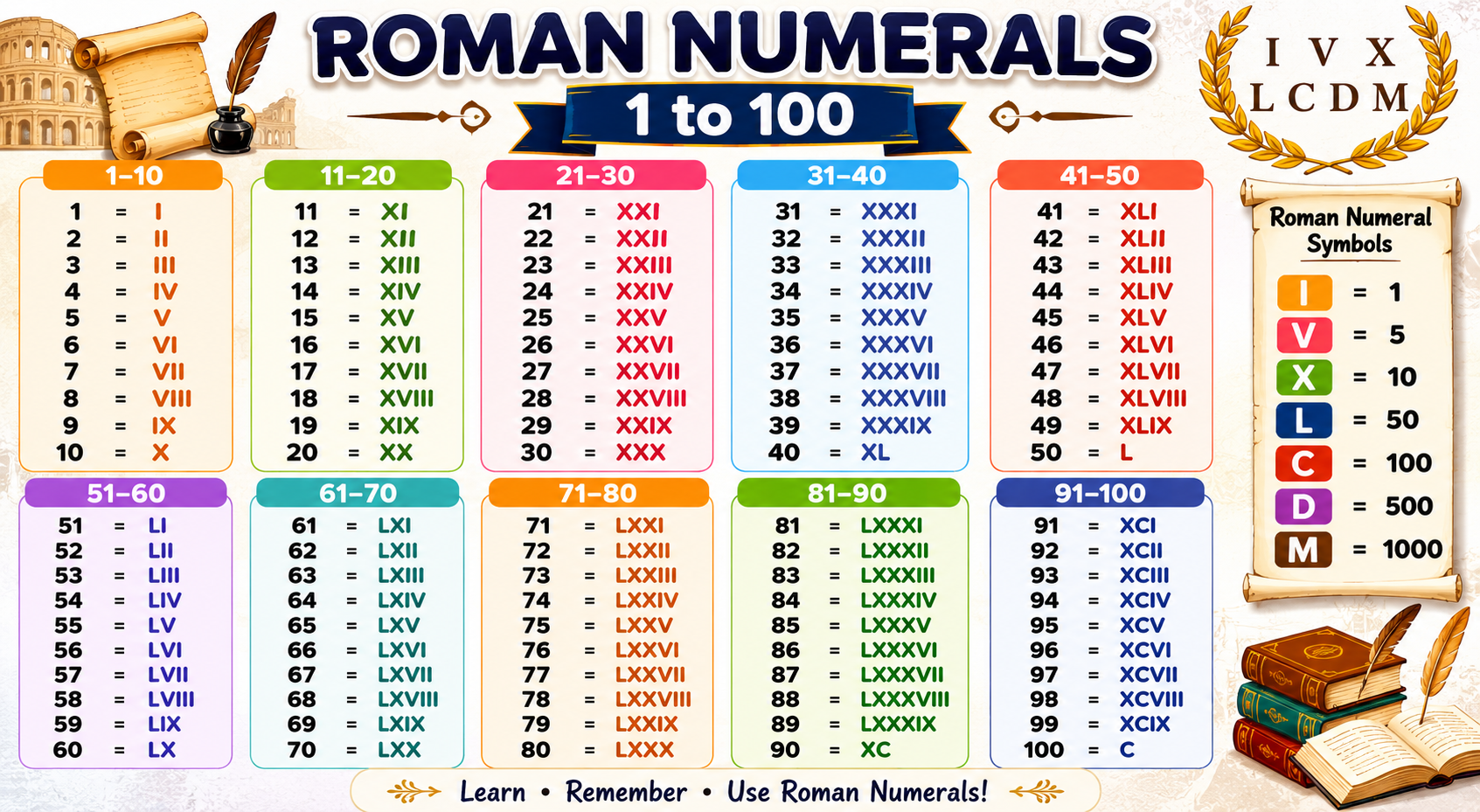
    The Roman numeral equivalents for 60, 70, 80, 90, and 100 are:
    • 60: LX
    • 70: LXX
    • 80: LXXX
    • 90: XC
    • 100: C
     

    Ans. Here is the breakdown:

    • D = 500
    • CC = 200
    • L = 50
    • XX = 20
    • VII = 7 

    Added together (500 + 200 + 50 + 20 + 7), this gives you 777.

    Ans. The number 9999 is written in Roman numerals as 9999 = I̅X̅CMXCIX.


    iXAns. The number 69 in Roman numerals is LXIX

    Ans. The digit 0 was not needed in the Roman numeral system because this is not a positional system. The only case when it was used was when the number was actually zero, which they called nulla.

    Ans. Whether 69 is considered a lucky number depends entirely on the context. In mathematics, it is a formal “lucky number”. In spiritual and cultural contexts, it carries distinct meanings ranging from profound harmony to popular humor.

    Ans. Number 6 is considered lucky primarily due to Chinese culture, where it translates to “smooth” or “well-off” (representing flowing wealth and blessings). In Numerology, it symbolizes harmony and Venus, while in religion/nature, it reflects creation and perfect geometric balance.

    Moonpreneur

    Moonpreneur

    Moonpreneur is an ed-tech company that imparts tech entrepreneurship to children aged 6 to 15. Its flagship offering, the Innovator Program, offers students a holistic learning experience that blends Technical Skills, Power Skills, and Entrepreneurial Skills with streams such as Robotics, Game Development, App Development, Advanced Math, Scratch Coding, and Book Writing & Publishing.
    Subscribe
    Notify of
    guest

    0 Comments
    Inline Feedbacks
    View all comments

    RELATED ARTICALS

    Explore by Category

    MOST POPULAR

    GIVE A GIFT OF $10
    MINECRAFT GIFT
    TO YOUR CHILD

    JOIN A FREE TRIAL CLASS

    FREE PRINTABLE MATH WORKSHEETS

    DOWNLOAD 3rd GRADE MATH WORKSHEET
    Download Now

    DOWNLOAD 4rd GRADE MATH WORKSHEET
    Download Now

    DOWNLOAD 5rd GRADE MATH WORKSHEET
    Download Now

    DOWNLOAD 4rd GRADE MATH WORKSHEET
    Download Now

    MATH QUIZ FOR KIDS - TEST YOUR KNOWLEDGE

    MATH QUIZ FOR GRADE 3

    Start The Quiz

    MATH QUIZ FOR GRADE 4

    Start The Quiz

    MATH QUIZ FOR GRADE 5

    Start The Quiz

    MATH QUIZ FOR GRADE 6

    Start The Quiz