Attend our in-person Robotics & Math


If you’ve ever paused over a recipe, a woodworking plan, or a math worksheet and wondered, what is 3/8 as a decimal? You’re not alone. Fractions like 3/8 show up everywhere, from drill bit sizes to stock prices, and knowing how to switch between fraction and decimal form is one of those small math skills that pays off constantly. In this guide, we’ll answer the question directly, walk through two easy methods to get there, and show you exactly why the answer works the way it does.
3/8 as a Decimal
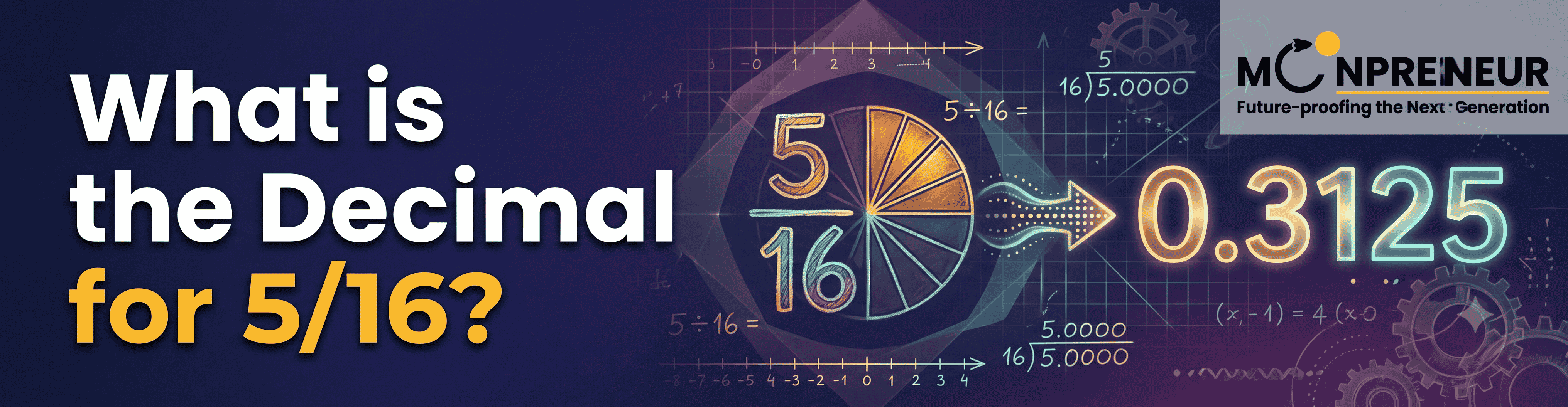
3/8 as a decimal is 0.375. That’s it: short, clean, and exact. Unlike some fractions that turn into long repeating decimals, 3/8 divides evenly and terminates after three digits.
In other words: 3 ÷ 8 = 0.375
How to Convert 3/8 to a Decimal (Step-by-Step)
There are two simple ways to work this out on paper. Both give you the same result, so pick whichever feels more natural.
This is the most reliable way to convert any fraction into a decimal because it works regardless of the denominator.
Instead of long division, you can scale the fraction to a denominator of 1,000, making it easy to read the decimal.
Why Does 3/8 Equal 0.375?
It comes down to place value. The fraction 375/1,000 is read as “375 thousandths,” and in decimal form the three digits after the decimal point represent tenths, hundredths, and thousandths:
- 3 → three tenths (0.3)
- 7 → seven hundredths (0.07)
- 5 → five thousandths (0.005)
Add those together — 0.3 + 0.07 + 0.005 — and you land right back at 0.375. This is why the place value method and long division always agree with each other.
Is 3/8 a Terminating or a Repeating Decimal?
3/8 is a terminating decimal, meaning the division ends cleanly with no remainder and no repeating pattern. A fraction will always terminate when its denominator, in lowest terms, has no prime factors other than 2 or 5. Since 8 equals 2 × 2 × 2, it fits that rule perfectly, which is exactly why 3/8 as a decimal comes out to a neat 0.375 rather than an endless repeating string of digits.
Compare that to a fraction like 1/3, which repeats forever as 0.333…, because 3 isn’t built from 2s or 5s.
Decimal Equivalents of Common Eighths
| Fraction | Decimal | Percentage |
|---|---|---|
| 1/8 | 0.125 | 12.5% |
| 2/8 (1/4) | 0.25 | 25% |
| 3/8 | 0.375 | 37.5% |
| 4/8 (1/2) | 0.5 | 50% |
| 5/8 | 0.625 | 62.5% |
| 6/8 (3/4) | 0.75 | 75% |
| 7/8 | 0.875 | 87.5% |
A quick way to verify your fraction-to-decimal conversion is to multiply the decimal by the original denominator. If you get the original numerator back, your answer is correct.
Final Thought
So, what is 3/8 as a decimal? It’s simply 0.375, a clean, terminating decimal you can reach through long division or by converting to an equivalent fraction over 1,000. Once you see the pattern behind eighths, converting any similar fraction becomes second nature, whether you’re reading a tape measure, adjusting a recipe, or double-checking a homework answer.
You can opt for our Advanced Math or Vedic Math+Mental Math courses. Our Math Quiz for grades 3rd, 4th, 5th, and 6th helps in further exciting and engaging in mathematics with hands-on lessons.
Related Blog:
How to Subtract Fractions: A Step-by-Step Guide for Beginners
How to Divide Fractions: Simple Steps, Examples & Practice Problems
How to Add Fractions – 3 Simple Steps
Factors of 36 – Prime Factorization, Factor Pairs, and Examples
What is 0.375 as a Fraction? Learn to Convert Decimal to Fraction Form
What is the Long Division Method? Step-by-Step Guide for Kids
Frequently Asked Questions
3/8 as a decimal is 0.375. You can find this by dividing 3 by 8 or by converting the fraction into 375/1,000.
Yes. 3/8 and 0.375 represent exactly the same value—one is written as a fraction and the other as a decimal.
Multiply 0.375 × 100 to convert it into a percentage. The answer is 37.5%.
No. 0.375 is a terminating decimal, meaning it ends after three digits and does not repeat forever.
Since the third decimal digit is 5, 0.375 rounds up to 0.38.