Attend our in-person Robotics & Math


A fraction is an indication of either a whole number or a portion of something. If you are thinking of how to express 25 as a fraction, then the answer is quite easy; 25 as a fraction is written as 25/1. All whole numbers can be indicated as a fraction, where the denominator will be 1.
For instance, 25/1 indicates 25 over 1, and when divided, we get 25. Equally, we could make equivalent fractions by multiplying both the denominator and the numerator with the same number.
Let us look at how we will indicate 25 as a fraction, simplest form of 25, and finally convert 25 percent to a fraction with steps and examples.
What Is 25 as a Fraction?
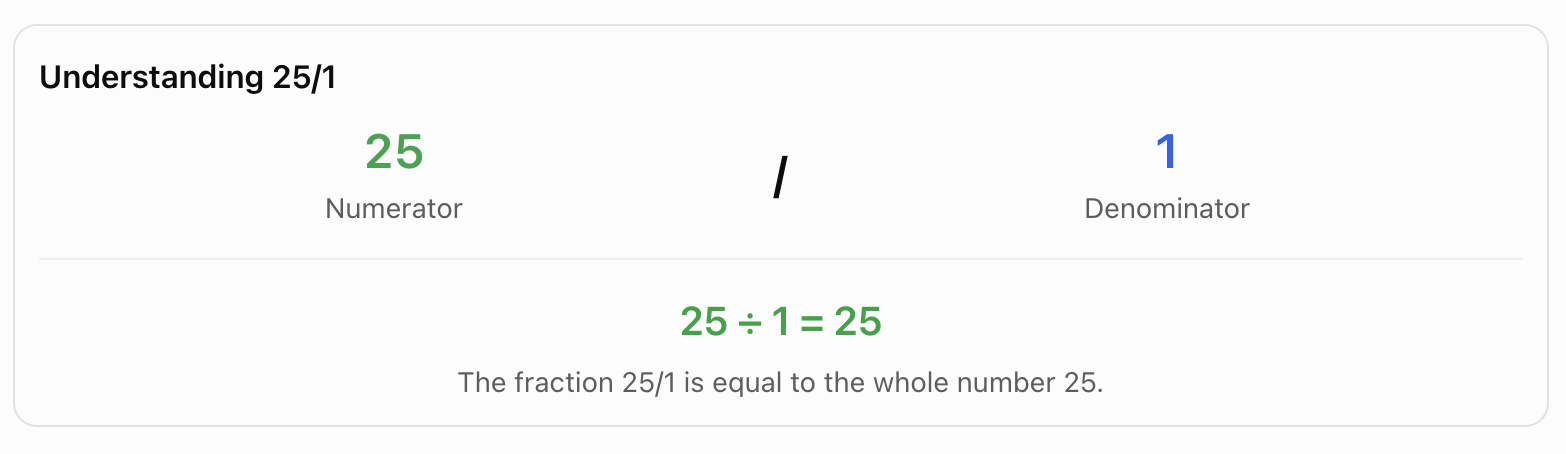
The whole number 25 written as a fraction is:
25/1
In this fraction:
- Numerator: 25 (the top number).
- Denominator: 1 (the bottom number).
When you divide 25 by 1, the result is 25. Therefore, 25/1 has the same value as the whole number 25.
How Do You Write 25 as a Fraction?
Converting a whole number into a fraction is easy. You only need to follow three simple steps.
Step 1: Write 25 as the numerator.
The numerator is the top number of a fraction. Start by writing 25 on top.
Step 2: Put 1 as the denominator.
Every whole number can be written over 1 because dividing a number by 1 does not change its value.
Step 3: Write the final fraction.
Place the numbers together to get your answer:
25=25/1
Final Answer: 25/1
So, 25 as a fraction is 25/1.
What Is 25 as a Fraction in Simplest Form?
The simplest form of a fraction means that its numerator and denominator have no common factor other than 1.
For the number 25, the fraction is:
25/1
Let’s check its factors:
- Factors of 25: 1, 5, 25.
- Factors of 1: 1.
The greatest common factor (GCF) of 25 and 1 is 1. Therefore, the fraction cannot be reduced any further.
Recommended Reading: What Are the Factors of 25? (Factor Pairs, Prime Factors & Examples)
What Are the Equivalent Fractions of 25?
Equivalent Fractions of 25/1
Equivalent fractions are fractions that have different numerators and denominators but represent the same value. They may look different, but their mathematical values remain equal.
You can find equivalent fractions of 25/1 by multiplying both the numerator and denominator by the same nonzero number. This keeps the value of the fraction unchanged.
For example, multiply both the numerator and denominator by 2:
Similarly, you can multiply 25/1 by 3, 4, 5, or other nonzero numbers to create more equivalent fractions.
Examples of Equivalent Fractions of 25
| Equivalent Fraction | Decimal Value |
|---|---|
| 25/1 | 25 |
| 50/2 | 25 |
| 75/3 | 25 |
| 100/4 | 25 |
| 125/5 | 25 |
| 150/6 | 25 |
Key Takeaway: All these fractions represent the same whole number, which is 25. Even though their numerators and denominators are different, their values remain equal because both parts of the original fraction are multiplied by the same number.
How to Convert 25 into a Decimal?
Converting a fraction into a decimal is simple. You just need to divide the numerator by the denominator.
The fraction is:
25/1
Now divide: 25/1=25.0
Therefore, the decimal form of 25/1 is 25.0, which is the same as 25.
How to Convert 25 into a Decimal?
There are a number of errors which may be encountered while converting whole numbers into fractions.
In this regard, consider the following points:
- Zero as denominator: It is not allowed to have the fraction in the form 25/0 as division by zero is not possible.
- Confusion between whole numbers and percentage: Remember that 25 is different from 25 percent.
- No simplification: It is crucial to ensure that there are some common factors between the numerator and denominator.
- Modification of either of them: When the equivalent fractions are being created, the numerator and denominator are multiplied by the same factor.
These guidelines will enable you to understand fractions better.
Conclusion
In order to write 25 as a fraction, it is critical to learn the basic concepts. A whole number can be effectively converted to a fraction if one places 1 in the denominator. Thus, the simplest form of 25 is written as 25/1.
It is essential to remember that 25 and 25% are not the same numbers. While for 25, we put 1 in the denominator, for 25 percent to be counted in its simplest form, it is written as a fraction as 1/4. Knowing the difference is important for solving fractions and percentages in your day-to-day calculations.
You can opt for our Advanced Math or Vedic Math+Mental Math courses. Our Math Quiz for grades 3rd, 4th, 5th, and 6th helps in further exciting and engaging in mathematics with hands-on lessons.