Attend our in-person Robotics & Math


Kids are born curious. They drop spoons from high chairs to test gravity, tear open cardboard boxes to build forts, and ask “why” until your brain hurts. But somewhere between elementary school worksheets and middle school grades, that natural curiosity often fizzles out—especially when it comes to math and science.
If you are looking at how to encourage a child’s interest in stem, you don’t need a degree in engineering or an expensive lab in your basement. You just need a few simple tweaks to how you handle everyday conversations, weekend projects, and household mishaps.
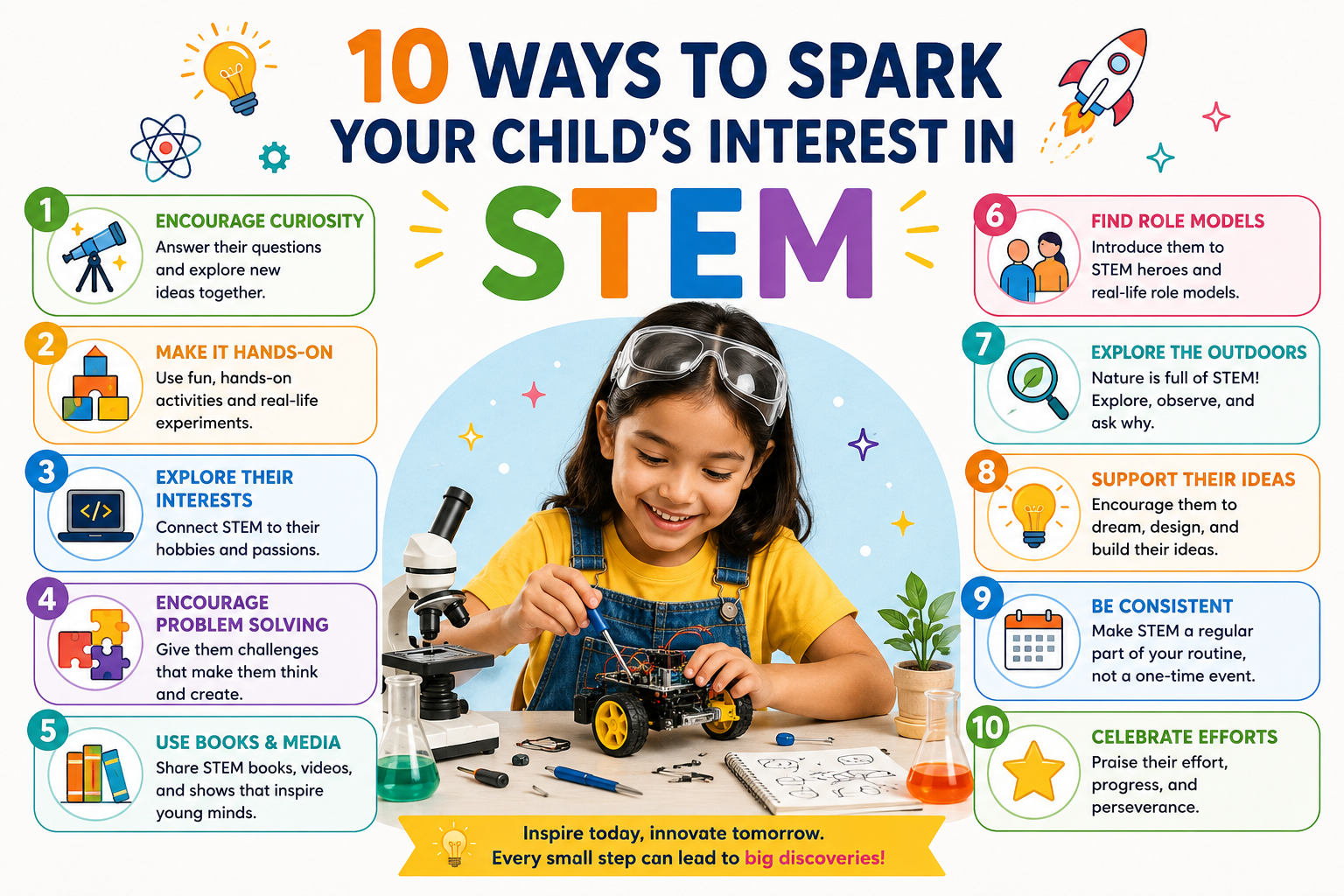
Here are 10 creative ways to engage children in STEM to help your child build confidence and stay curious in a tech-driven world.
Explore this reading: What is AI Literacy?
10 ways to spark your child’s interest in stem
1. Ditch Generic Praise for Strategic Encouragement
Saying “you’re so smart” when your child builds a tall LEGO tower feels natural and is one of the best ways to help your child prepare for a STEM career, but research shows it can backfire. When kids think their technical ability is something they are simply born with, they freeze up the moment a project gets difficult.
Instead, point out the specific process, effort, and strategy they used:
- "I love how you tried three different base shapes before finding one that could hold the weight."
- "You spent 40 minutes troubleshooting that line of code without giving up. That was great patience."
Clear, specific feedback breeds resilience. It reminds kids that skill comes from practice, which is so important in keeping girls interested in STEM when society tells us that technical subjects are “hard.”
Explore this reading: Mouse Practice Games for Kids to Improve Computer Mouse Skills
2. Treat “Failure” Like Data Collection
In traditional school environments, making a mistake means losing points. In engineering, making a mistake is just gathering information about what doesn’t work.
When a paper rocket fails to launch or a home science experiment flops, resist the urge to step in and fix it immediately.
Ask open-ended questions:
- That wasn't what I'd thought. “What do you think caused the collapse?
- What variable we should change in our next attempt?
Normalizing errors takes the fear out of being wrong. When kids understand that a mistake isn’t a reflection of their own failure, they’re much more likely to dive into hard math and coding problems.
3. Catch the Middle School Drop-off Early
Studies show a sharp pattern in how children relate to science and technology as they grow up. While early elementary kids show equal enthusiasm across the board, middle school is where confidence often plummets.
By the time they reach 11, girls start dropping out of stem at alarming rates, due to peer pressure, a lack of visible role models and less hands-on learning. To counter this decline, introduce low-pressure “tinker time” during middle school. Let them experiment with free visual coding platforms like Scratch or beginner electronics kits, without grading their work or testing them afterwards
4. Design “Mastery Experiences” with Small Wins
Nobody likes playing a game where they lose every single turn. If a child’s first experience with programming involves typing complex syntax into a blank text editor, they will likely quit out of frustration.
Start with small, bite-sized projects that guarantee a fast win:
- Wire a single battery to a tiny motor to make a paper cup "scribble bot."
- Write five lines of block code to make a sprite dance on screen.
These mini-wins create a powerful sense of self-efficacy, the internal belief that “I can figure this out.” That first shot of confidence carries them through the harder subjects down the line
Explore this reading: Learning Coding, Robotics and Other Tech Hobbies for Kids
5. Get Hands-On with Household Teardowns
Abstract concepts in textbooks rarely stir passion. Physical items you can touch, open, and break apart.
Weekend Idea: Before tossing an old computer mouse, a broken toaster, or a dead remote control into the trash, hand your kid a screwdriver set. Let them open the casing and inspect the circuit boards, switches, and wiring underneath. Demystifying the everyday objects to turn passive consumers of technology into curious creators.
6. Co-Learn and Say “I Don’t Know”
You don’t have to have all the answers to be a great mentor. But, in reality, pretending to know everything can make STEM feel intimidating and out of reach.
When your kid asks you how a solar panel works, or why the Wi-Fi is out, tell them the truth:
- Actually, I don't know the mechanism exactly. Let’s sketch a quick diagram together.
7. Connect Tech to Real-World Helping
One of the big reasons that many kids lose interest in math and computer science is that the assignments feel abstract or disconnected. They don’t know how to solve for x, or write a loop, in terms of human lives.
Rethink technical fields so they are about social impact and community values:
- How environmental engineers design ocean cleanup arrays to save marine life
- Here’s how app developers are creating software to help blind people navigate public transit.
- What are some ways biomedical designers are employing 3D printers to create low-cost prosthetics for kids?
When children realize that coding, robotics, and mathematics are tools for helping people, their engagement jumps significantly.
8. Find a Social STEM Community
Learning is social by nature. A child may drop an interest in building circuits or solving logic puzzles if they feel like they are the only one in their friend group who likes to do it.
Encourage them to join local robotics clubs, coding groups, or after school tech programs. Peer-to-peer hands-on projects turn technical skills into a social experience, rather than a lonely chore.
9. Model Calm Troubleshooting When Tech Breaks
Kids watch how adults respond to stress. When the TV remote stops responding, the phone freezes, or a piece of furniture arrives missing a bolt, notice your immediate reaction.
If Kids learn tech problems are stressful and impossible if you throw up your hands in frustration. You take a deep breath and say, “Okay, let’s troubleshoot this step-by-step.” They learn that technical glitches are just simple puzzles that need a logical solution.
10. Introduce Relatable, Multi-Dimensional Role Models
“If kids think a scientist is a person sitting in a basement all by themselves in a white lab coat, a lot of them will walk away. Show them that real-world engineers, programmers, and mathematicians are just regular people with different passions.
Look for stories, videos, and books on professionals who mix STEM with music, fashion, sports, or digital art. When kids see people who look like them building cool things without losing their personality, they realize there’s room for them in tech, too.
Successful Parenting Strategies
Conclusion
The goal isn’t to push your child toward a specific college major or career path when it comes to helping them build a lasting interest in science and technology. It’s about giving them the tools, the confidence, and the curiosity to ask big questions and build their own answers. Curiosity, hands-on learning and encouragement are the building blocks for creative ways to engage children in STEM. These Ways to Help Your Child Prepare for a STEM Career show How Parents Can Foster Children’s Interest in STEM, keeping students motivated and enthusiastic about lifelong STEM learning.
Looking for a comprehensive parenting guide to ensure you are on the right track? Explore a wealth of parenting wisdom and educational insights in Moonpreneur’s blogs. Additionally, you can join our programs that nurture the next generation of innovators. Book a free trial now!