Attend our in-person Robotics & Math



Screen fatigue is a growing challenge for parents. Finding science gifts for kids that hold their attention without relying on a tablet screen or an app can feel like a gamble.
Children naturally love discovering how things work, but many popular STEM toys on the market either require a constant Bluetooth connection or leave parents cleaning up dyed messes for hours.
We evaluated dozens of leading experiment sets, microscopes, and electronic builds with young testers to curate the best science gifts for kids. Each option was evaluated on unboxing friction, mess level, independent play value, and real-world scientific learning.
Explore this reading: What is AI Literacy?
Direct Comparison: Top Gifts for Kids Who Love Science
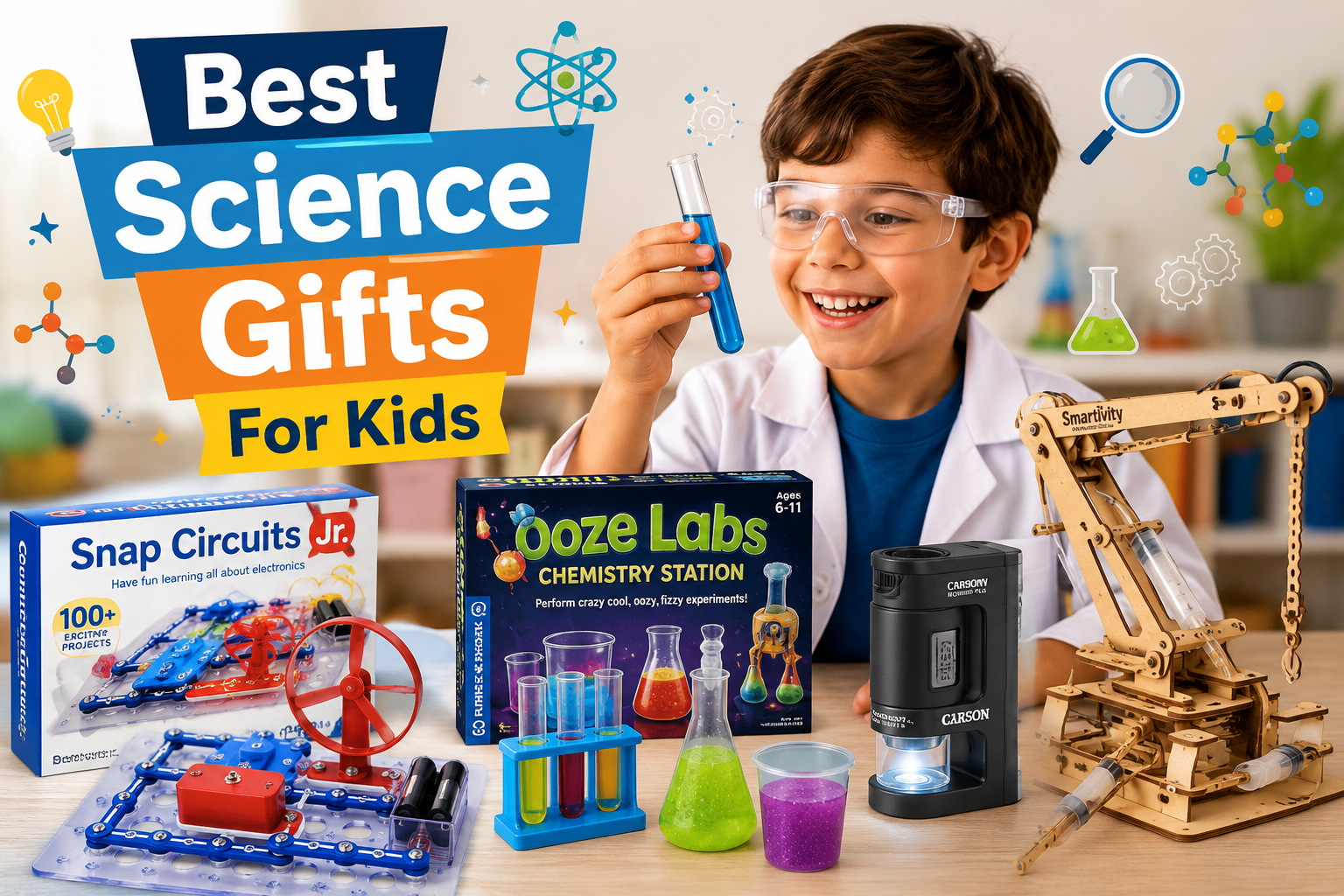
- Best Overall Electronics Gift: Snap Circuits Jr. SC-100 (Zero screens, zero soldering)
- Best Chemistry & Geology Lab: Thames & Kosmos Ooze Labs / Nat Geo Mega Science Kit
- Best Mechanical Physics Set: Smartivity Hydraulic Crane & Launcher
- Best Portable Biology Tool: Carson MicroBrite Plus 60x–120x LED Pocket Microscope
- Best Early Learner Gift: Learning Resources Primary Science Lab Set
Explore this reading: Mouse Practice Games for Kids to Improve Computer Mouse Skills
| Product | Field | Screen | Prep | Mess | Replay |
|---|---|---|---|---|---|
| Snap Circuits Jr. | ⚡ Electrical | ❌ None | 2 min | 1/5 | 5/5 |
| Thames & Kosmos | 🧪 Chemistry | ❌ None | 10 min | 3/5 | 4/5 |
| Smartivity Crane | 💧 Fluid | ❌ None | 5 min | 2/5 | 4/5 |
| Carson MicroBrite | 🔬 Biology | ❌ None | 0 min | 1/5 | 5/5 |
| Learning Lab Set | 🧫 Chemistry | ❌ None | 2 min | 2/5 | 4/5 |
Explore this reading: Learning Coding, Robotics and Other Tech Hobbies for Kids
1. Snap Circuits Jr. SC-100 — Best Science Gift for Circuitry & Electronics
- Primary Science Field: Electrical Physics, Circuitry, and Logic Switches
- Target Age: 8–12 years
- Batteries Needed: 2 AA batteries
Why It’s One of the Best Science Gifts for Kids:
Unlike app-enabled robotics that require Bluetooth syncing or software updates, Snap Circuits uses physical plastic boards where electrical parts button-snap together safely.
When our young testers snapped the motor and plastic fan blade into a completed loop, the fan launched 3 feet into the air. The manual relies entirely on clear pictorial diagrams, allowing kids to execute 101 different builds independently without asking for a parent’s smartphone.
Parent Testing Note: The plastic snaps are durable, but ensure your child doesn’t snap two power terminals directly together without a resistor or light bulb in between, or the AA batteries will warm up quickly.
2. Thames & Kosmos Ooze Labs Chemistry Station — Top Pick for Hands-On Chemistry
- Primary Science Field: Acids, bases, polymer science, and chemical indicators
- Target Age: 6–11 years
- Parent Supervision: Recommended for setup
Why It’s Ideal for Gifts for Kids Who Love Science:
Most budget “chemistry” sets for kids are just baking soda and food dye in thin plastic cups. Thames & Kosmos includes real lab gear: plastic beakers, test tubes, test tube racks, syringes, and a centrifuge setup.
Kids can conduct non-hazardous, safe experiments—like creating slime, chromatography tests, and color-changing reactions. It feels like “authentic science” to a child, which boosts their confidence significantly.
Parent Testing Note (Mess Control): Place a plastic tray under the workstation before starting. While the chemical compounds are safe for home use, liquid spillages can stain unsealed wooden tables.
3. Smartivity Hydraulic Crane & Launcher – Best Kit for Mechanical Engineering
- Main Science Subject: Pascal’s principle, fluid pressure, levers, and mechanical advantage
- Target age: 8–12 years
- Materials: Engineered sustainable wood, rubber bands, syringes, water tubing
What Makes This Different For Young Builders:
If your child loves science and mechanical construction, this kit is a great step up from the standard building blocks as a gift. Kids build a working wooden crane powered by nothing but water-filled syringes. Pushing one syringe piston forces water through a tube, raising and lowering the mechanical arm.
There are no electronics or screens involved. It teaches classical fluid mechanics through pure tactile feedback.
Parent Testing Note: The laser-cut wood pieces fit tightly. Younger kids with weaker fine-motor skills might need an adult to help press a few key joints together.
4. Carson MicroBrite Plus LED Pocket Microscope — Best Portable Biology Gift
- Primary Science Field: Microscopy, cell structures, surface textures, and optics
- Magnification: 60x to 120x zoom
- Weight: 2.1 oz (fits in a coat pocket)
Why It’s a Top Science Gift for Outdoorsy Kids:
Traditional glass-slide microscopes sit on a desk and break easily. The Carson MicroBrite is a rugged plastic pocket device equipped with a bright built-in LED light.
Kids can press it directly against a leaf, a fabric fiber, salt crystals, or tree bark in the backyard. During testing, young explorers spent up to an hour outdoors looking at plant micro-structures without looking toward a digital screen once.
5. Learning Resources Primary Science Lab Set – Best Screen-Free Gift for Young Learners
- Primary Science Area: Sensory exploration, measurement of volume, and mixing of colors
- Target Age:3 to 6 years
- Key Feature: Oversized, unbreakable science tools for small hands
Why Kids Love It:
Before children can learn complex formulas, they need to learn to observe. This screen-free set comes with chunky beakers, test tubes with stands, magnifying glasses, and fun activity cards. Parents can use simple kitchen ingredients (such as water, vinegar, food coloring and baking soda) to run repeatable experiments that build fine motor skills.
How to Choose: What is a Good Science Gift for an 8-Year-Old (Buyer’s Guide)
When shopping for what is a good science gift for an 8-year-old, matching the product to the child’s developmental age and interest style prevents the toy from gathering dust:
- Beware of “App-Required” Fine Print: Many STEM kits advertise screen-free play on the front of the box, but hide a requirement in fine print: “Download our app to access assembly instructions.”
- Avoid Single-Use Experiment Kits: Kits that only include single-use powders (like basic slime buckets) get discarded after 15 minutes. Choose reusable tools (like optical lenses, circuits, or wooden gears).
- Check Age-Level Calibration: A 9-year-old will quickly get bored with kits rated for “Ages 4–8”.As a parent, always prioritize choosing the best kits for kids that are suitable for their developmental stage to keep them engaged and challenged.
Conclusion
Finding the best science gifts for kids is not just about buying a toy. It’s about inspiring curiosity, creativity and a lifelong love of learning. No matter what your child’s favorite activity is—building electrical circuits, doing chemistry experiments, exploring nature with a microscope, designing engineering projects—the right science gift can help make the everyday fun educational experience
Select a science gift that will hold your child’s interest as they learn new concepts, depending on their age, interests and developmental stage. STEM kits without screens, hands-on experiments and interactive learning tools can help develop problem solving, critical thinking and confidence in ways that traditional toys often can’t.
The best science gifts are those that ask questions, that make you want to explore, that make learning fun. A quality science kit offers kids the opportunity to explore, experiment and learn valuable STEM skills that will last a lifetime.
Looking for a comprehensive parenting guide to ensure you are on the right track? Explore a wealth of parenting wisdom and educational insights in Moonpreneur’s blogs. Additionally, you can join our programs that nurture the next generation of innovators. Book a free trial now!