
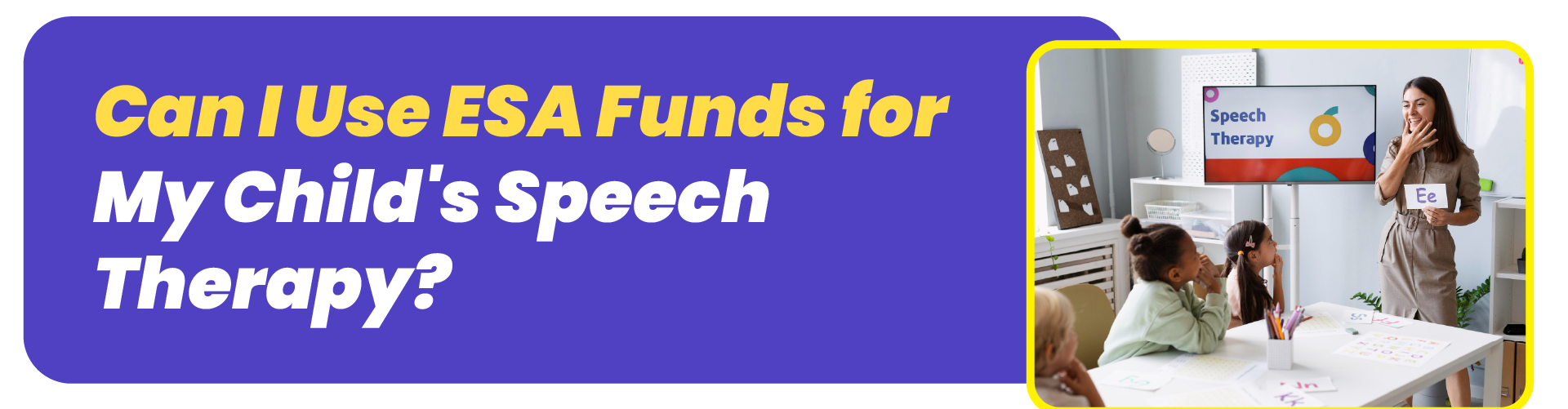


Your child qualifies for an Education Savings Account, and you’re staring at a list of approved expenses, wondering: Can I really use this for the therapy my child needs?
The short answer is yes, in most states with ESA programs. But understanding how to maximize these funds for speech therapy, educational therapy, or other specialized services requires knowing what’s covered, what works, and how to make informed choices.
What Are ESA Funds and Who Can Use Them?
Education Savings Accounts (ESAs) are state-funded accounts that give parents direct control over their child’s education dollars. As of 2024, 12 states offer ESA programs, with funding ranging from $5,000 to over $10,000 per student annually, according to EdChoice’s policy tracker.
Most ESA programs explicitly allow funds for therapeutic services when they support educational outcomes. This includes:
- Speech-language therapy
- Occupational therapy
- Educational therapy (for reading, math, executive function)
- Behavioral therapy related to learning
The key requirement: services must be education-related, not purely medical.
What Does Research Say About These Therapies?
Speech Therapy Works, and Early Intervention Matters
Research from the American Speech-Language-Hearing Association shows that 70-80% of preschoolers with language delays who receive therapy demonstrate significant improvement. A 2023 systematic review in the Journal of Speech, Language, and Hearing Research found that intensive speech intervention (2-3 times weekly) produced measurable gains within 6 months for school-age children with articulation and language disorders.
The catch? Timing matters. Children who start speech therapy before age 5 show better long-term outcomes than those who begin later, according to NIH-funded longitudinal studies.
Educational Therapy Fills a Real Gap
Educational therapy—targeted instruction for learning disabilities like dyslexia or dyscalculia—has strong evidence behind structured approaches. The Institute of Education Sciences reports that students receiving evidence-based interventions like Orton-Gillingham for dyslexia showed reading gains equivalent to 6-12 months of progress in just 16 weeks.
What’s important: not all “educational therapy” is created equal. Programs grounded in the Science of Reading or evidence-based math interventions consistently outperform generic tutoring.
Recommended Reading: No Zero Grading Policy: Future of Education
How to Use Your ESA Funds Wisely
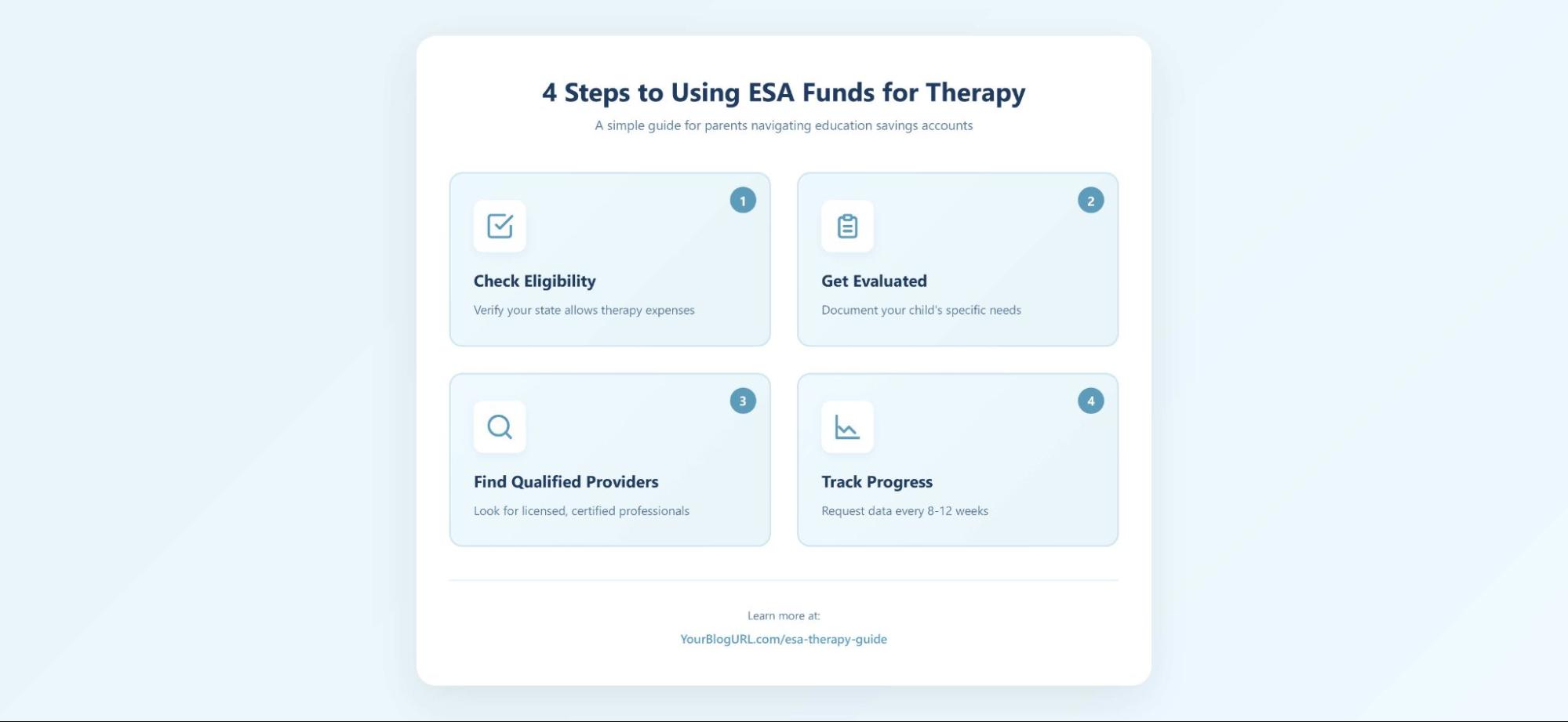
1. Verify Your State’s Rules
Start with your state’s ESA portal to confirm therapy expenses are covered. States like Arizona, Florida, and West Virginia explicitly list therapeutic services; others may require pre-approval.
2. Choose Qualified Providers
Look for licensed professionals:
- Speech-language pathologists (SLPs) with ASHA certification
- Educational therapists certified through the Association of Educational Therapists (AET)
- Occupational therapists (OT) licensed in your state
Ask providers if they accept ESA funds directly or if you’ll need to pay and submit receipts for reimbursement.
3. Request Evidence-Based Approaches
During consultations, ask: “What specific method or program do you use, and what does research say about it?” Red flag: vague answers or proprietary programs with no published outcomes.
4. Track Progress with Data
Every 8-12 weeks, request progress reports showing measurable improvement (test scores, speech samples, work samples). If progress stalls after 3-4 months, consider seeking a second opinion.
What You Can Do This Week
- Check your state’s ESA portal for a list of approved therapy expenses and required documentation
- Request evaluations from your child’s school or a private provider to identify specific needs
- Research providers using ASHA’s ProFind tool (for SLPs) or the AET directory (for educational therapists)
- Schedule consultations and ask about their approach, timeline, and expected outcomes
Helpful Resources for Parents
- EdChoice ESA Policy Tracker: https://www.edchoice.org/school-choice/types-of-school-choice/education-savings-account/
- ASHA ProFind (Find a Speech Therapist): https://www.asha.org/profind/
- Association of Educational Therapists Directory: https://www.aetonline.org/find-an-educational-therapist
- What Works Clearinghouse (Evidence-Based Interventions): https://ies.ed.gov/ncee/wwc/
- Understood.org (Learning Disabilities & Therapy Options): https://www.understood.org/en/articles/types-of-specialists-who-help-kids-with-learning-disabilities
Moonpreneur is on a mission to disrupt traditional education and future-proof the next generation with holistic learning solutions. Its Innovator Program is building tomorrow’s workforce by training students in AI/ML, Robotics, Coding, IoT, and Apps, enabling entrepreneurship through experiential learning.