




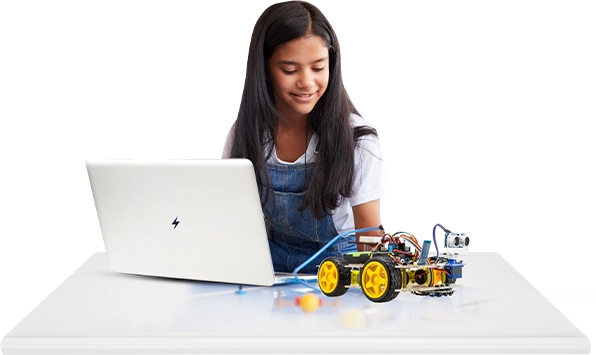

Educational methods have changed dramatically since the Fourth Industrial Revolution began in the 1990s; today, learning incorporates smart technology, artificial intelligence (AI), and robotics into everyday lessons. Classrooms are now being transformed into laboratories for exploring and developing new ideas and technologies at an advanced rate and right age to introduce your kid to robotics..
Robotics classes for children epitomize how schools deliver hands-on learning experiences. Instead of learning just theory, children learn through hands-on experiences by building and creating robots as well as solving real problems.
According to McKinsey Digital research, nearly 60 percent of future jobs will have some degree of automation associated with them. This indicates that there is an ever-growing demand for individuals who are adept at interacting with robotics, AI, and other emerging technologies. As a result, companies from all industries are in search of top talent who can successfully thrive and grow in today’s technology-rich environment.
Robotics education is no longer just a hobby; providing opportunities for children to explore robotics will enable them to develop essential skills that they will continue to use throughout their lives, including critical thinking, problem-solving, creativity, and technological literacy.
A Question Every Modern Parent Is Asking?
If you are a parent these days, it is likely that you have heard of robotics classes, coding workshops, STEM labs, or even AI programs for children. Your child might have come home telling you about how they built a robot, or you may have seen a robotics kit for sale online. You could be wondering:
What age is appropriate to introduce robotics to my child?
This is a good question—but the answer is not just a number.
Robotics has nothing to do with making engineers when your child is 5 years old, rather developing skills associated with solving problems, creativity, logical thought, and confidence (which will be useful no matter what career they follow).
Our guide will help you break down:
- The best age to start with robotics
- Robotics at various ages
- Cognitive readiness levels
- How robots will benefit your child at each of the above levels
- Indicators of readiness
- Errors frequently made by parents introducing robotics
- How to properly introduce robotics to your child.
Age-by-Age Guide to Introducing Robotics
Ages 4–6: Foundations Through Play
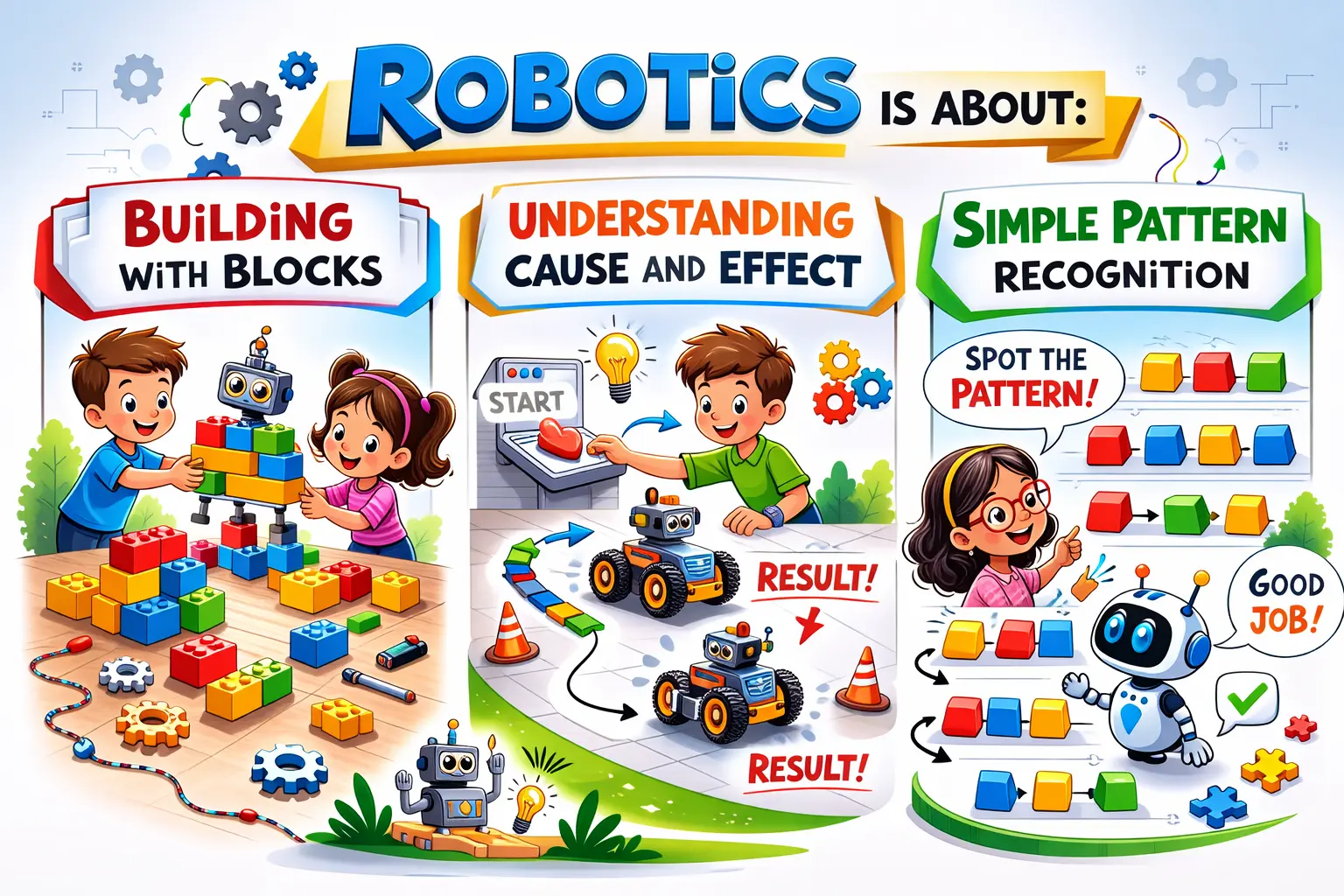
Kids between four and six are naturally curious explorers of the world around them. When introducing robotics to this age group, it is best done as a form of play rather than an engineering class. Young kids learn through hands-on experience with activities that develop both their imagination and their motor skills. For example, having children build blocks, use simple snap-together kits, or use button-based coding toys will help them understand the basics of direction, sequencing, and cause and effect.
When they press a button and their robot moves forward, they begin to understand that there is a cause and effect between action and result. The understanding of cause and effect is what will create the foundation of logical thinking as they mature. At this age, complex coding or screen-based work is not necessary. Tactile, physical interaction is enough to develop coordination, creativity, and self-confidence.
The objective for this age group is not to “teach robotics” but rather to develop curiosity and a problem-solving mindset that will make it easier for them to take on structured robotics in the future.
Elementary Years (Ages 7–9): The Ideal Time to Start Structured Robotics
Structured robotics can be taught to children between the ages of 7 and 9, helping children develop their logical reasoning ability, multi-step instructions, and sequencing ability, therefore allowing robotics to be taught not only as simple button pressing but also through basic programming, motor/sensor building, and how systems interact.
The natural curiosity of children of this age causes them to ask more complex questions than before and enjoy learning how things can be improved or fixed. Getting children involved in robotics will allow them to try out new ideas, develop problem-solving skills, and build patience. Children who use guided kits/workshops/beginner programs will develop a sense of pride in their accomplishments when their robots are built and start working correctly, as well as have a longer-term interest in robotics.
Pre-Teen Stage (Ages 10–12): Developing Real Skills and Confidence
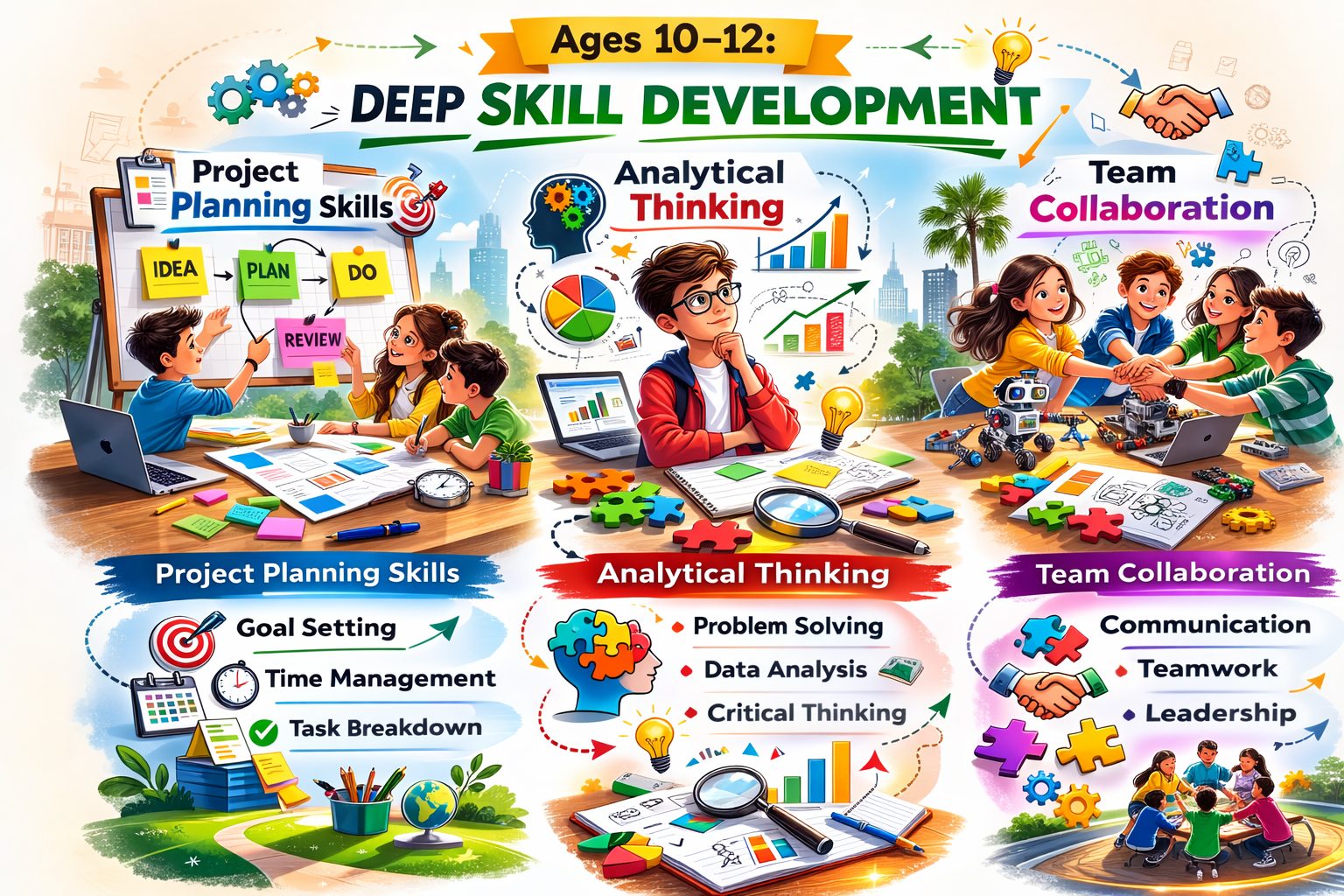
From about 10 to 12 years of age, children can learn at a much deeper level. The analytical skills of children greatly improve around this age, enabling them to understand many more complex ideas and concepts such as sensors, loops in programming, and mechanical design. At this stage, children will be excited about creating projects that solve problems as opposed to simply putting together parts—for example, a robot that will follow a line, a robot that avoids obstacles, or an automation model. Competitive programs such as FIRST Robotics Competition can demonstrate how robotics can promote teamwork, innovation, and determination.
Children in this age group will gain tremendously with project-based education. They are much more confident when they create a project from the beginning and then see it work/come to life. Children at this age will begin to see the links between robotics and real-life examples—what automation creates in the lives of everyday people.
There is tremendous potential at this age regarding skill development.
Ages 13–16: Advanced Robotics & Career Pathways
As students age into their adolescent years, many will start to look for ways to incorporate their skills into future careers. Many teenagers can now grasp sophisticated concepts related to electronics, programming languages, and even introductory-level artificial intelligence. Students may also work with development platforms such as Arduino, build autonomous systems, or take part in hands-on automation projects in their everyday life.
Robotics will be a major tool in shaping students’ career choices. Not only do they have plenty of opportunities to get their hands on robots and robotics programming via competitions, but many of today’s large companies, such as SpaceX and Tesla, can serve as inspiration for students who are interested in innovative engineering-related fields.
Teenagers are beginning to think more analytically about ways that technology can solve real-world problems. Robotics is no longer viewed as an activity for them to play with but more of a way in which they can create solutions for others. As they continue to learn about and utilize robotics, they may create prototypes for their ideas, enter robotics competitions, or begin developing a plan for a future STEM-related academic path.
Finally, regardless of age, learning should always be enjoyable—not under pressure. Students should place greater importance on being encouraged instead of perfection.
Age-by-Age Guide to Introducing Robotics
There is no age when all kids can begin working with robots; however, there is a continuum of developmental stages during which children’s robotic experiences will grow.
Robotics for toddlers is based on play-based discovery, while kindergarten through fifth-grade children will often have more structured learning experiences that include sessions designed to engage both hands-on and visually with their robot-based projects.
As children transition into pre-teens, they will be ready to use robots to develop more advanced technical skills and use their creativity as they create innovative projects and prepare themselves for careers as teenagers.
For most parents who want to know when they should start formal robotic training for their children, that is typically at age seven, but the most important aspect of determining whether a child is ready to begin now or later is their level of curiosity combined with their ability to demonstrate patience while trying new things.
Here’s How to Tell if Your Children are in Love with Robotics!
Are you not sure if your children are into robotics? Fret not! Look for these signs, and you will easily get to understand if your children are already interested in robotics.
- Your kids have a knack for robotics games for kids and gadgets.
- They love talking endlessly about the latest gadgets and devices.
- They show curiosity as to how and why something is happening, especially when it comes to devices, robots, and modern technology.
- Your kids love participating in tech fests organized at school.
- They come up with solutions (or at least try) for technical issues at your home or workplace.
- They are big fans of cartoons and movies that revolve around robotics for children, AI, and modern technology.
Things Parents Should Not Do
One common mistake is to start with kits that are too advanced, which can be frustrating. Another is only focusing on coding and not the creative and mechanical parts of robotics. Robotics is a field that combines design, engineering, electronics, and creativity.
It’s also important not to compare your child to other kids. There are two valid ways for kids to start: some start at six and some at ten. The goal is steady growth, not pressure right away.
Conclusion
Consider your child’s interest in robots rather than their chronological age as the key factor in determining when to start using robotic toys with them. He will gain more from learning through play than through pressure if he is learning through excitement.
Robotic systems offer your child the opportunity to learn how to think rather than simply learning how to create physical products. He will develop the capacity to be creative, resilient, cooperative, and confident, and the ability to work together with other children.
The age or chronological year in which you introduce your child to robotics (five years, seven years, or twelve years) does not matter as much as nurturing their curiosity and being as supportive as you can in helping them along their journey.
Moonpreneur is on a mission to disrupt traditional education and future-proof the next generation with holistic learning solutions. Its Innovator Program is building tomorrow’s workforce by training students in AI/ML, Robotics, Coding, IoT, and Apps, enabling entrepreneurship through experiential learning.
Update: This article was last updated on 26th February 2025 to reflect the accuracy and up-to-date information on the page.


















Not robotics, but my kid, addicted to their phone. Why is that?
Take them to the future! Emphasize practical uses of robots in space exploration, health, or even daily living. They could be intrigued by a robot cook.
Great article! It’s important to introduce robotics early to spark creativity and problem-solving skills.