


 Attend our in-person Robotics & Math




Making games may not seem connected to math, but they actually work together like good teammates. Game development, where games are created, uses a lot of math. But, how much math do game developers need? This article explores why knowing some math is important for game development and how it can be useful for different jobs in the gaming world. In short lets explore in details the Ideal Math Proficiency Level for Game Developers.
| Ideal Math Proficiency Level for Game Developers: | ||
|---|---|---|
| Stages | Maths | Role |
| Stage 1 | Algebra & Geometry | 1. Algebra for problem-solving and game rules 2. Geometry for 3D settings, controlling character movement, and keeping characters from colliding. |
| Stage 2 | Trigonometry (trig), calculus & linear algebra | 1. Trigonometry for angles and movements in games 2. Calculus for physics and fancy graphics 3. Linear algebra for transforming things and working with 3D graphics. |
| Stage 3 | Differential equations, numerical methods, & fancy probability theory | 1. Differential equations for simulating tricky things. 2. Numerical methods for solving intricate problems 3. Probability theory for making smart computer characters look real |
What kind of math should game developers know: Steps
1. Starting Level:
An ideal math proficiency level for game developers is to know some basic math at the primary level. This means understanding operations like addition, subtraction, multiplication, and division. It’s like the foundation of a building. Game developers also need to know algebra, which uses letters to solve problems, and geometry, which helps create game elements like characters and environments.
Algebra helps with making game rules and solving problems, while geometry is used for creating 3D environments, determining how characters move, and preventing them from bumping into things. So, knowing these basic math ideas is important for dealing with in-game money, scores, and basic calculations.
2. Next Level
Once you’ve got the basics, you can move on to a bit more advanced math. This includes trigonometry (trig), calculus, and linear algebra.
Trigonometry helps with things like angles and movements in games, calculus is handy for physics and fancy graphics, and linear algebra is all about transforming things and working with 3D graphics.
Developers who know this kind of math can solve more complex problems, add cool features to games, and make them work better. This is especially important for those who work on the essential parts of games like graphics and physics engines.
3. Expert Level:
Not every game developer needs to be a math genius, but if you’re working on really high-tech graphics, physics, or smart computer opponents, then advanced math is your friend. This includes things like differential equations, numerical methods, and fancy probability theory.
Differential equations help simulate tricky things like fluid movements in the game. Numerical methods solve problems that regular math can’t, and probability theory is used to make smart computer characters act more like real people.
4. Different Jobs, Different Math:
Not everyone in game development needs to be a math wizard. Different jobs require different math skills. Artists, for example, might focus more on making things look good rather than complex math.
On the other hand, programmers dealing with physics or graphics need a deeper math understanding.
The key is teamwork. A game is made by a team with different skills. While one person dives deep into math for graphics, another might focus on making things look cool. Working together brings out the best in a game.
5. Tools to Help:
In today’s game-making world, developers have helpful tools and libraries that do a lot of the hard math work for them. Engines like Unity and Unreal and libraries such DirectX and OpenGL have readymade functions that make complicated math easier.
But, knowing the basics is still important. If a developer understands the math behind the tools, they can make better choices, fix problems faster, and make games run smoother.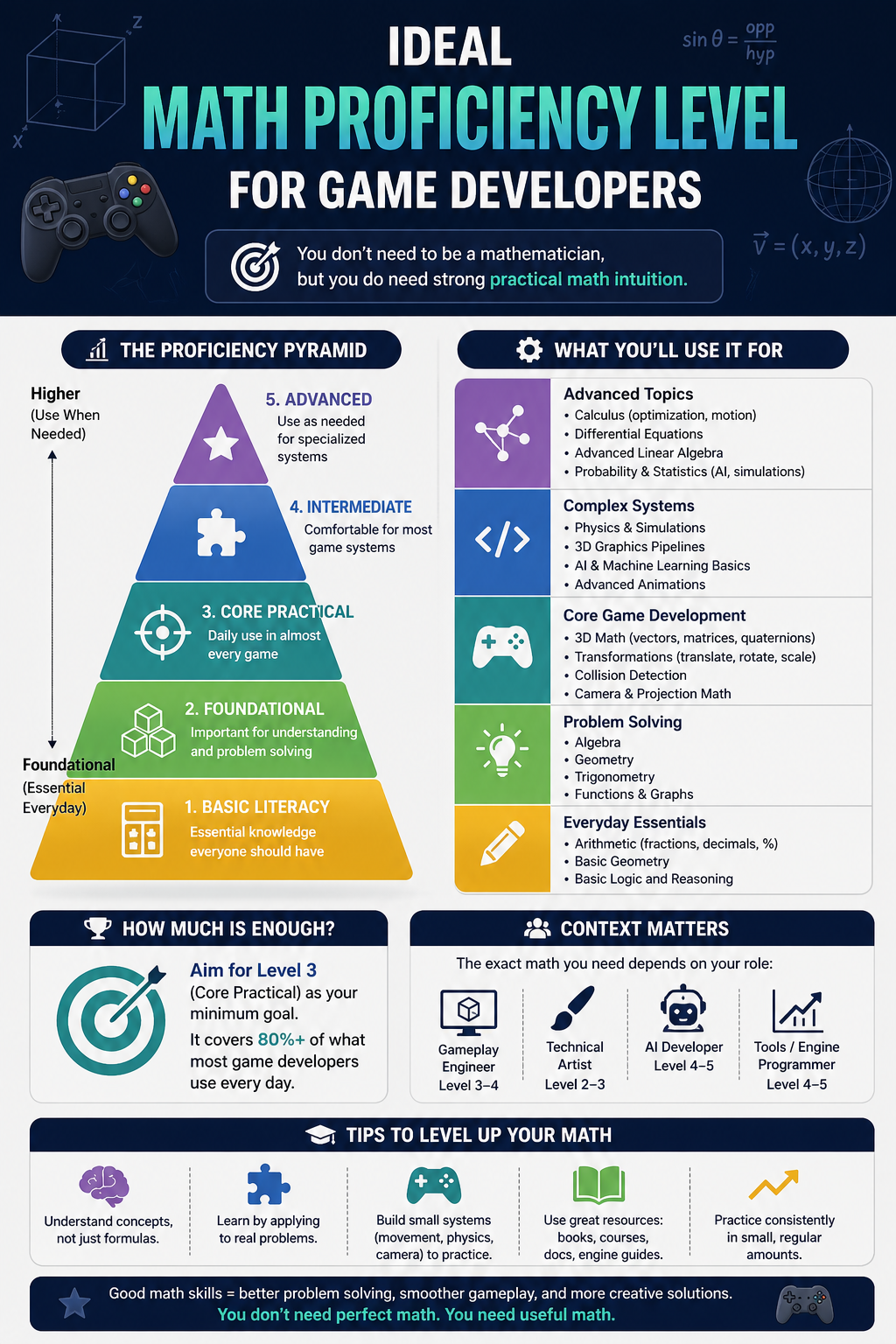
Conclusion:
Hope we helped satisfy your curiosity about what the ideal math proficiency level for game developers is, remembering that the amount of math game developers need depends on the job. Basic math is a must, but the level of math knowledge can vary. Developers should find a good balance between knowing enough math and using it practically. Teaming up with others and using tools smartly helps create awesome games.
Whether you’re just starting or have been making games for a while, understanding math in game development opens doors for creating amazing and creative games in this always-changing world.
Want to excite your child about math and sharpen their math skills? Moonpreneur’s online math curriculum is unique as it helps children understand math skills through hands-on lessons, assists them in building real-life applications, and excites them to learn math.
You can opt for our Advanced Math or Vedic Math+Mental Math courses. Our Math Quiz for grades 3rd, 4th, 5th, and 6th helps in further exciting and engaging in mathematics with hands-on lessons.
FAQS:
1. How much math do you really need to know to program a game?
Ans. You need basic math, algebra, and some geometry. Advanced math depends on your role, especially for graphics, physics, or AI.
2. What’s the highest level of math required for game development?
Ans. The highest level of math in game development is usually advanced linear algebra, calculus, and physics- mainly for graphics, simulations, and game engines.
3. Do game studios hire people based on their math knowledge alone?
Ans. They prioritize programming skills. problem-solving and project experience, like games or a portfolio. Math helps, especially for graphics or physics roles, but it’s just one part of the skill set.
4. Does game development require coding?
Ans. Yes, game development usually requires coding, but not always for every role












My son wants to be a game developer but lacks interest in math.
You can try enrolling him in game dev or math courses to make him interested in learning.