

You just logged into your ESA account. The balance looks good. But now you’re staring at 47 browser tabs- curriculum reviews, manipulative sets, educational games—and you still don’t know what to buy.
If this sounds familiar, you’re not alone. Over 100,000 Arizona families are navigating Empowerment Scholarship Accounts this year, and the question isn’t just “what can I buy?” It’s “what actually works?”
Here’s what the research says, and how to spend smarter.
Why Physical Learning Tools Matter More Than You Think
Traditional wisdom says education happens in textbooks. Science disagrees.
The National Council of Teachers of Mathematics has championed manipulatives, physical objects like base-ten blocks or fraction tiles, for decades. A 2025 study on multisensory learning found that combining tactile, visual, and auditory inputs significantly improved retention and reduced learning anxiety compared to textbook-only approaches.
When your child physically moves a block to solve a problem, they’re building concrete mental maps that abstract numbers can’t provide. This isn’t about making learning “fun”, it’s about making it stick.
The key: Not all hands-on tools deliver equal results. High-quality manipulatives align with specific learning objectives and come with clear instructional guides for parents.
What Parents Are Actually Buying
Arizona’s ESA program offers a window into real spending patterns. Beyond private school tuition, families are investing ESA funds in:
- Science equipment (microscopes, chemistry kits)
- Educational technology subscriptions and coding tools
- Physical education equipment for home P.E. requirements
This shift reflects a broader truth: home education works best when it mirrors the multisensory, varied approach of excellent classrooms, not just replicating desk work at the kitchen table.
Your Three-Step Buying Framework
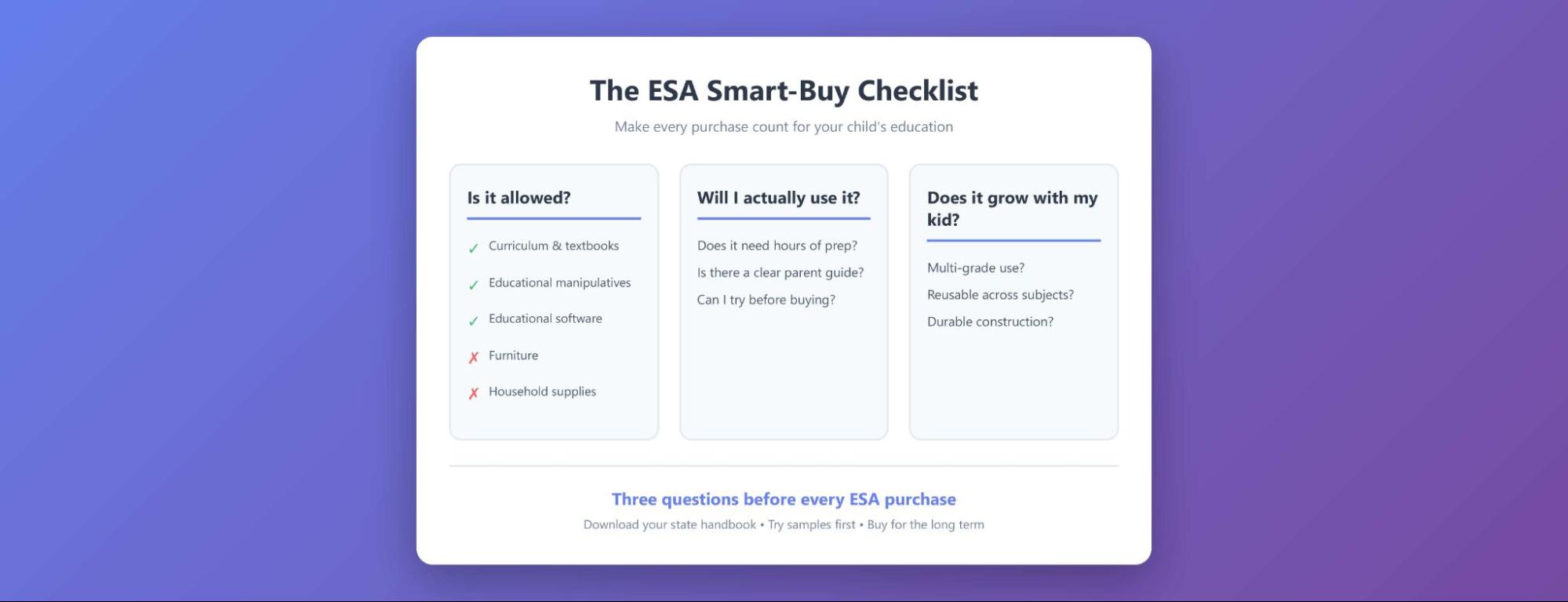
Before clicking “purchase,” run each item through this filter:
1. Verify It’s Actually Allowed
Every state ESA program maintains a detailed handbook of approved expenses. Generally allowed: curriculum, textbooks, educational manipulatives. Typically prohibited: furniture, household items, basic consumables.
The gray zone? Educational board games, art supplies, or specialized equipment. Check your state’s specific guidelines before assuming.
Resource: Access your state’s ESA handbook through Arizona’s ESA Program or Florida’s Family Empowerment sites.
2. Choose “Open-and-Go” Over Prep-Heavy
Unless you’re a former teacher, avoid curricula requiring hours of preparation. Look for materials labeled “parent-led” or “open-and-go” with clear instructor guides.
This isn’t about taking shortcuts—it’s about sustainability. Research on homeschool persistence shows parent burnout is a primary factor in program abandonment.
3. Prioritize Multi-Year Value
High-quality manipulatives grow with your child. Magnetic tiles teach geometry to first-graders and engineering principles to middle schoolers. Pattern blocks work for both basic shapes and advanced fraction concepts.
The math: A $60 manipulative set used across four grade levels costs $15 per year. A $200 single-grade curriculum you’ll never reuse costs exactly that.
What This Means for You This Week
Three concrete actions:
- Audit one struggling subject. If your child fights with abstract concepts (especially math), identify one physical manipulative that addresses that specific skill. Fraction tiles for division. Base-ten blocks for place value.
- Download your current handbook. Log in to your ESA portal (ClassWallet, Step Up, etc.) and locate the 2025–2026 “Disallowed Expenses” list. Bookmark it. This prevents rejected reimbursements.
- Request sample units before committing. Most quality publishers offer free trial units. Use materials for two weeks. If they cause tears—yours or theirs—skip the full purchase.
The goal isn’t to perfect every choice. It’s building a learning environment where your child can actually engage with ideas—not just read about them.
Additional Resources:
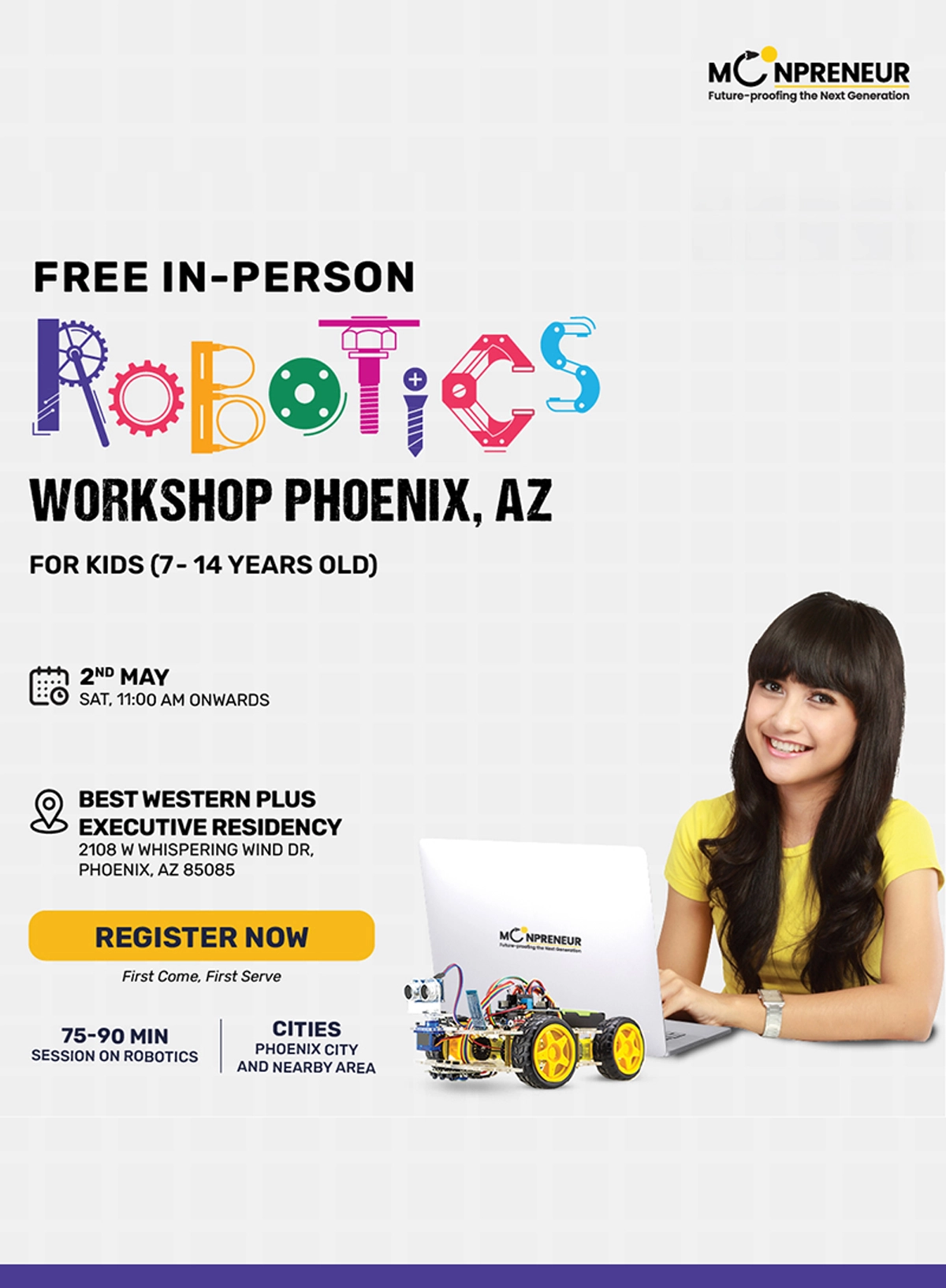
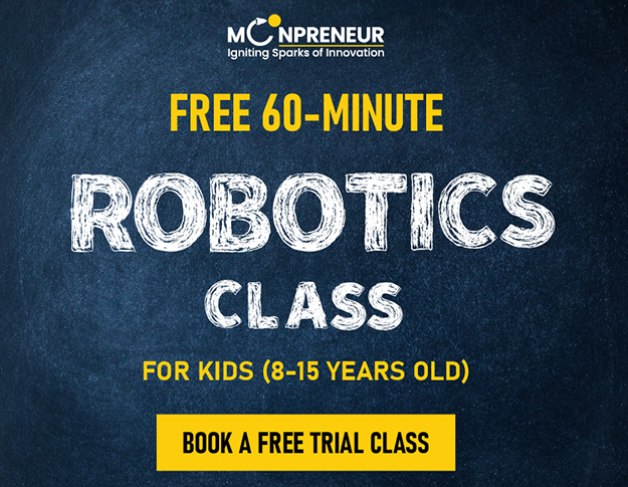
Moonpreneur is on a mission to disrupt traditional education and future-proof the next generation with holistic learning solutions. Its Innovator Program is building tomorrow’s workforce by training students in AI/ML, Robotics, Coding, IoT, and Apps, enabling entrepreneurship through experiential learning.