


Update: This article was last updated on 17th March 2026 to reflect the accuracy and up-to-date information on the page.
Mathematics as an expression of the human mind reflects the active will, the contemplative reason, and the desire for aesthetic perfection. Its basic elements are logic and intuition, analysis and construction, generality and individuality.
Richard Courant, German-American mathematician
“Mathematics is the language in which God has written the universe.”
— Galileo Galilei
Introduction: Mathematics, or math for short, might sound like a big word, but it's like a friendly helper that makes everyday life more exciting. From counting toys to cooking delicious meals, useful application of math in daily life show how math is always by our side, making things perfect. Not sure how to help your child with math at home? In this journey into the world of math, we'll explore how it plays a super cool role in our daily adventures.
1. Counting and Numbers
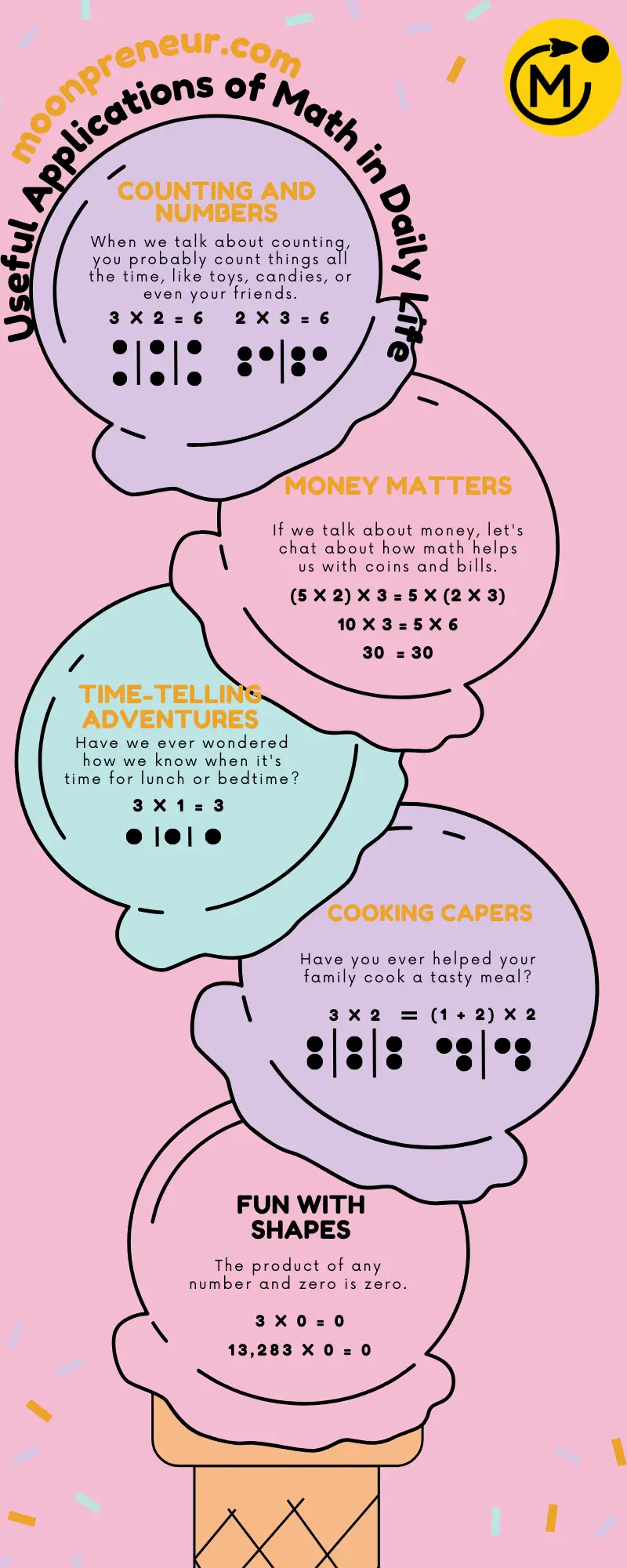
The most fundamental application of mathematics in everyday life is counting. Whether you’re tracking grocery items, reading page numbers, or splitting a dinner bill, numbers are at the core of every interaction.
Children naturally start with counting — and that instinct grows into a skill that follows us throughout life. Number sense forms the base of all other maths in daily life concepts.
Recommended reading: Developing a Deeper Understanding of Math Concepts
QUICK FACT
The average adult makes over 35,000 decisions per day, many involving basic number reasoning.
2. Managing Money
One of the most important real-life applications of mathematics is personal finance. Budgeting, calculating discounts, splitting expenses, and saving for goals all require arithmetic and planning skills.
For example: if you earn ₹15,000/month and spend ₹11,000, mathematics tells you exactly how long it’ll take to save up for a ₹20,000 laptop — about 5 months. This is mathematics in day to day life at its most practical.
Recommended reading: Math AI in Education: Changing the Way of Learning
DID YOU KNOW?
People who regularly use mental maths for budgeting are 3x more likely to hit their savings goals, according to financial literacy research.
3. Telling Time & Planning
Mathematics in everyday life includes something as simple as reading a clock. Calculating travel time, scheduling tasks, and managing deadlines are all exercises in subtraction, addition, and proportion.
Planning a day, a trip, or even a meeting uses mathematics, from calculating how early to leave to figuring out time zones when calling internationally.
4. Cooking & Measurements
Recipes are a perfect example of mathematics in everyday life. Measuring ingredients, adjusting portions for more guests, or converting grams to cups all involve fractions, ratios, and multiplication.
If a cake recipe serves 4 and you need to serve 10, the application of mathematics helps you scale every ingredient proportionally, no guesswork, just maths.
TRY THIS
Next time you cook, try doubling or halving a recipe yourself; it’s a great real-life application of fractions and ratios.
5. Shapes & Spatial Thinking
Geometry is one of the most visible applications of mathematics. Arranging furniture, choosing the right frame size, packing a suitcase efficiently, or reading a map all rely on spatial reasoning.
Engineers, architects, and even interior designers use these exact principles at a larger scale, making geometry one of the most impactful real-life applications of mathematics in professional life.
Recommended reading: Top 5 Middle School Math Projects You Should Try
6. Shopping & Discounts
Every shopping trip is an exercise in mathematics in day-to-day life. Calculating 20% off, comparing price per unit, or estimating total cart value before checkout, these are all instant mental calculations we perform.
Understanding percentages and ratios helps you make smarter purchasing decisions and avoid being misled by “deals” that aren’t really saving you money.
7. Maths in Daily Life Project Ideas
If you’re looking for maths in daily life project ideas for school or home, here are some engaging options:
▸ Track your spending: Record daily expenses for a week and create a simple bar chart. Covers addition, averages, and data representation.
▸ Cook a new recipe: Pick one that serves 6 and scale it down to 2. Covers fractions and ratios.
▸ Map your commute: Calculate the fastest route using distance and time. Covers speed, distance, and time equations.
▸ Savings goal planner: Set a goal, calculate weekly savings needed, and track progress. Covers division, multiplication, and simple interest.
TAKEAWAY
The best maths in daily life project ideas connect abstract concepts to real decisions, that’s what makes maths click for learners of all ages.
Mathematics in everyday life is everywhere Once you see it, you can't unsee it. From budgeting to baking, every moment is a chance to apply and strengthen your maths skills.
Conclusion
Certainly, Math is not a scary subject but a fantastic tool that makes our everyday life awesome! Just remember the next time you’re playing with toys, helping in the kitchen, or solving puzzles, that math is right there with you, adding a sprinkle of magic to every moment! Embrace the math adventure and let the numbers make your daily life super cool.
Want to excite your child about math and sharpen their math skills? Moonpreneur’s online math curriculum is unique as it helps children understand math skills through hands-on lessons, assists them in building useful applications of math in daily life, and excites them to learn math.
You can opt for our Advanced Math or Vedic Math+Mental Math courses. Our Math Quiz for grades 3rd, 4th, 5th, and 6th helps in further exciting and engaging in mathematics with hands-on lessons.