
Mental math is not just about speed – it’s about seeing patterns. One of the most powerful and elegant tricks used by math experts is multiplying numbers close to 100 without long calculations. Whether you’re a student preparing for exams, a competitive test aspirant, or simply someone who enjoys quick math, this technique can dramatically improve your accuracy and confidence.
Here, we’ll explore the expert method step by step, understand why it works, and practice it with clear examples.
Why Focus on Numbers Close to 100?
Numbers like 96, 97, 102, 105 are very close to 100, which is a base number. Multiplying such numbers using traditional methods takes time, but when you relate them to 100, the calculation becomes surprisingly simple.
This approach is widely used in Vedic Mathematics and mental calculation techniques because it:
- Reduces large multiplications into small additions/subtractions
- Minimizes chances of error
- Saves time in exams and interviews
The Core Idea Behind the Trick
The expert method is based on two simple steps:
- Find how far each number is from 100
- Use cross addition and simple multiplication
Recommended reading: Order of Operation in Math
Let’s understand this with examples.
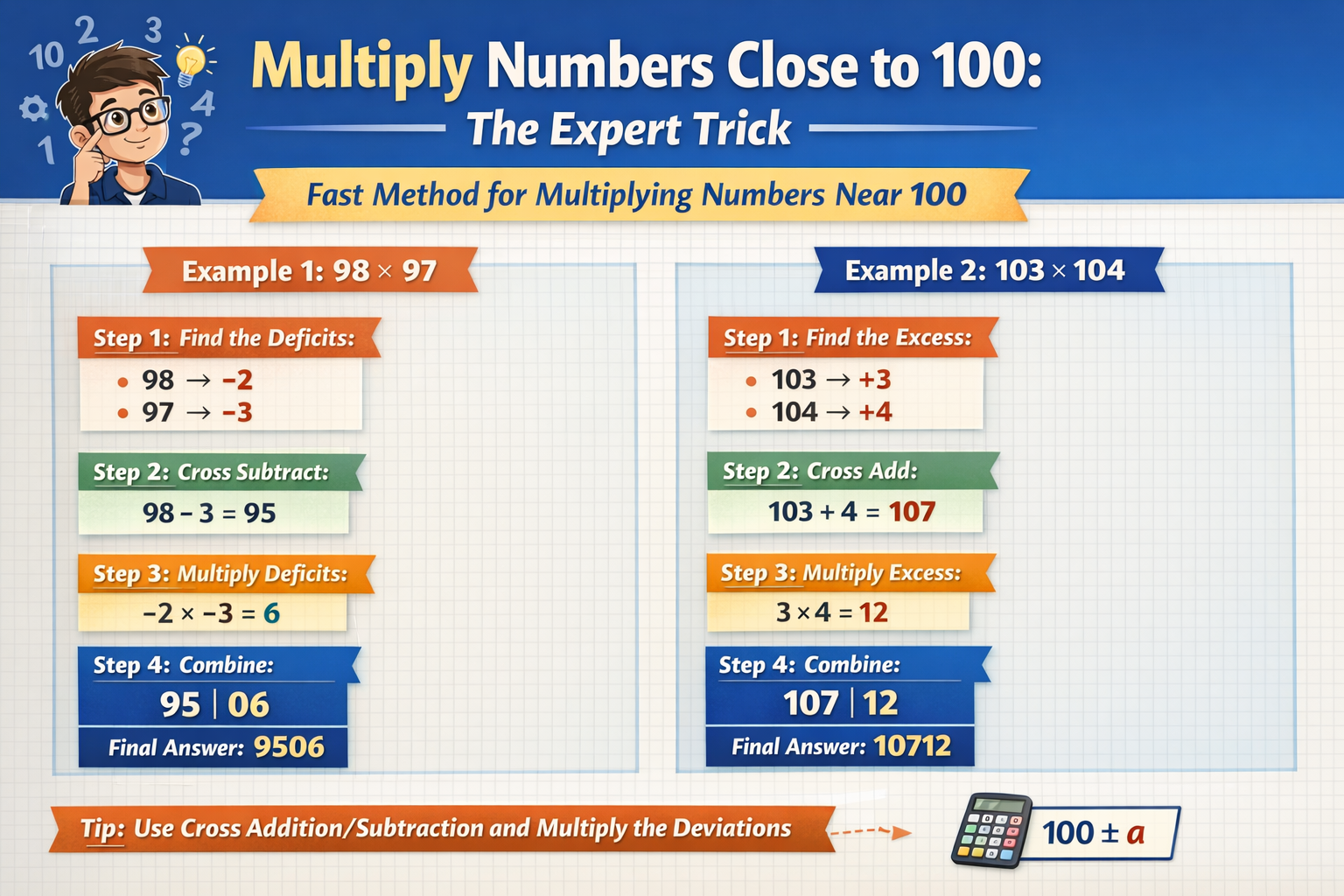
Case 1: Both Numbers Less Than 100
Example: 98 × 97
Step 1: Find the deficits from 100
- 98 is 2 less than 100 → −2
- 97 is 3 less than 100 → −3
Step 2: Cross subtract
- 98 − 3 = 95
(or 97 − 2 = 95, both give the same result)
Step 3: Multiply the deficits
- (−2) × (−3) = 6
Step 4: Combine the results
- Final answer = 9506
So,
98 × 97 = 9506
No long multiplication required!
Case 2: Both Numbers Greater Than 100
Example: 103 × 104
Step 1: Find the excess over 100
- 103 → +3
- 104 → +4
Step 2: Cross add
- 103 + 4 = 107
Step 3: Multiply the excess values
- 3 × 4 = 12
Step 4: Combine
- Final answer = 10712
So,
103 × 104 = 10712
Case 3: One Number Less Than 100, One Greater Than 100
Example: 98 × 103
Step 1: Deviations from 100
- 98 → −2
- 103 → +3
Step 2: Cross add/subtract
- 98 + 3 = 101
(or 103 − 2 = 101)
Step 3: Multiply deviations
- (−2) × 3 = −6
Step 4: Combine carefully
- Final answer = 10094
So,
98 × 103 = 10094
Here, attention to signs is important—but the process remains simple.
Why This Method Works (Expert Insight)
Mathematically, this technique is based on:
(100+a)(100+b) = 100(100+a+b)+ab
By breaking numbers into 100 ± a, you reduce a big multiplication into:
- One easy addition/subtraction
- One small multiplication
Experts rely on this structure to calculate faster and more reliably.
Recommended reading: Vedic Sutra for Multiplication in Math
Tips to Master This Technique
- Always keep two digits on the right side (because base is 100)
- Practice with nearby numbers like 94×96, 105×107, etc.
- Start slow, then increase speed
- Verify answers initially to build confidence
Curious about the ‘how’ and ‘why’? Watch the full explanation here:
Final Thoughts
Multiplying numbers close to 100 doesn’t have to be intimidating. With this expert method, you can solve such problems mentally in seconds. It’s not magic—it’s pattern recognition and smart math. The more you practice, the more natural it feels. Soon, you’ll find yourself calculating faster than a calculator!
Want to excite your child about math and sharpen their math skills? Moonpreneur’s online math curriculum is unique as it helps children understand math skills through hands-on lessons, assists them in building real-life applications, and excites them to learn math.
You can opt for our Advanced Math or Vedic Math+Mental Math courses. Our Math Quiz for grades 3rd, 4th, 5th, and 6th helps in further exciting and engaging in mathematics with hands-on lessons.
FAQs
- Is this method applicable only for numbers close to 100?
This method works best for numbers close to 100, but it can also be extended to other base numbers like 10, 50, 1000, etc. However, using 100 as a base is the easiest and most common for beginners. - Do I need to learn Vedic Mathematics to use this technique?
No, you don’t need formal knowledge of Vedic Mathematics. This technique is simple, logical, and can be learned by anyone with basic addition and multiplication skills. - How can I avoid mistakes while using this method in exams?
Always double-check the signs (plus or minus) while multiplying the deviations and ensure you keep two digits on the right side of the final answer since the base is 100. Regular practice helps eliminate errors.