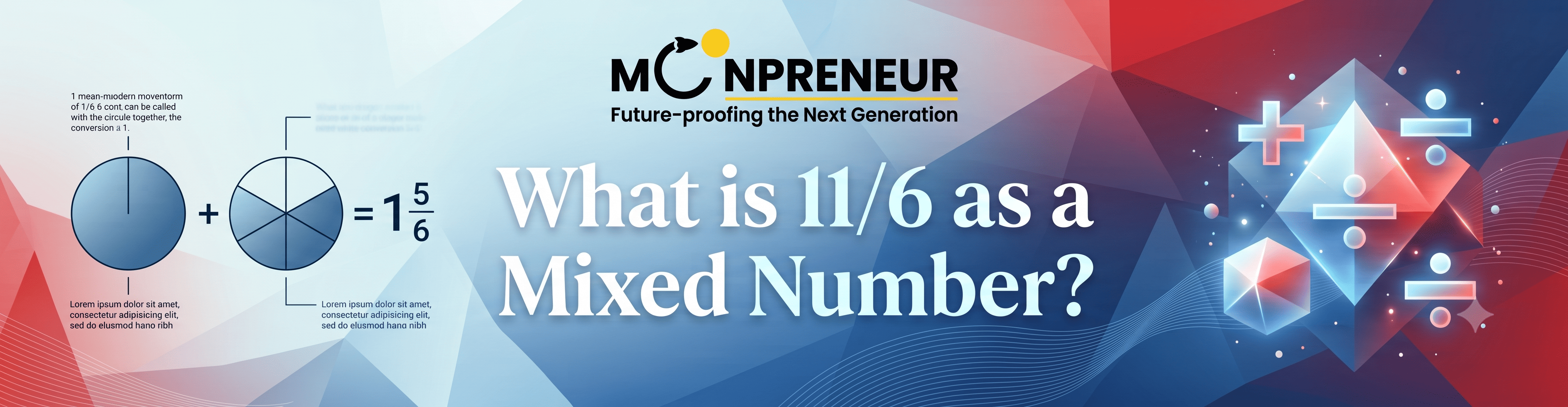

Fractions have a funny way of showing up right when you least expect them— splitting a pizza, measuring flour for a cake, or solving a math worksheet. If you've ever paused and asked yourself, “What is 12/5 as a mixed number?” you're in exactly the right place.
By the end, you'll know the answer and understand exactly why it works.
What Does “Mixed Number” Even Mean?
Before we tackle 12/5 as a mixed number, let's get your fraction vocabulary straight. In the world of fractions, there are two main characters:
The top number (numerator) is smaller than the bottom number (denominator).
The numerator is equal to or larger than the denominator. This means the value is 1 or more.
🧩 So, What Is a Mixed Number?
A mixed number takes an improper fraction and rewrites it as a whole number plus a proper fraction, like 2 ⅔.
It's the same value, just written in a more readable way. Think of it as translating fraction-speak into everyday language: instead of saying “twelve fifths,” you can say “two and two-fifths.”
✏️ Write 12/5 as a Mixed Number: The Step-by-Step Method
Ready to actually write 12/5 as a mixed number? Grab a pencil and follow along. The whole process boils down to one simple operation: division.
Divide the Numerator by the Denominator
In the fraction 12/5, the numerator is 12, and the denominator is 5. Divide 12 by 5:
That quotient, the “how many times 5 fits into 12” number, becomes the whole number part of our mixed number.
The Remainder Becomes the New Numerator
5 goes into 12 two full times (2 × 5 = 10), leaving 2 left over. That leftover amount, 2, becomes the numerator of our mixed number's fraction.
Keep the Same Denominator
The denominator never changes during this conversion. Since we started with fifths, we stay in fifths. So the fractional part is 2/5.
Put It All Together
Combine the whole number from Step 1 with the fraction from Steps 2 and 3:
And there you have it! That's the complete answer to “What is 12/5 as a mixed number?” It's 2 wholes and 2/5, written properly as 2 ²⁄₅.
Why Does This Method Work?
It helps to understand the logic, not just the mechanics. The fraction 12/5 literally means “12 groups of one-fifth.” Since 5 fifths make one whole (5/5 = 1), we can bundle those twelve fifths into complete wholes:
- 5 fifths = 1 whole
- Another 5 fifths = another whole (2 wholes so far)
- That uses up 10 of our 12 fifths
- 2 fifths remain, unable to form another whole
So we end up with 2 complete wholes and 2/5 left over — visually, imagine two full pizzas plus two out of five slices from a third pizza. That mental picture is exactly what the mixed number 2 2/5 represents.
Double-Checking Your Work
Verify Your Answer
Turn your calculation into a quick confidence check!
Math feels much less scary when you can verify your own answer. To confirm that 2 2/5 is truly equal to 12/5, convert the mixed number back into an improper fraction using this quick formula:
💡 Plugging in our numbers:
Multiply
Whole number × Denominator: 2 × 5 = 10
Add the Numerator
Add the numerator: 10 + 2 = 12
Place Over the Denominator
Keep the original denominator: 12/5
2 2/5 = 12/5
We land right back where we started, which confirms our conversion was correct. This back-and-forth check is a great habit to build, especially before a test.
A Few More Examples for Practice
Build confidence by trying these conversions yourself.
Once you've mastered writing 12/5 as a mixed number, the same three-step process (divide, note the remainder, keep the denominator) applies to any improper fraction. Try these on your own, then check the answers below!
Notice a Pattern?
The whole number tells you how many times the denominator fits completely, and the remainder always becomes the new numerator sitting on top of the original denominator.
Conclusion
So, what is 12/5 as a mixed number? It’s 2 2/5 — two whole units plus two-fifths more. The trick to converting any improper fraction is always the same: divide, track the remainder, and hold onto your original denominator. Once that rhythm clicks, you’ll be able to write 12/5 as a mixed number — or convert any fraction like it — in just a few seconds, no calculator required.
Fractions aren’t obstacles; they’re just numbers wearing a disguise. Once you know how to unmask them, math gets a whole lot friendlier.
You can opt for our Advanced Math or Vedic Math+Mental Math courses. Our Math Quiz for grades 3rd, 4th, 5th, and 6th helps in further exciting and engaging in mathematics with hands-on lessons.