
The basis for developing solid math abilities is learning multiplication tables from 1-20. It does not matter if you’re a student, parent or teacher, knowing these multiplication tables will allow for faster and easier calculation. The use of multiplication tables can be found with school work as well as in your daily routine.
A common thought students have when memorizing multiplication tables is; it becomes increasingly difficult once you hit table 11 and beyond. In this article, you will discover some easy memory tricks, patterns, daily practice routines, and a complete understanding of the multiplication tables from 1-20. This information will make mastering the multiplication tables easy and fun to learn!
What Are Multiplication Tables?
Multiplication charts, often referred to as multiplication tables, are a way of tracking what happens when you multiply one number against another.
For example 2 multiplied by 3 equals 6.
The way we can make sense of the number 6 is by continuously adding the number 2 a total of (3) years;
2+2+2 = 6
Once a student learns their lunch money multiplication charts for numbers 1 through 20 they will have the ability to quickly calculate without the need to pull up an application on their cell phone in order to complete the task.
Why Is It Important To Learn Multiplication Tables To 20?
A student who has learned their multiplication tables 1-20 will have made it easier to complete any math-related problems they may encounter.
- Advantages Of Knowing All Multiplication Tables
- Faster calculations
- Improved mental arithmetic skills
- Easier to compute fractions and division
- Higher scores on exams
- Time savings when completing school assignments
Simple Tricks to Learn Tables 1 to 20
1. Start with Easy Tables
Learn small tables first:
- Table of 1
- Table of 2
- Table of 5
- Table of 10
These are the easiest tables to remember.
2. Learn Through Skip Counting
Counting up in 3s helps students learn the multiplication tables faster.
The Numbers in the table are as follows:
3, 6, 9, 12, 15
You will just add another 3 to each number.
3. Find Patterns in Tables
By looking at patterns in multiplication tables, the child will learn to have fun with arithmetic.
The table of 5 ends with either 0 or 5.
For example: 5, 10, 15, 20, 25
The Last digit in the table of 10 will always end with 0.
For example: 10, 20, 30, 40, 50
4. Use Repeated Addition
Multiplication is the same as adding together the same number a certain number of times. Therefore:
4+4+4=12
Therefore:
3 x 4 = 12
By using this method, children will have an easier time understanding the concept of multiplication.
5. Practise on a Daily Basis
Every day practice is how you can learn multiplication tables from 1-20 the quickest.
Easy Daily Schedule
Morning
- Two times in the morning read them out loud.
Afternoon
- Solve a multiplication problem set of ten during the afternoon.
Evening
- Practice reviewing the tables orally by memory
Even if you perform 10 Minutes of practice that will greatly benefit your ability to learn the tables 1 – 20.
Easy Tricks for Difficult Tables
Easy Ways to Remember Times Tables That Are Harder to Memorise
Trick For The 9 Times Table
If you add together both digits of the answer; you will always have the total of 9.
Example: 9×4=36
3+6=9.
Table of 11 Trick
When multiplying a single digit; just write down that digit twice to find the answer.
Example: 11 x 5 = 55.
1 to 20 Tables Photo
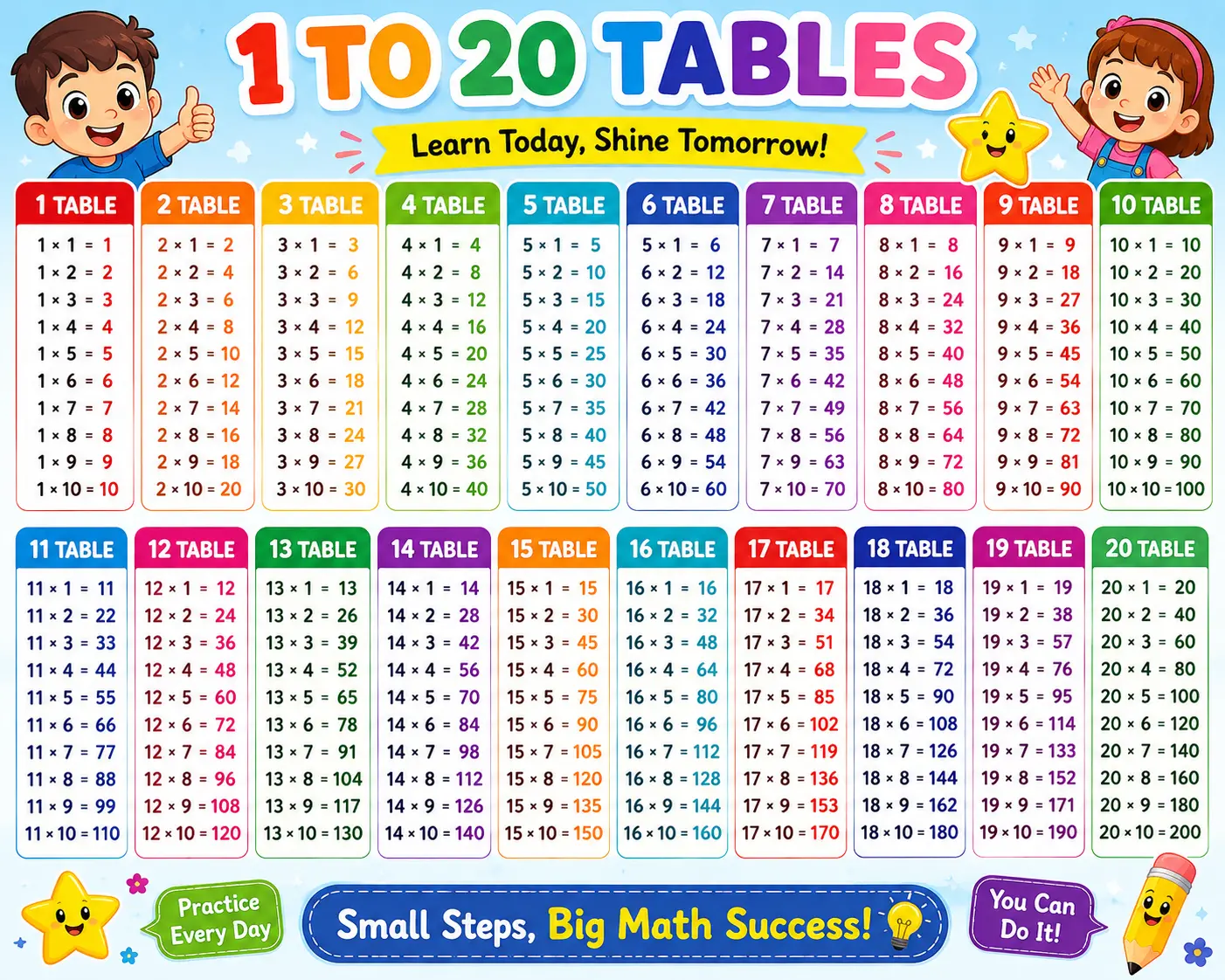
Different Ways to Learn Times Tables
When kids have fun when they learn, it makes learning easier for them.
- Fun Activities
- Flash Cards
- Songs with Times Tables
- Games
- Quiz Competitions
- Puzzles
These activities encourage memorization as well as give children confidence.
Common Mistakes Students Make
- Learning the Times Tables without Understanding
- Students should learn and understand the repeating patterns and how multiple times can be seen in addition.
- Not Practicing on a Daily Basis
- In order to remember any new information, it is important to review what has been learned regularly.
- Learning All the Times Tables Together
- It is recommended to learn two or three at a time.
Tips for Parents & Teachers
- Encourage children daily
- Use flash cards & charts
- Make math fun
- Reward small progress
- Practice Often
Positive Learning = Greater Confidence.
Patterns, skip counting, charting out the times tables, and doing the tables every day are the quickest ways to learn.
By consistently practicing your times tables every day and through using multiplying strategies.
Yes, having visual examples will assist students in learning their times tables quickly.
7 multiplied by, 8 multiplied by, and 12 multiplied by are usually the three times tables that most students will struggle with.
Conclusion
Summary Learning the multiplication tables of 1 to 20 is fairly simple and will be easier for students based on the use of multiplication patterns and consistent practice. There are several different techniques that can assist students in the process, including skip-counting, repeated addition and colorful charts that will provide a visual effect to students so they can better understand the multiplication tables.
As students continue to practice, daily review and engaging in fun activities will provide enjoyment while learning. Once students have mastered the multiplication tables of 1 to 20, they will develop confidence in their ability to complete math equations accurately.
Want to excite your child about math and sharpen their math skills? Moonpreneur’s online math curriculum is unique as it helps children understand math skills through hands-on lessons, assists them in building real-life applications, and excites them to learn math.
You can opt for our Advanced Math or Vedic Math+Mental Math courses. Our Math Quiz for grades 3rd, 4th, 5th, and 6th helps in further exciting and engaging in mathematics with hands-on lessons.