
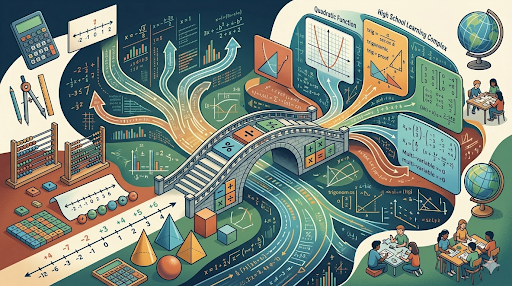
Most parents think of 8th-grade math as “more of the same.” A few harder problems, bigger numbers, maybe some algebra. But researchers and math educators tend to see it differently — as the year that quietly determines whether a teenager walks into 9th grade with confidence or scrambles to catch up.
If you’re homeschooling this year, that context changes everything about how you choose a curriculum.
The Year the Math Gets Real
Here’s a number worth knowing: according to a Thomas B. Fordham Institute analysis, students who complete a rigorous algebra-focused 8th-grade curriculum are measurably more likely to succeed in high school STEM coursework — and the gap widens by 10th grade.
What makes 8th grade the turning point? It’s the first year your child encounters genuinely new mathematical territory, not just extensions of what came before. They’ll move from working with rational numbers to grappling with irrational ones — numbers like √2 and π that can’t be written as fractions and go on forever without repeating. They’ll encounter scientific notation and start reasoning about quantities at the scale of atoms and galaxies.
Most significantly, this is the year functions enter the picture. A function is one of the most important ideas in all of mathematics — the formal relationship between an input and an output — and 8th grade is where students first meet it head-on.
Recommended Reading: What is Metric System?
Five Domains, One Bigger Idea
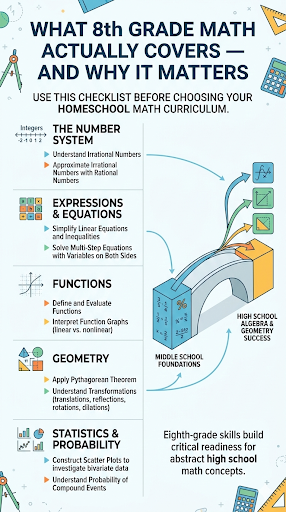
The Common Core framework for Grade 8 organizes content into five areas, but the smartest curricula treat them as one connected story:
The Number System builds the foundation — distinguishing rational from irrational numbers, placing them on a number line, and understanding why some decimals terminate while others go on forever.
Expressions and Equations is where algebra deepens. Students work with exponents, scientific notation, and slope — then solve linear equations with one variable before moving to systems of two equations at once. Both algebraic and graphical methods matter here.
Functions are the most conceptually new terrain. Students learn to define, build, compare, and interpret functions — understanding what it means for a relationship to be linear (constant rate of change) versus non-linear (something more complex). This domain feeds directly into high school algebra and beyond.
Geometry covers more ground than most parents expect: transformations on a coordinate plane, congruence and similarity, triangle angle properties, and a full treatment of the Pythagorean Theorem — including its proof and its use in finding distances between points. Volume formulas for cylinders, cones, and spheres round it out.
Statistics and Probability take a more analytical turn than in earlier grades. Students construct scatter plots, fit linear models to data, interpret slope and intercept in real-world contexts, and analyze two-way tables to find patterns in categorical data. It’s introductory data literacy — genuinely useful for the world your child is growing up in.
The One Thing Most Curricula Get Wrong
Research from the National Council of Teachers of Mathematics (NCTM) consistently finds that middle school curricula underserve the functions domain — often treating it as an add-on to algebra rather than its own major strand of thinking. A curriculum that reduces functions to memorizing y = mx + b is missing the point.
What strong instruction looks like: students construct a linear function from a real-world situation, graph it, interpret what the slope actually means in context, compare it to a non-linear example, and reason about what the graph’s shape tells them. That’s the standard to hold any curriculum to.
The What Works Clearinghouse also notes that connecting multiple representations — tables, graphs, equations, and verbal descriptions — is one of the strongest predictors of lasting math understanding at this level. If a curriculum only ever asks students to solve for x, that’s a warning sign.
Questions Worth Asking Before You Commit
- Does the functions unit stand on its own, with genuine depth — or is it tucked into the algebra chapter as an afterthought?
- Does geometry include coordinate work and proof, or just formulas to memorize?
- Does the statistics unit connect explicitly to the linear equations students are learning alongside it?
- Are systems of equations solved both graphically and algebraically?
- Are real-world contexts woven throughout, or bolted on at the end of each chapter?
Four Steps to Get Started This Week
- Run a 7th grade gap check first. A quick 10–15 question review of rational numbers, proportional reasoning, and two-step equations will tell you where to shore things up before 8th grade content begins. Gaps here compound fast.
- Prioritize the functions unit when comparing options. Request a sample lesson. If it’s mostly equation-solving with a graph tacked on, keep looking. The functions domain is the clearest window into a curriculum’s overall rigor.
- Supplement with math games to build fluency. Research from the Joan Ganz Cooney Center suggests that well-designed educational games can improve math fluency and motivation — especially for students who find abstract algebra dry. Moonpreneur’s Math Game Zone is worth bookmarking: it’s built around problem-solving and designed to make practice feel less like work. A 20-minute session a few times a week can reinforce concepts your child is working through in their main curriculum.
- Use EdReports.org as a filter. This independent nonprofit rates K–12 math curricula against CCSS standards for free. Look specifically at “Gateway 1: Focus and Coherence” scores for Grade 8 — it tells you whether the curriculum teaches the right things at the right depth.
The stakes of this year aren’t about pressure. They’re about possibility. A student who finishes 8th grade with real fluency in functions, algebra, and geometric reasoning doesn’t just pass 9th grade math — they’re ready to actually enjoy it.
Want to excite your child about math and sharpen their math skills? Moonpreneur’s online math curriculum is unique as it helps children understand math skills through hands-on lessons, assists them in building real-life applications, and excites them to learn math.
You can opt for our Advanced Math or Vedic Math+Mental Math courses. Our Math Quiz for grades 3rd, 4th, 5th, and 6th helps in further exciting and engaging in mathematics with hands-on lessons.