Attend our in-person Robotics & Math


Update: This article was last updated on 23 May 2026 to reflect the accuracy and up-to-date information on the page.
Have you ever looked at a soda bottle and noticed it says “500 mL”? Or heard a weather forecast predict temperatures in degrees Celsius? That is the metric system at work. The metric system is the world’s most widely used system of measurement, and for good reason. It is logical, consistent, and built entirely on powers of ten, making metric conversion simpler than almost any other measurement framework in existence.
Whether you are a student trying to ace your next math test, a parent helping with homework, or simply someone curious about how the world measures things, this comprehensive guide will walk you through everything you need to know about the metric system, from its fascinating history to its base units, metric scale, prefixes, and step-by-step metric conversions.
The Metric System was first introduced in France in the late 18th century and has since become the standard system of measurement in science, industry, and everyday life.
Quick Fact: Over 95% of the world’s countries officially use the metric system (also known as the International System of Units, or SI). Only three nations, the United States, Liberia, and Myanmar, have not fully adopted it.
1. What Is the Metric System? — Definition & Overview
The metric system is a decimal-based, internationally recognized system of measurement used to quantify physical properties such as length, mass, volume, temperature, and time. Unlike older imperial units that use arbitrary conversion factors (such as 12 inches in a foot or 16 ounces in a pound), the metric system uses a clean base-10 structure, where every unit is either 10 times larger or 10 times smaller than the adjacent unit.
In formal scientific and governmental contexts, the metric system is referred to as the International System of Units — abbreviated as SI (from the French “Système International d’Unités”). The SI was established in 1960 by the General Conference on Weights and Measures (CGPM) and is continuously updated to reflect advances in science and technology.
So when someone asks “what is the metric system,” the short answer is: it is the global standard for measurement that makes science, trade, medicine, and everyday life consistent across borders.
Recommended Reading: Navigating the World of Matrix Math Problems: A Comprehensive Guide
Definition: The metric system is a base-10 system of measurement in which each unit is related to the others by a factor of 10, making metric conversions as easy as multiplying or dividing by powers of 10.
2. History of the Metric System
The story of the metric system begins during the French Revolution. Before the late 18th century, France alone had over 700 different measurement units, which made commerce, taxation, and science extremely chaotic. A scientist named Charles Maurice de Talleyrand proposed the idea of a universal measurement system grounded in nature.
In 1791, the French Academy of Sciences formally defined the metre as one ten-millionth of the distance from the Earth’s equator to the North Pole, measured along a meridian passing through Paris. In 1799, the metric system was officially adopted in France, and the first physical standards for the metre and kilogram were created.
Over the next two centuries, the metric system spread globally. The Metre Convention of 1875 — signed by 17 nations — established the International Bureau of Weights and Measures (BIPM). Today, the SI is maintained and updated by the BIPM and is the authoritative standard for measurement worldwide.
| Year | Milestone |
|---|---|
| 1791 | France defines the metre based on Earth’s geometry |
| 1799 | The first official metric system was adopted in France |
| 1875 | The Metre Convention was signed by 17 nations |
| 1960 | The International System of Units (SI) was formally established |
| 1983 | Metre redefined based on the speed of light |
| 2019 | SI base units redefined using fundamental physical constants |
3. The 7 Base Units of the Metric System (SI Units)
The modern metric system (SI) is built on seven base units. All other units in science and everyday life are derived from these seven. Think of them as the foundational building blocks of the entire measurement universe.
| Base Unit | Symbol | Measures | Common Example |
|---|---|---|---|
| Metre | m | Length / Distance | A door is about 2 metres tall |
| Kilogram | kg | Mass / Weight | A bag of sugar is 1 kilogram |
| Second | s | Time | A heartbeat is about 1 second |
| Ampere | A | Electric Current | Standard household current is ~10 A |
| Kelvin | K | Temperature | Absolute zero = 0 K (= −273.15°C) |
| Mole | mol | Amount of Substance | Used in chemistry lab calculations |
| Candela | cd | Luminous Intensity | A standard candle is ~1 candela |
For everyday use in school mathematics, the three most important base units are the metre (length), the gram (mass — technically the kilogram), and the litre (volume, which is a derived unit). These three form the foundation of most metric system questions you will encounter from grades 3 through 8.
4. The Metric Scale, Understanding Prefixes
One of the greatest strengths of the metric system is its consistent use of prefixes. These prefixes are added to any base unit to create larger or smaller measurements, and they always represent the same power of ten regardless of which base unit they are attached to. This is what makes the metric scale so elegant and easy to learn.
| Prefix | Symbol | Power of 10 | Value | Example |
|---|---|---|---|---|
| Tera | T | 1012 | 1,000,000,000,000 | Terabyte (TB) in computing |
| Giga | G | 109 | 1,000,000,000 | Gigabyte (GB) on your phone |
| Mega | M | 106 | 1,000,000 | Megametre (Mm) — planetary distances |
| Kilo | k | 103 | 1,000 | Kilometre (km), Kilogram (kg) |
| Hecto | h | 102 | 100 | Hectolitre, Hectometre |
| Deka | da | 101 | 10 | Dekametre |
| (Base) | — | 100 | 1 | Metre, Gram, Litre |
| Deci | d | 10−1 | 0.1 | Decimetre (dm) |
| Centi | c | 10−2 | 0.01 | Centimetre (cm) |
| Milli | m | 10−3 | 0.001 | Millimetre (mm), Millilitre (mL) |
| Micro | μ | 10−6 | 0.000001 | Micrometre (μm) — cell size |
| Nano | n | 10−9 | 0.000000001 | Nanometre (nm) — DNA strand width |
Memory Trick: To remember the most common prefixes in order, use this mnemonic: “King Henry Died By Drinking Cold Milk” — Kilo, Hecto, Deka, Base, Deci, Centi, Milli.
5. Metric Meter, Understanding Length in the Metric System
The metric metre (spelled “meter” in American English) is the base unit of length in the metric system. It is defined as the distance light travels in a vacuum in exactly 1/299,792,458 of a second — a definition adopted in 1983 to ensure perfect precision and reproducibility.
The metric meter is central to everyday measurement. Here are the most common metric length units derived from the metre, and how they relate to each other:
| Unit | Symbol | Relation to Metre | Real-World Example |
|---|---|---|---|
| Kilometre | km | 1 km = 1,000 m | Distance between cities |
| Hectometre | hm | 1 hm = 100 m | Length of a soccer field (~1 hm) |
| Dekametre | dam | 1 dam = 10 m | Height of a 3-storey building |
| Metre | m | Base unit | Height of a door (~2 m) |
| Decimetre | dm | 1 dm = 0.1 m | Length of a large hand |
| Centimetre | cm | 1 cm = 0.01 m | Width of a fingernail |
| Millimetre | mm | 1 mm = 0.001 m | Thickness of a credit card |
Understanding the metric meter is especially important for students since it is the building block for area (square metres, m²) and volume (cubic metres, m³) as well. The metric system’s treatment of length is the clearest demonstration of how the metric scale works in practice.
6. Metric Conversions: How to Convert Between Units
Metric conversion is the process of changing a measurement from one unit to another within the metric system. Because the metric system is base-10, every conversion simply involves moving the decimal point to the left (to go to a larger unit) or to the right (to go to a smaller unit).
The Golden Rule of Metric Conversions
- Moving to a LARGER unit (e.g., mm → cm → m → km): DIVIDE by 10 for each step, or equivalently move the decimal point LEFT.
- Moving to a SMALLER unit (e.g., km → m → cm → mm): MULTIPLY by 10 for each step, or equivalently move the decimal point RIGHT.
Example: To convert 3.5 km to metres: km → m is 3 steps DOWN the metric scale, so multiply by 10³ = 1000. Answer: 3.5 × 1000 = 3,500 metres.
Metric Conversion Chart for Length
| From \ To | km | m | cm | mm |
|---|---|---|---|---|
| 1 km | 1 | 1,000 | 100,000 | 1,000,000 |
| 1 m | 0.001 | 1 | 100 | 1,000 |
| 1 cm | 0.00001 | 0.01 | 1 | 10 |
| 1 mm | 0.000001 | 0.001 | 0.1 | 1 |
Metric Conversion Chart for Mass (Weight)
| From \ To | kg | g | mg |
|---|---|---|---|
| 1 kg | 1 | 1,000 | 1,000,000 |
| 1 g | 0.001 | 1 | 1,000 |
| 1 mg | 0.000001 | 0.001 | 1 |
Metric Conversion Chart for Volume
| From \ To | kL | L | mL |
|---|---|---|---|
| 1 kL | 1 | 1,000 | 1,000,000 |
| 1 L | 0.001 | 1 | 1,000 |
| 1 mL | 0.000001 | 0.001 | 1 |
7. Temperature Conversion: Celsius and Fahrenheit
While the SI base unit of temperature is the Kelvin (K), the metric system commonly uses degrees Celsius (°C) for everyday temperatures. Here are the key formulas:
| Conversion | Formula | Example |
|---|---|---|
| °C to °F | °F = (°C × 9/5) + 32 | 100°C = 212°F (water boiling) |
| °F to °C | °C = (°F − 32) × 5/9 | 98.6°F = 37°C (body temperature) |
| °C to K | K = °C + 273.15 | 0°C = 273.15 K |
| K to °C | °C = K − 273.15 | 373.15 K = 100°C |
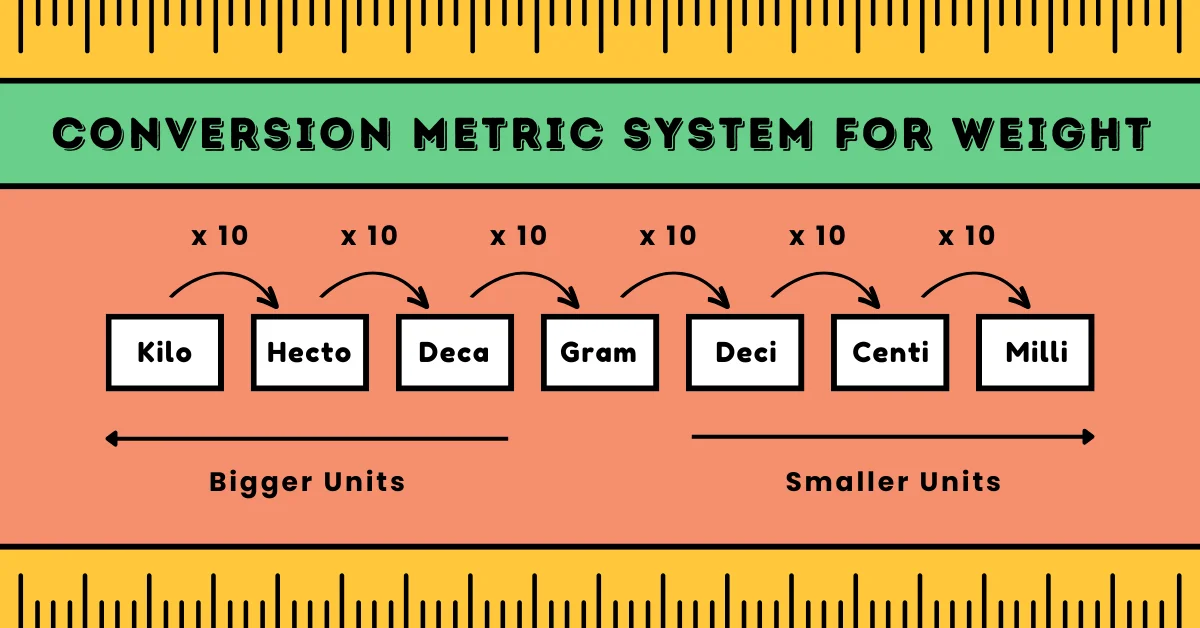
In addition to these base units, the Metric System also uses prefixes to denote multiples or fractions of the base units.
For example,
Kilo = thousand times the base unit
Centi = one hundredth
Milli = one thousandth
Metric Conversions
Converting different units in the Metric System is straightforward due to its decimal nature. To convert from one unit to another, you simply need to multiply or divide by powers of ten based on the prefixes involved. Here are some common conversion factors:
1 kilometer (km) = 1000 meters (m)
1 gram (g) = 0.001 kilograms (kg)
1 liter (L) = 1000 milliliters (mL)
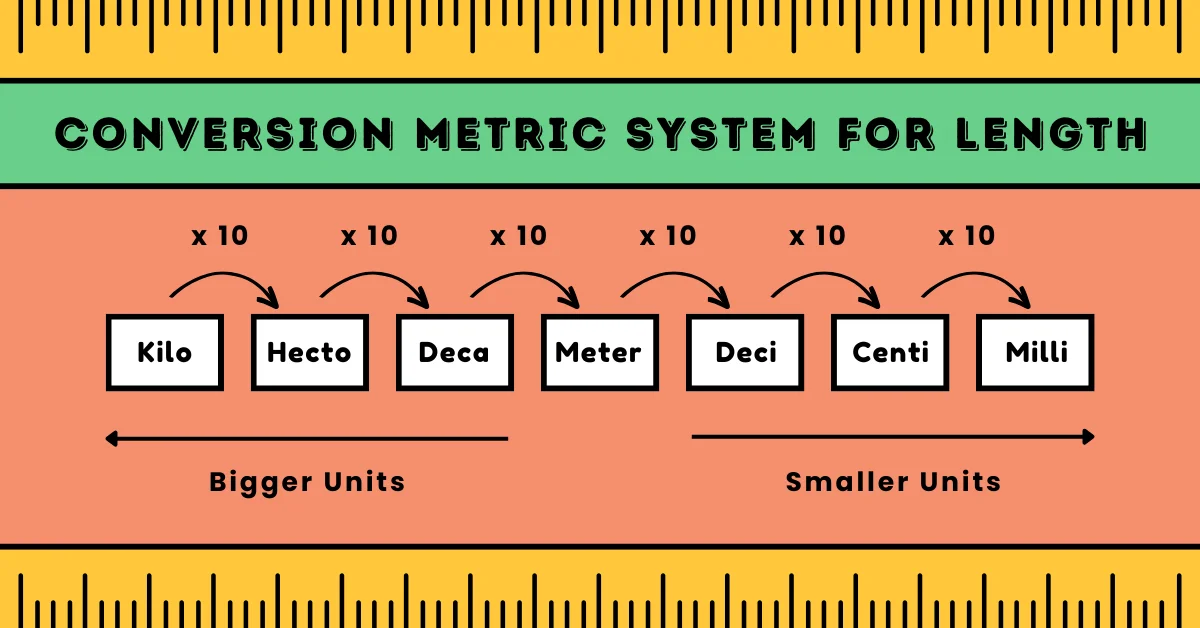
When converting between units, it is important to pay attention to the prefixes and ensure that the units are consistent before performing the conversion.
Converting between metric units is a simple matter of moving the decimal point to the right or left based on the prefixes. For example, to convert 2.5 kilometers to meters, move the decimal point three places to the right, giving you 2,500 meters. To convert 0.005 grams to milligrams, you would move the decimal point three places to the left, giving you 5 milligrams.
Solved Examples on Metric System
Example 1: Convert 2500 meters to kilometers.
1 kilometer = 1000 meters
2500 meters = 2500/1000 kilometers (since 1 kilometer = 1000 meters)
= 2.5 kilometers
Example 2: Convert 4.5 kilograms to grams.
1 gram = 0.001 kilograms
4.5 kilograms = 4.5 x 1000 grams (since 1 kilogram = 1000 grams)
= 4500 grams
Example 3: Convert 800 milliliters to liters.
1 liter = 1000 milliliters
800 milliliters = 800/1000 liters (since 1 liter = 1000 milliliters)
= 0.8 liters
Example 4: Convert 5000 liters to milliliters.
1 liter = 1000 milliliters
5000 liters = 5000 x 1000 milliliters (since 1 liter = 1000 milliliters)
= 5,000,000 milliliters
Example 5: Convert 7 grams to kilograms.
1 kilogram = 1000 grams
7 grams = 7/1000 kilograms (since 1 kilogram = 1000 grams)
= 0.007 kilograms
Recommended Reading: What is unit rate? Example and FAQs
8. The Metric System vs. the Imperial System
Students in countries like the United States often encounter both the metric system and the imperial (or US customary) system. Understanding how they differ — and how to convert between them — is a valuable real-world skill.
Measurement Systems Compared
| Property | Metric System | Imperial System |
|---|---|---|
| Basis | Powers of 10 (decimal) | Arbitrary ratios (e.g., 12, 16, 5,280) |
| Length | mm, cm, m, km | inch, foot, yard, mile |
| Mass | mg, g, kg | ounce, pound, ton |
| Volume | mL, L, kL | fluid ounce, cup, pint, gallon |
| Temperature | Celsius (°C), Kelvin (K) | Fahrenheit (°F) |
| Used By | ~195 countries standard | USA, Myanmar, Liberia partial |
| Ease of Conversion | Very easy (move decimal) | Complex (memorise ratios) |
| Metric System · Imperial System · Global Standards Reference | ||
Key Metric-to-Imperial Conversion Facts
- 1 metre = 3.281 feet = 39.37 inches
- 1 kilometre = 0.621 miles
- 1 kilogram = 2.205 pounds
- 1 litre = 0.264 gallons = 33.81 fluid ounces
- 1 centimetre = 0.394 inches
9. Real-World Applications of the Metric System
Understanding the metric system is not just a school requirement — it is a life skill. Here are the key areas where the metric system and metric conversions are used every day:
Medicine and Healthcare
Doctors prescribe medicine in milligrams (mg) and millilitres (mL). Blood pressure is measured in millimetres of mercury (mmHg). Body temperature is recorded in Celsius. An incorrect metric conversion in medicine can be life-threatening, which is why the metric system is the universal standard in healthcare globally.
Science and Research
The metric system is the language of science. Every scientific measurement — from the nanometre scale used in nanotechnology to the gigametre scale used in astrophysics — uses SI units. This ensures that scientists around the world can share and reproduce results without unit-confusion errors.
Cooking and Nutrition
Food labels worldwide use grams for mass and millilitres or litres for volume. Recipes from professional chefs use metric measurements because they are more precise and reproducible than imperial cups and tablespoons.
Engineering and Construction
Architects design buildings in metres and centimetres. Engineers specify tolerances in millimetres. Road signs in metric countries show distances in kilometres. The metric system ensures safety and consistency in all engineering applications.
Sports
Track events are measured in metres (100 m sprint, 400 m hurdles, 1,500 m run). Swimming pools are 50 metres long. Shot put, discus, and javelin distances are all recorded in metres. Even in the USA, many sporting events officially use metric measurements.
International Trade
Goods traded across borders must be measured in a common system. The metric system is the international standard for trade, which is why product specifications, shipping weights, and container volumes all use SI units in global commerce.
10. Common Mistakes Students Make with Metric Conversions
Even students who understand the metric system conceptually often make predictable errors when doing metric conversions. Here are the most common pitfalls — and how to avoid them:
- Moving the decimal point in the wrong direction: Always ask yourself — am I going to a LARGER or SMALLER unit? Larger unit = divide (decimal moves left). Smaller unit = multiply (decimal moves right).
- Confusing metric prefixes: Milli means one thousandth (÷1,000), not one hundredth. Centi means one hundredth (÷100). Students often mix these up on tests.
- Forgetting to count the correct number of steps on the metric scale: When converting from km to cm, there are 5 steps, not 3. Always draw out the prefix ladder before calculating.
- Mixing metric and imperial units in the same calculation: Never mix metres with feet, or litres with gallons in the same equation without first converting everything to the same system.
- Using the wrong base unit: Volume in the metric system uses litres (L) for liquids and cubic metres (m³) for solids in engineering. Students sometimes confuse the two.
11. Practice Problems for Students
Test your understanding of the metric system with these practice problems. Solutions are provided at the end.
- Convert 7,200 metres to kilometres.
- Convert 0.85 kg to grams.
- Convert 450 mL to litres.
- Convert 3.6 cm to millimetres.
- Convert 2,000 mg to grams.
- A road sign shows a distance of 15 km. How many metres is this?
- A medicine bottle contains 250 mL. How many litres is this?
- Convert 5.25 litres to millilitres.
- An athlete runs 1,500 metres. How many kilometres did they run?
- Convert 120 cm to metres.
Answers
- 7,200 m ÷ 1,000 = 7.2 km
- 0.85 kg × 1,000 = 850 g
- 450 mL ÷ 1,000 = 0.45 L
- 3.6 cm × 10 = 36 mm
- 2,000 mg ÷ 1,000 = 2 g
- 15 km × 1,000 = 15,000 m
- 250 mL ÷ 1,000 = 0.25 L
- 5.25 L × 1,000 = 5,250 mL
- 1,500 m ÷ 1,000 = 1.5 km
- 120 cm ÷ 100 = 1.2 m
Frequently Asked Questions (FAQs)
1. What is the metric system in simple words?
Ans. The metric system is a way of measuring things — like length, weight, and volume — using units that are all related by powers of 10. It is the standard measurement system used in science and in most countries around the world.
2. What is the metric system also called?
Ans. The metric system is formally called the International System of Units, abbreviated as SI (from French: Système International d’Unités). It was established in 1960 and is updated regularly by the International Bureau of Weights and Measures (BIPM).
3. What are the 3 main units of the metric system?
Ans. For everyday use, the three most important metric units are: the metre (m) for length, the gram (g) or kilogram (kg) for mass, and the litre (L) for volume.
4. Why does the US not use the metric system?
Ans. The United States adopted its customary system based on British imperial units before the metric system became widely established. While US industries and science use metric measurements, the everyday customary system remains dominant due to cultural inertia and the cost of widespread transition.
5. What is the difference between metric and imperial?
Ans. The metric system is base-10 and used globally; the imperial system uses arbitrary conversion factors (e.g., 12 inches to a foot, 5,280 feet to a mile) and is primarily used in the United States. Metric conversions are much simpler because you only need to multiply or divide by 10, 100, or 1,000.
6. How do I remember metric conversions easily?
Ans. Use the mnemonic “King Henry Died By Drinking Cold Milk” to remember the prefix order from largest to smallest: Kilo, Hecto, Deka, Base unit, Deci, Centi, Milli. For each step you move down, multiply by 10; for each step up, divide by 10.
7. Is the metric system used in India?
Ans. Yes. India officially adopted the metric system on April 1, 1957, replacing the older system of British imperial units. All official, scientific, commercial, and educational measurements in India use SI units.
8. What does the metric meter measure?
Ans. The metric metre (meter) measures length or distance. It is the base unit of length in the SI system. Common metric metric derivatives include kilometres (for long distances), centimetres (for everyday objects), and millimetres (for fine measurements).
Conclusion
The metric system is far more than just a set of measurement units — it is a universal language that connects scientists, engineers, doctors, athletes, and students across every corner of the globe. Understanding what the metric system is, how the metric scale works, and how to perform metric conversions accurately is an essential skill that will serve you in school, in your career, and in daily life.
From the fundamental metric metre that measures the world around us, to the elegant prefix system that scales any unit up or down by factors of ten, the metric system is a marvel of human ingenuity — born in the French Revolution and refined over more than two centuries into the precise, logical system we rely on today.
The key takeaways from this guide are: the metric system is decimal-based; prefixes like kilo, centi, and milli apply consistently to all base units; metric conversions are performed by multiplying or dividing by powers of 10; and the metric system is the official standard in science, medicine, trade, and education for the vast majority of the world.
Moonpreneur understands the needs and demands this rapidly changing technological world is bringing with it for our kids. Our expert-designed Advanced Math course for grades 3rd, 4th, 5th, and 6th will help your child develop math skills with hands-on lessons, excite them to learn, and help them build real-life applications.
Register for a free 60-minute Advanced Math Workshop today!