
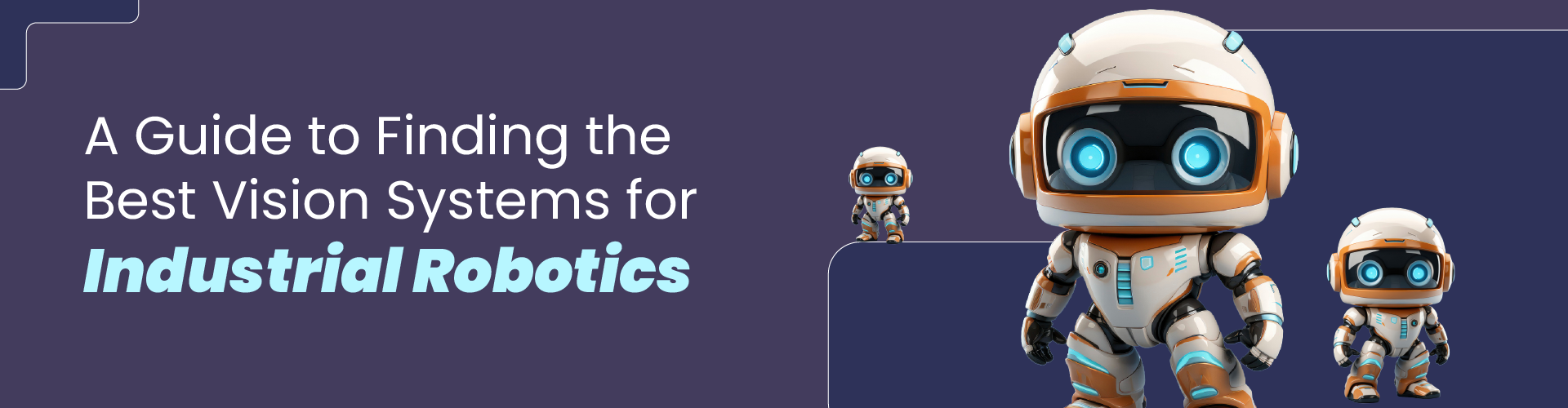
Industrial robotics is evolving faster than ever, and at the center of this progress lies one powerful technology—machine vision systems. Whether it’s quality inspection, object recognition, measurement, or automation, the right vision system determines how accurately and efficiently a robot performs. This guide will help you understand what vision systems do, the types available, and how to choose the best vision systems for industrial robotics based on your needs.
Comparison of Vision Systems for Industrial Robotics
| Vision System Type | What It Captures / How It Works | Best For / Use Cases | Key Advantages | Main Limitations / Challenges |
|---|---|---|---|---|
| 2D Vision | Captures flat 2D images (X & Y axes) using standard cameras. | Barcode/label reading, surface inspection, print-quality checks, label verification, basic pick-and-place with fixed orientation. |
• Low cost & easy integration • Fast processing & high throughput • Simple setup & maintenance • Ideal for controlled environments |
• No Z-axis/depth info • Sensitive to lighting & shadows • Poor for complex shapes or varied orientations |
| 2.5D Vision (Height Maps) | Adds limited depth/height info (height maps) on top of 2D imaging. | Tasks needing modest depth insight — height variation checks, surface flatness, alignment, component orientation. |
• Better depth awareness than 2D • Cheaper & simpler than 3D • Good middle-ground option |
• Not true 3D • Limited volumetric understanding • Performance varies widely across models |
| 3D Vision | Captures full 3D data (X, Y, Z, volume, orientation) via structured light, stereo, ToF, or laser triangulation. | Bin-picking, volumetric measurement, complex assembly, 3D inspection, robotic guidance. |
• Accurate depth & volumetric measurement • Works well with complex surfaces & varied lighting • Enables advanced robotics & automation |
• Higher hardware/software cost • Complex calibration & integration • Heavy computation may reduce speed |
| AI-Powered / Smart Vision Systems | Uses 2D, 2.5D, or 3D cameras with deep learning/ML for intelligent inspection & pattern recognition. | Complex inspections, variable product appearance, subtle defects, aesthetic checks, adaptive quality control, advanced recognition. |
• Highly flexible & adaptive • Detects subtle defects • Scalable with retraining • Reduces manual rule creation |
• Requires large training datasets • More expensive (ML pipeline + hardware) • Overkill for simple static tasks • Less explainable than rule-based systems |
How to Use This Comparison in Your Decision Making
- Use 2D Vision when your tasks are simple, parts are flat or uniform, and the environment (lighting, orientation) is stable. It’s budget-friendly and efficient.
- Use 2.5D if you need some depth/height information — e.g., for checking surface flatness, minor height variation, or simple orientation detection — but don’t need full 3D geometry.
- Use 3D Vision when you deal with complex shapes, random part orientation, volumetric measurements, or require spatial awareness (e.g. bin picking, robotic assembly).
- Use AI-Powered Vision when products vary, defects are subtle or non-uniform, or lighting/appearance conditions change; or when you need adaptive, scalable inspection across variants.
What Is a Vision System in Industrial Robotics?
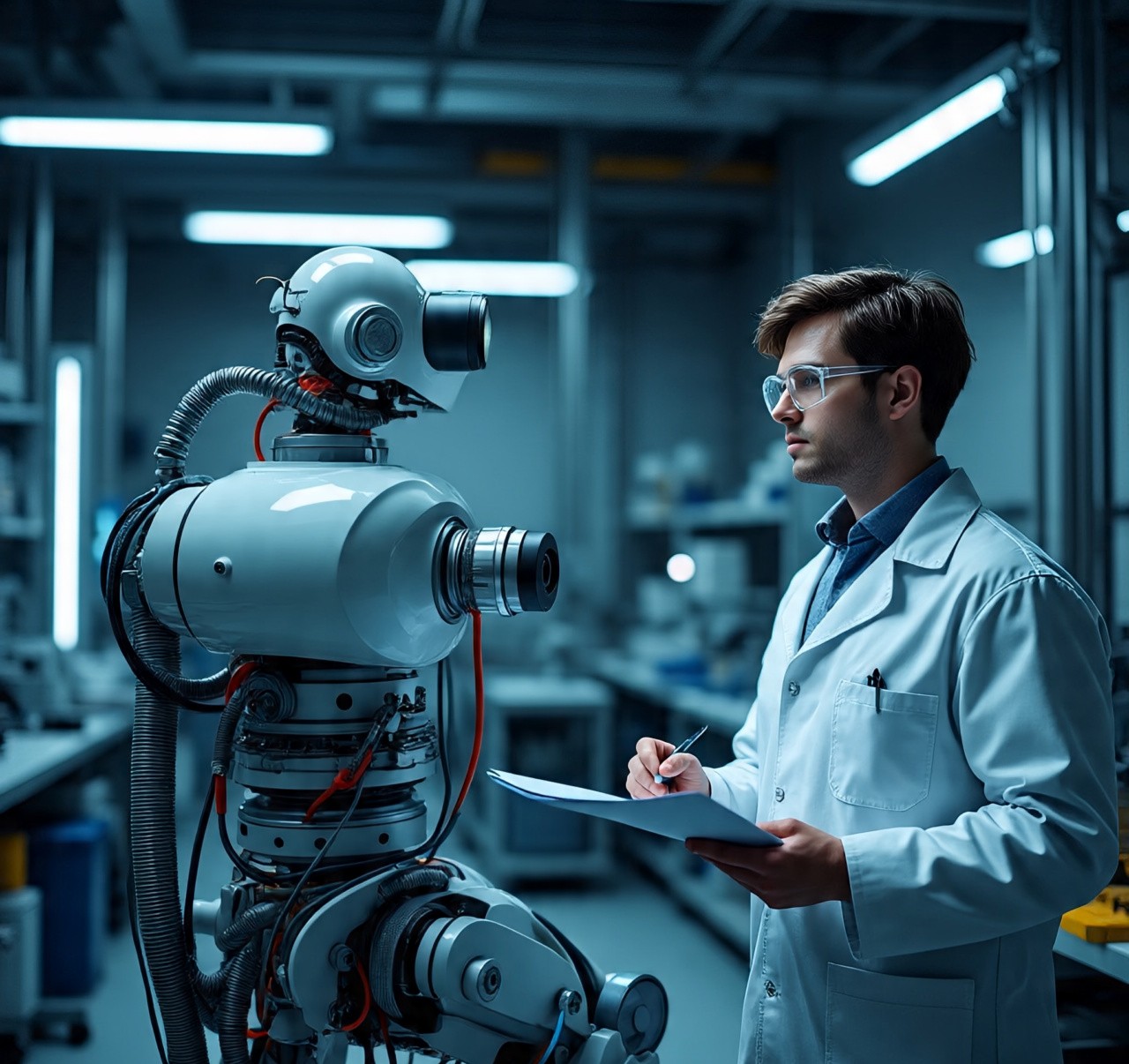
A vision system uses cameras, sensors, and software to help robots “see” their surroundings. It captures images, interprets them using algorithms or AI, and guides robots to make decisions.
In modern factories, vision systems are essential for:
- Detecting defects
- Sorting products
- Guiding robotic arms
- Tracking items on conveyor belts
- Ensuring quality and consistency
With smarter automation and AI, businesses can significantly boost manufacturing accuracy while reducing costs.
Recommended Reading: Doral Academy of Colorado | Arvada, CO (For STEM)
Key Factors to Consider When Choosing a Vision System
1. Type of Application
Is the task inspection, measurement, tracking, or assembly?
For basic inspection—2D is enough.
For bin picking or advanced automation—choose 3D or AI-based systems.
2. Accuracy & Resolution
Higher resolution cameras provide clearer images and better defect detection.
Industries like electronics or pharmaceuticals require very high precision.
3. Speed and Processing Power
Faster production lines need vision systems capable of:
- High-speed image capture
- Real-time processing
- Low latency detection
4. Integration Compatibility
Choose systems that work smoothly with:
- Your industrial robots (KUKA, FANUC, ABB, UR, etc.)
- Existing PLCs
- Software platforms (ROS, custom automation software)
5. Lighting Conditions
Good lighting is critical. Some systems include built-in illumination; others need external lighting.
6. Scalability
Look for future-ready features like AI learning, additional camera support, or compatibility with newer robotic models.
Top Vision System Use Cases in Industrial Robotics
✔ 1. Quality Inspection
Vision systems detect defects, cracks, alignment errors, and inconsistencies in manufacturing.
✔ 2. Automated Sorting
Robots use cameras to recognize items by shape, size, or color and sort them accurately.
✔ 3. Pick-and-Place Automation
Vision helps robotic arms identify objects and pick them precisely—even if they are not aligned.
✔ 4. Assembly Line Automation
Vision-guided robots place components with high precision, improving speed and reducing human errors.
✔ 5. Warehouse and Logistics
Vision systems support automated scanning, package tracking, and inventory management.
Recommended Reading: Cranberry-Prosperity Elementary | Beckley, WV (For STEM)
Related blogs
- Essential Robotics Skills Every Industrial Engineer Must Develop
A Complete Guide to Finding the Best Vision Systems for Industrial Robotics
How Automation and Robotics Are Transforming Airline Operations
Rise of Robotics in Food Processing | Benefits, Applications & Future
AI-Enhanced Robotics: The $124 Billion Revolution Reshaping Industry and Labor
Benefits of Using Advanced Vision Systems in Robotics
- Improved accuracy and repeatability
- Reduced human error
- Higher production speed
- Lower long-term costs
- Better quality control
- Enhanced safety
- Predictive analytics (AI vision)
By integrating advanced vision technology, factories achieve smarter, faster, and more reliable automation.
How AI Is Transforming Machine Vision in Industrial Robotics
- AI-enabled vision systems can:
- Learn from sample images
- Detect patterns beyond human vision
- Adapt to product variations
- Predict defects before they happen
Industries like automotive, electronics, packaging, and pharmaceuticals use AI vision systems for next-level manufacturing intelligence.
Conclusion
Finding the best vision systems for industrial robotics requires understanding your application, accuracy needs, integration requirements, and budget. As robotics and AI continue to advance, vision systems will play an even bigger role in building smart, automated, and highly efficient factories. Investing in a well-matched vision system today ensures long-term productivity, safety, and cost savings tomorrow.
Moonpreneur is on a mission to disrupt traditional education and future-proof the next generation with holistic learning solutions. Its Innovator Program is building tomorrow’s workforce by training students in AI/ML, Robotics, Coding, IoT, and Apps, enabling entrepreneurship through experiential learning.
Frequently Asked Questions
Vision systems are camera-based technologies that help robots capture and interpret images to make intelligent decisions during automation tasks.
For simple inspections, 2D vision works well. For high-precision or complex items, 3D or AI-powered vision systems are best.
AI vision systems detect complex patterns, learn from variations, and provide highly accurate, adaptive inspection compared to traditional methods.
Most modern vision systems support integration with major robotic brands like ABB, FANUC, KUKA, and Universal Robots.
Good lighting ensures clear images, reduces detection errors, and improves the accuracy of inspections and object recognition.