

In today’s fast-paced industrial world, robotics has become the backbone of modern manufacturing. From automation and smart factories to AI-driven machines, industrial engineers must build strong robotics skills to stay competitive. This guide explains the essential robotics skills every industrial engineer needs, why they matter, and how engineers can develop them for real-world success.
Whether you’re starting your journey or upgrading your career, these skills will help you design, manage, and optimize advanced robotic systems across various industries.
⭐ Why Robotics Skills Matter for Industrial Engineers
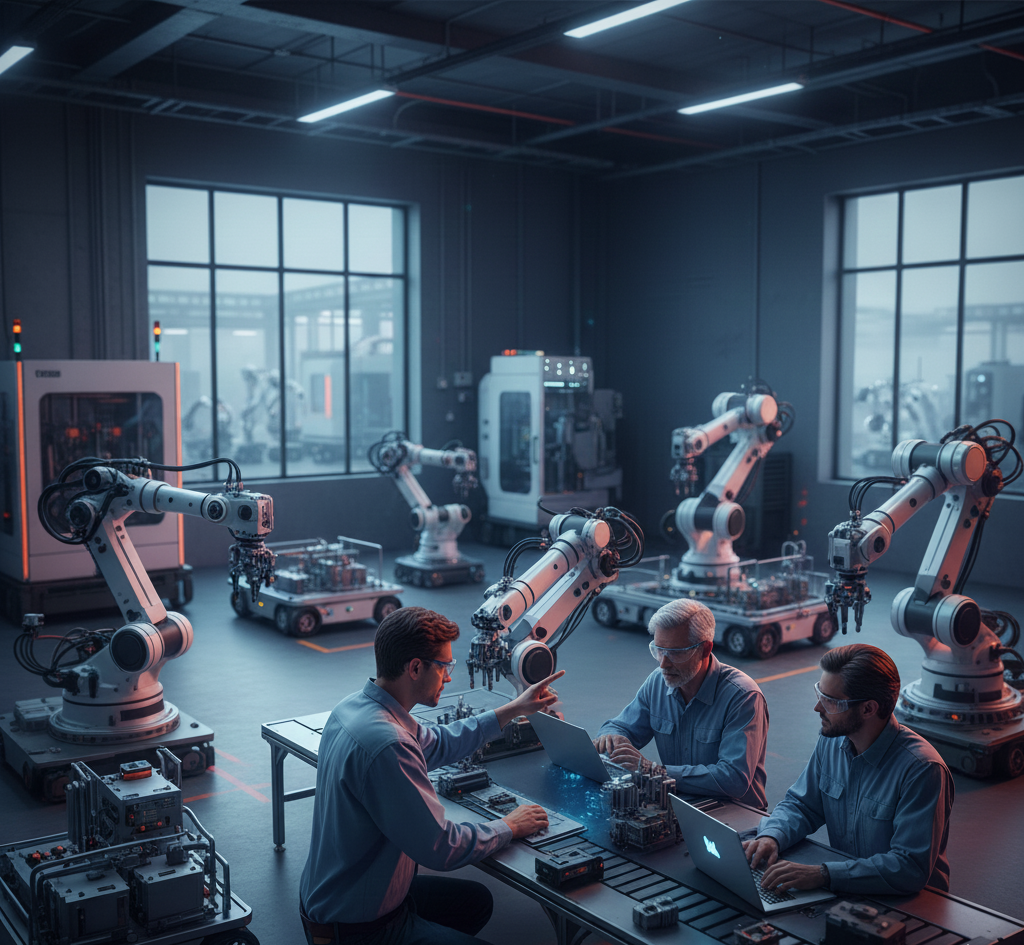
Robotics is no longer optional—it’s a core part of industrial engineering. Modern industries rely on robotics for:
- Faster and safer manufacturing
- Higher precision and quality
- Reduced operation costs
- Automated inspection and assembly
- Smart, data-driven production
Industrial engineers who master robotics can lead automation initiatives, improve workflows, and innovate better systems for future-ready factories.
✅ Comparison Chart of Robotics Skills for Industrial Engineers
| Robotics Skill | What It Includes | Why It’s Important | Skill Level Needed | Tools / Technologies |
|---|---|---|---|---|
| Mechanical Design Skills | CAD modeling, robot arm design, kinematics, materials knowledge | Ensures robots are structurally strong, precise, efficient | Intermediate–Advanced | SolidWorks, AutoCAD, Fusion 360 |
| Electrical & Electronics Skills | Sensors, circuits, motors, power systems, wiring | Helps diagnose errors, integrate components, and maintain robots | Intermediate | MATLAB, Multisim, Arduino |
| Programming for Robotics | Python, C++, ROS control, automation scripts | Allows engineers to instruct robot tasks & automate workflows | Advanced | Python, C++, ROS, RobotStudio |
| Control Systems | PID control, motion planning, trajectory calculation | Ensures accurate, smooth, safe robot movement | Intermediate–Advanced | MATLAB/Simulink, LabVIEW |
| Industrial Automation Skills | PLC programming, SCADA, production line integration | Required for manufacturing robot deployment | Intermediate | Siemens PLC, Allen-Bradley, SCADA |
| Machine Vision & AI | Object detection, defect inspection, camera calibration | Enables robots to “see,” inspect, pick-and-place, and analyze | Advanced | OpenCV, TensorFlow, Cognex, Keyence |
| Troubleshooting & Maintenance | Robot calibration, predictive maintenance, diagnostics | Reduces downtime and improves machine lifespan | Beginner–Intermediate | CMMS tools, diagnostic kits |
| Safety & Compliance | ISO standards, safe robot zones, emergency protocols | Prevents accidents and ensures workplace safety | Intermediate | ISO 10218, OSHA guidelines |
Essential Robotics Skills Every Industrial Engineer Must Develop
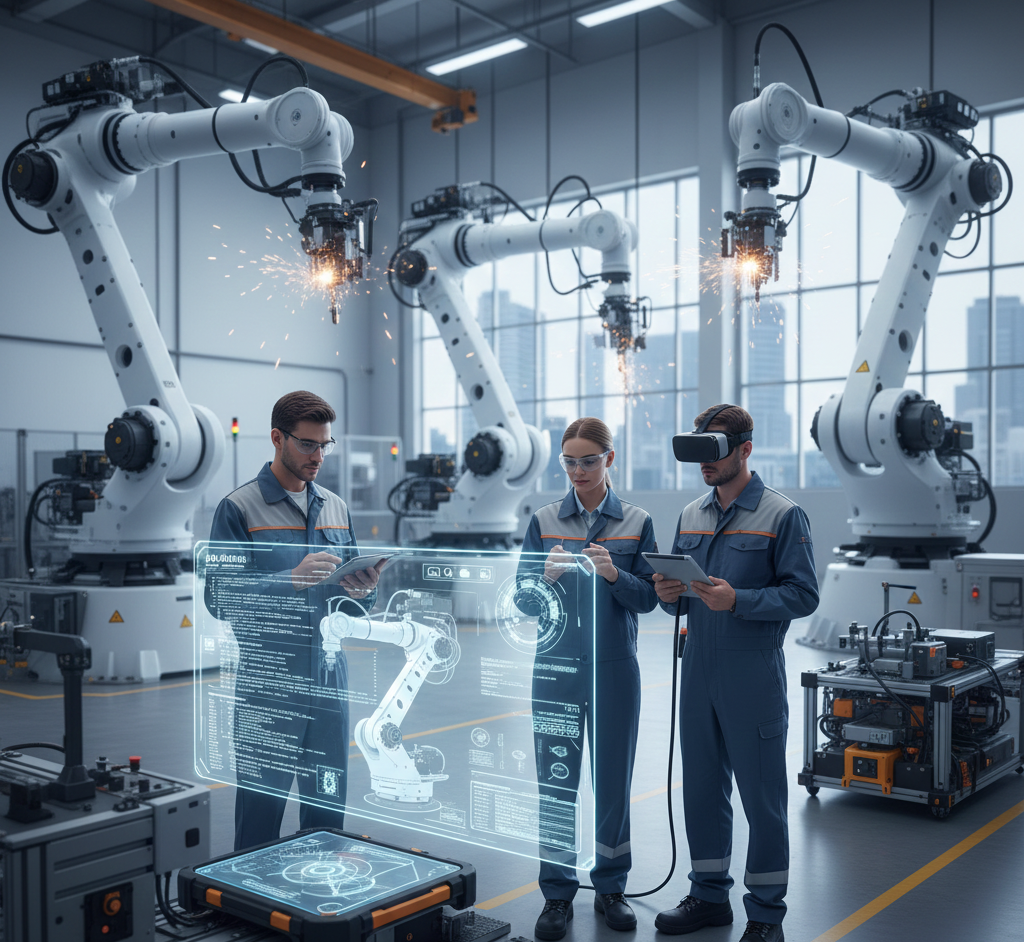
⭐ 1. Understanding Core Robotics Fundamentals
To design or manage robotic systems, engineers need to understand the basics:
- Robot kinematics (motion, speed, angles, movement)
- Dynamics (forces, loads, torque)
- Control systems
- Sensors and actuators
- Robot configurations (SCARA, articulated, delta, collaborative robots)
These fundamentals help engineers work confidently with any robotic system.
⭐ 2. Programming & Automation Skills
Programming is crucial in robotics. Industrial engineers must know how to code robot movements, logic, and automation sequences.
Useful Programming Languages:
- Python (AI, automation, scripting)
- C/C++ (embedded systems, robot control)
- MATLAB (robotics simulation, control algorithms)
- ROS (Robot Operating System)
- Vendor-specific languages:
- FANUC – TP Programming
- ABB – RAPID
- KUKA – KRL
- UR – Polyscope
Programming helps engineers automate tasks, troubleshoot issues, and integrate robots with production lines.
⭐ 3. Knowledge of Industrial Automation Systems
Modern factories use both robotics and automation tools. Engineers need strong knowledge of:
- PLCs (Programmable Logic Controllers)
- SCADA systems
- HMI interfaces
- Industrial communication protocols (Ethernet/IP, OPC UA, Modbus)
- Sensors, vision systems, safety systems
This skill ensures seamless robot integration with machines, conveyors, assembly lines, and inspection systems.
⭐ 4. Understanding Machine Vision & AI
Automation is evolving through machine vision and AI-powered robotics.
Industrial engineers should learn:
- 2D/3D vision systems
- Object detection and inspection
- Barcode/QR scanning
- Deep learning for defect detection
- Image processing algorithms
This knowledge helps engineers integrate smart vision systems to improve precision and automate complex tasks.
⭐ 5. Robotics Simulation & Digital Twin Skills
Before implementing robots in factories, engineers use simulation software to test:
- Robot paths
- Cycle times
- Collision detection
- Productivity analysis
Popular Robotics Simulation Tools:
- RoboDK
- MATLAB Robotics Toolbox
- Siemens Tecnomatix
- ABB RobotStudio
- Gazebo with ROS
Simulation helps reduce cost, errors, and implementation time.
⭐ 6. Mechanical Design Skills
Many robotics tasks require designing custom parts or fixtures. Industrial engineers benefit from:
- CAD software (SolidWorks, AutoCAD, Fusion 360)
- Understanding mechanical components
- Material selection
- Designing grippers, jigs, and mounts
These skills help engineers adapt robotics solutions to specific manufacturing needs.
⭐ 7. Data Analytics & Industry 4.0 Skills
Modern robots generate data that can improve efficiency. Engineers must know:
- IoT (Internet of Things)
- Predictive maintenance
- Data visualization
- Cloud-based robotics
- Smart manufacturing technologies
Industry 4.0 knowledge helps engineers optimize processes using real-time analytics.
⭐ 8. Problem-Solving & Troubleshooting Skills
Robotic systems require constant monitoring and troubleshooting. Engineers must be able to:
- Identify mechanical or electrical issues
- Diagnose software errors
- Improve robot performance
- Ensure safety compliance
Strong problem-solving skills make engineers invaluable in automation environments.
Related blogs
- Essential Robotics Skills Every Industrial Engineer Must Develop
- A Complete Guide to Finding the Best Vision Systems for Industrial Robotics
- How Automation and Robotics Are Transforming Airline Operations
- Rise of Robotics in Food Processing | Benefits, Applications & Future
- AI-Enhanced Robotics: The $124 Billion Revolution Reshaping Industry and Labor
- RoboRevolution – The Rise of Robotics in Modern Industries
How Industrial Engineers Can Develop These Robotics Skills
Here’s how you can start building these essential skills:
- Enroll in robotics courses and certifications
- Practice with robotics kits or simulators
- Attend automation workshops or internships
- Work on real industrial projects
- Learn programming and AI fundamentals
- Collaborate with cross-functional automation teams
- Explore ROS and open-source robotics tools
Small consistent steps lead to massive skill growth.
Conclusion
Developing the essential robotics skills every industrial engineer needs is key to staying relevant and future-ready. Robotics is transforming industries with automation, precision, and AI-driven innovation. By mastering programming, vision systems, automation tools, mechanical design, and simulation, industrial engineers can lead the next generation of smart factories.
Investing in these skills today opens opportunities in manufacturing, automotive, aerospace, logistics, healthcare automation, and more.
Moonpreneur is on a mission to disrupt traditional education and future-proof the next generation with holistic learning solutions. Its Innovator Program is building tomorrow’s workforce by training students in AI/ML, Robotics, Coding, IoT, and Apps, enabling entrepreneurship through experiential learning.
Frequently Asked Questions
Industrial engineers need programming, automation, machine vision, simulation, mechanical design, and troubleshooting skills to work effectively with robotic systems.
They can begin with online courses, robotics kits, programming languages like Python, and simulation tools such as RoboDK or ROS.
Machine vision helps robots inspect products, detect defects, and interact with objects accurately, making automation more intelligent.
Yes. Programming is essential for controlling robot movements, automation logic, and integrating robots with factory systems.
Manufacturing, automotive, aerospace, electronics, logistics, packaging, and pharmaceutical industries all rely heavily on robotics.