Attend our in-person Robotics & Math



Mathematics is often called the language of the universe, and nowhere is that more evident than in proportional relationships. Whether you are calculating speed on a road trip, scaling up a recipe, or designing an engineering structure, one concept quietly governs them all: the constant of proportionality.
In this comprehensive guide, we will break down what the constant of proportionality is, explore its definition, formulas, and real-world applications, and show you step by step how to find it. By the end, you will have a crystal-clear understanding of this foundational mathematical concept.
QUICK DEFINITION The constant of proportionality (k) is the fixed ratio that relates two proportional quantities. It answers the question: how much does y change for every one unit change in x? |
1. Constant of Proportionality Definition
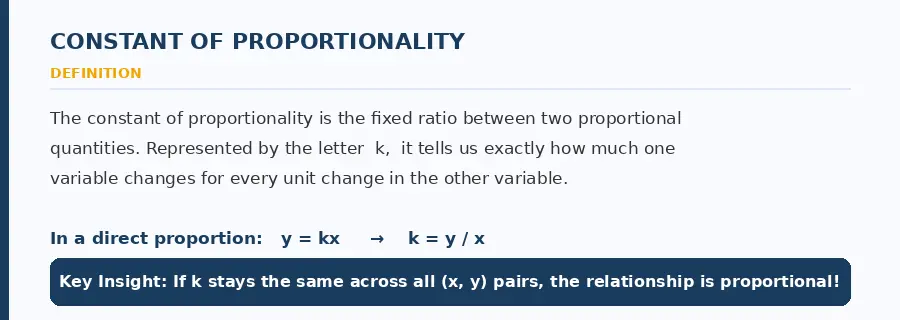
The constant of proportionality definition refers to the constant value (k) that describes the relationship between two variables that change in proportion to each other. In mathematical terms, when two quantities x and y are proportional, their ratio remains constant, and that constant value is k.
Formally: If y is directly proportional to x, then y = kx, where k = y/x.
Formally: If y is inversely proportional to x, then y = k/x, where k = xy.
WHY IS IT CALLED ‘CONSTANT’? The term ‘constant’ is the key; it means k never changes regardless of which x and y values you pick from the proportional relationship. |
2. What is a Constant of Proportionality? (In Simple Terms)
Let us answer what the constant of proportionality is using an everyday analogy.
Imagine you walk into a store where every apple costs $3. If you buy 1 apple, you pay $3. If you buy 5 apples, you pay $15. If you buy 10 apples, you pay $30. No matter how many apples you pick up, the price per apple never changes; it is always $3.
That unchanging value, $3 per apple, is the constant of proportionality. It is the fixed rate, the scale factor, or the unit rate that links your two quantities (number of apples and total cost).
Total Cost = 3 × Number of Apples → k = 3 |
So what is a constant of proportionality in a broader sense? It is the multiplier that scales one variable into another while maintaining a perfectly consistent relationship between them.
3. The Formula: Direct and Inverse Proportion
3.1 Direct Proportion
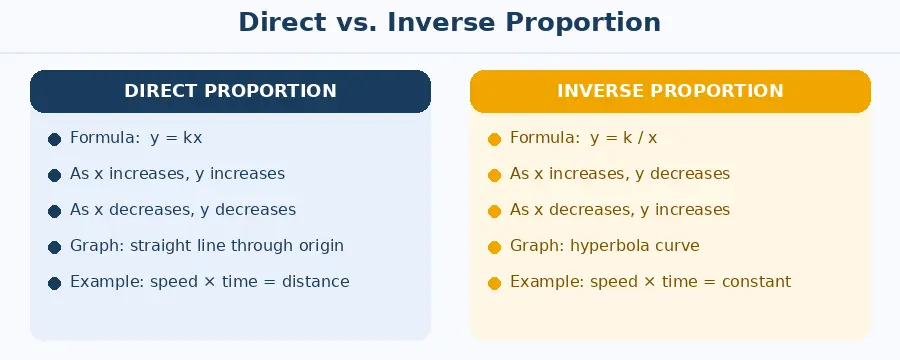
In a direct proportion, both variables increase or decrease together at the same rate.
y = kx or equivalently k = y / x |
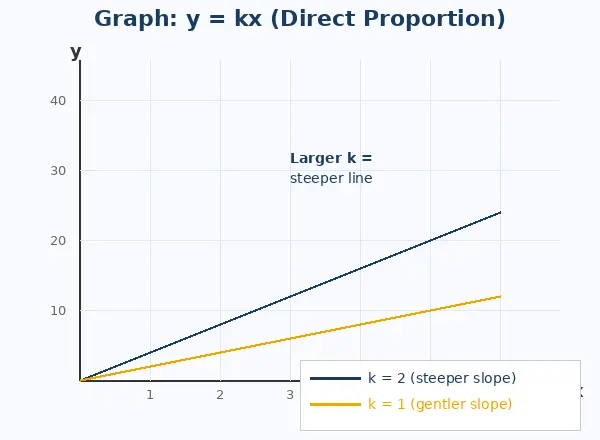
Here, as x gets larger, y gets proportionally larger. The slope of the line on a graph is exactly k. The relationship always passes through the origin (0, 0).
3.2 Inverse Proportion
In an inverse proportion, as one variable increases, the other decreases at a rate that keeps their product constant.
y = k / x or equivalently k = x · y |
Here, doubling x causes y to be halved. The graph produces a hyperbola rather than a straight line.
3.3 Summary Table of Formulas
Type | Formula | Find k | Graph Shape |
Direct Proportion | y = kx | k = y / x | Straight line through origin |
Inverse Proportion | y = k / x | k = x × y | Hyperbola curve |
4. How to Find the Constant of Proportionality (Step by Step)
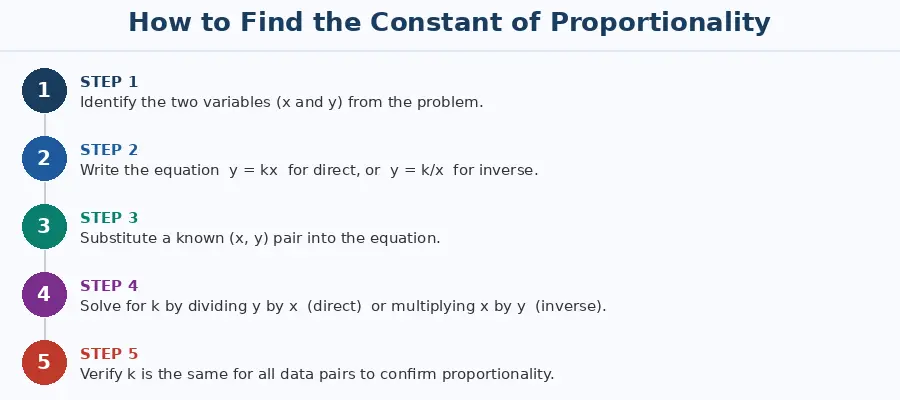
Understanding what the constant of proportionality is half the battle. The other half is knowing how to calculate it. Follow these five steps:
Worked Example 1: Direct Proportion
Problem: A car travels 240 km in 3 hours. Find the constant of proportionality and write the equation.
- Identify variables: x = time (hours), y = distance (km)
- Formula for direct proportion: y = kx
- Substitute known values: 240 = k × 3
- Solve for k: k = 240 / 3 = 80
- Equation: Distance = 80 × Time
RESULT The constant of proportionality k = 80 km/h means that for every 1 hour of travel, the car covers exactly 80 km. |
Worked Example 2: Inverse Proportion
Problem: It takes 6 workers 8 days to complete a project. Find k if you want to model the relationship between workers and days.
- Identify variables: x = number of workers, y = number of days
- Formula for inverse proportion: y = k / x
- Substitute known values: 8 = k / 6
- Solve for k: k = 8 × 6 = 48
- Equation: Days = 48 / Workers
RESULT k = 48 represents the total ‘person-days’ of work. With 12 workers, the project takes 48/12 = 4 days. |
5. Constant of Proportionality on a Graph
One of the most powerful ways to visualize what is the constant of proportionality is on a coordinate graph.
For Direct Proportion:
- The graph is always a straight line passing through the origin (0, 0).
- The slope of that line is exactly k.
- A steeper line means a larger k, a shallower line means a smaller k.
- If the line does not pass through (0, 0), the relationship is NOT proportional.
For Inverse Proportion:
- The graph forms a hyperbola, a curved shape that approaches but never touches the axes.
- As x increases, y decreases along the curve.
- The product of any (x, y) point on the curve always equals k.
6. Real-World Examples of Constant of Proportionality
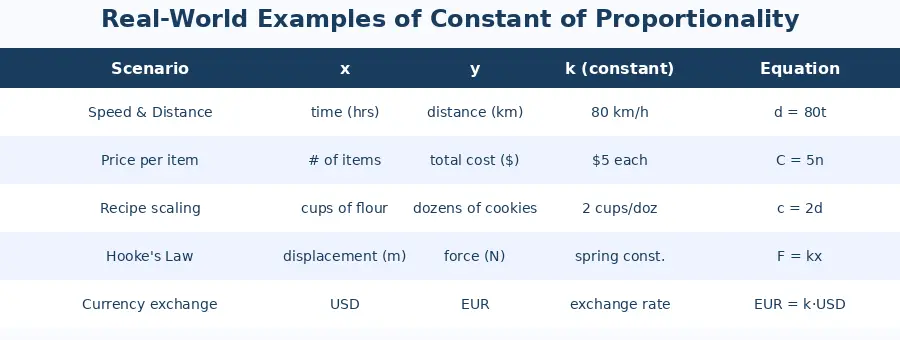
The constant of proportionality is not just a classroom concept. It shows up everywhere in the real world:
6.1 Speed and Distance
When driving at a constant speed of 60 km/h, the distance you travel is directly proportional to time. Here, k = 60. The equation is Distance = 60 × Time.
6.2 Currency Exchange
If 1 US Dollar (USD) exchanges for 0.92 Euros (EUR), then for any amount of USD, the EUR value = 0.92 × USD. The constant of proportionality is the exchange rate: k = 0.92.
6.3 Recipe Scaling
A recipe uses 2 cups of flour per dozen cookies. Whether making 2 dozen or 20 dozen, the ratio holds: k = 2. Flour = 2 × Dozens of cookies.
6.4 Hooke’s Law in Physics
Hooke’s Law states that the force (F) needed to stretch a spring is directly proportional to its displacement (x): F = kx, where k is the spring constant. This is one of the most famous applications of the constant of proportionality in science.
6.5 Medication Dosage
Doctors often prescribe medication at a constant dose per kilogram of body weight. If a drug is given at 5 mg/kg, then k = 5 and Dose = 5 × Weight.
7. Constant of Proportionality in Tables
A table of values is one of the best tools for identifying and confirming the constant of proportionality. The method: divide y by x for every row. If the result is always the same number, that number is k, and the relationship is proportional.
Example Table: Is this relationship proportional?
x (hours worked) | y (earnings $) | k = y / x | Proportional? |
2 | 30 | 30/2 = 15 | Yes |
5 | 75 | 75/5 = 15 | Yes |
8 | 120 | 120/8 = 15 | Yes |
10 | 150 | 150/10 = 15 | Yes |
ANALYSIS Since k = y/x = 15 for every row, this is a proportional relationship. The constant of proportionality is k = 15, meaning $15 earned per hour. |
What if it is NOT proportional?
x | y | k = y / x | Proportional? |
2 | 10 | 10/2 = 5 | Yes |
4 | 18 | 18/4 = 4.5 | No |
6 | 30 | 30/6 = 5 | Yes |
8 | 36 | 36/8 = 4.5 | No |
Because k is not constant across all rows, this relationship is NOT proportional, and there is no single constant of proportionality.
8. Common Mistakes to Avoid
Mistake | Why It Is Wrong | Correct Approach |
Confusing k with the y-intercept | y-intercept exists even in non-proportional linear equations | k is only the ratio y/x when the line passes through origin |
Dividing x by y instead of y by x | Gives 1/k, the reciprocal of the constant | Always compute k = y / x for direct proportion |
Assuming any linear graph is proportional | y = 3x + 2 is linear but NOT proportional | Proportional lines must pass through (0, 0) |
Using different units for x and y | Mixing units gives a meaningless k value | Keep units consistent throughout the calculation |
Forgetting to verify k for all data pairs | One matching pair does not confirm proportionality | Check k = y/x for every (x, y) pair in the table |
9. Practice Problems
Test your understanding with these problems. Answers are provided below each question.
Problem 1 (Direct Proportion)
A factory produces 350 units in 5 hours. Assuming constant production speed, find the constant of proportionality and predict output after 9 hours.
SOLUTION Answer: k = 350/5 = 70 units per hour. In 9 hours: 70 × 9 = 630 units. |
Problem 2 (Inverse Proportion)
Four pumps take 9 hours to fill a tank. How long would it take 6 pumps? Find k first.
SOLUTION Answer: k = 4 × 9 = 36 (total pump-hours). With 6 pumps: Time = 36/6 = 6 hours. |
Problem 3 (From a Table)
A table shows: (x=3, y=12), (x=6, y=24), (x=9, y=36). Is this proportional? If yes, state k.
SOLUTION Answer: k = 12/3 = 4, k = 24/6 = 4, k = 36/9 = 4. Since k is constant, YES, the relationship is proportional. k = 4. |
Problem 4 (Equation Writing)
A phone plan charges a flat $0.08 per text message. Write the proportional equation and identify k.
SOLUTION Answer: Cost = 0.08 × Number of texts. The constant of proportionality k = $0.08 per text. |
Conclusion
The constant of proportionality is one of the most practical and widely used concepts in mathematics. From understanding what is the constant of proportionality at a basic level, to applying the constant of proportionality definition in complex scientific formulas, mastering this concept opens doors to deeper mathematical reasoning and real-world problem-solving.
To summarize: whenever two quantities are proportional, there exists a single, unwavering number k that defines their relationship. Finding it is as simple as dividing one quantity by the other. Verifying it is as easy as checking that k remains the same across all value pairs.
You can opt for our Advanced Math or Vedic Math+Mental Math courses. Our Math Quiz for grades 3rd, 4th, 5th, and 6th helps in further exciting and engaging in mathematics with hands-on lessons.
FINAL THOUGHT Remember: In a proportional relationship, the ratio y/x is always constant. That constant is k, the constant of proportionality. Master it and you master the language of proportional thinking. |
Frequently Asked Questions (FAQs)
Q1: What is the constant of proportionality in simplest terms? A: It is the fixed number k that multiplies x to give y in a proportional relationship. Think of it as the unit rate or scale factor between two quantities. |
Q2: What is the constant of proportionality vs. the slope? A: For proportional relationships (lines through the origin), slope and k are the same value. However, slope applies to any linear equation, while k only applies when the relationship is truly proportional. |
Q3: Can the constant of proportionality be negative? A: Yes. A negative k in direct proportion means as x increases, y decreases in a linear fashion, though this is less commonly called ‘proportion’ in everyday language. |
Q4: What is a constant of proportionality in 7th-grade math? A: In 7th grade, students learn to identify k as the unit rate in tables, graphs, and equations. Common examples include speed, price per item, and conversion rates between units. |
Q5: How is the constant of proportionality used in science? A: It appears in Hooke’s Law (spring constant), Newton’s Second Law (F = ma, where a acts as k), Ohm’s Law (resistance as k between voltage and current), and many other physics and chemistry formulas. |
Q6: What is the difference between a proportional and non-proportional relationship? A: A proportional relationship has a constant k = y/x for all values, and its graph passes through (0, 0). A non-proportional linear relationship has a y-intercept other than zero, meaning y = kx + b where b is not zero. |