Attend our in-person Robotics & Math


A linear pair of angles is formed when two adjacent angles share a common vertex and a common ray, with their non-common sides forming a straight line (180°). The two angles are always supplementary — meaning ∠1 + ∠2 = 180°. Key conditions: they must be adjacent (sharing a vertex and a side), AND their outer sides must be collinear (forming a straight line).
always
formalized
What is a Linear Pair of Angles?
A linear pair of angles is one of the most foundational concepts in Euclidean geometry, appearing in everything from basic angle proofs to advanced trigonometry, architecture, and engineering.
📖 DEFINITION |
A linear pair of angles is formed when two adjacent angles have their non-common sides forming a straight line (a ray standing on a line). The two angles together always measure exactly 180 degrees — making them supplementary by definition. |
Think of it this way: imagine a perfectly straight road (a line). Now picture someone standing at a point on that road (a vertex) and pointing in a direction (a ray). That single ray divides the straight line into two angles on either side — those two angles form a linear pair.
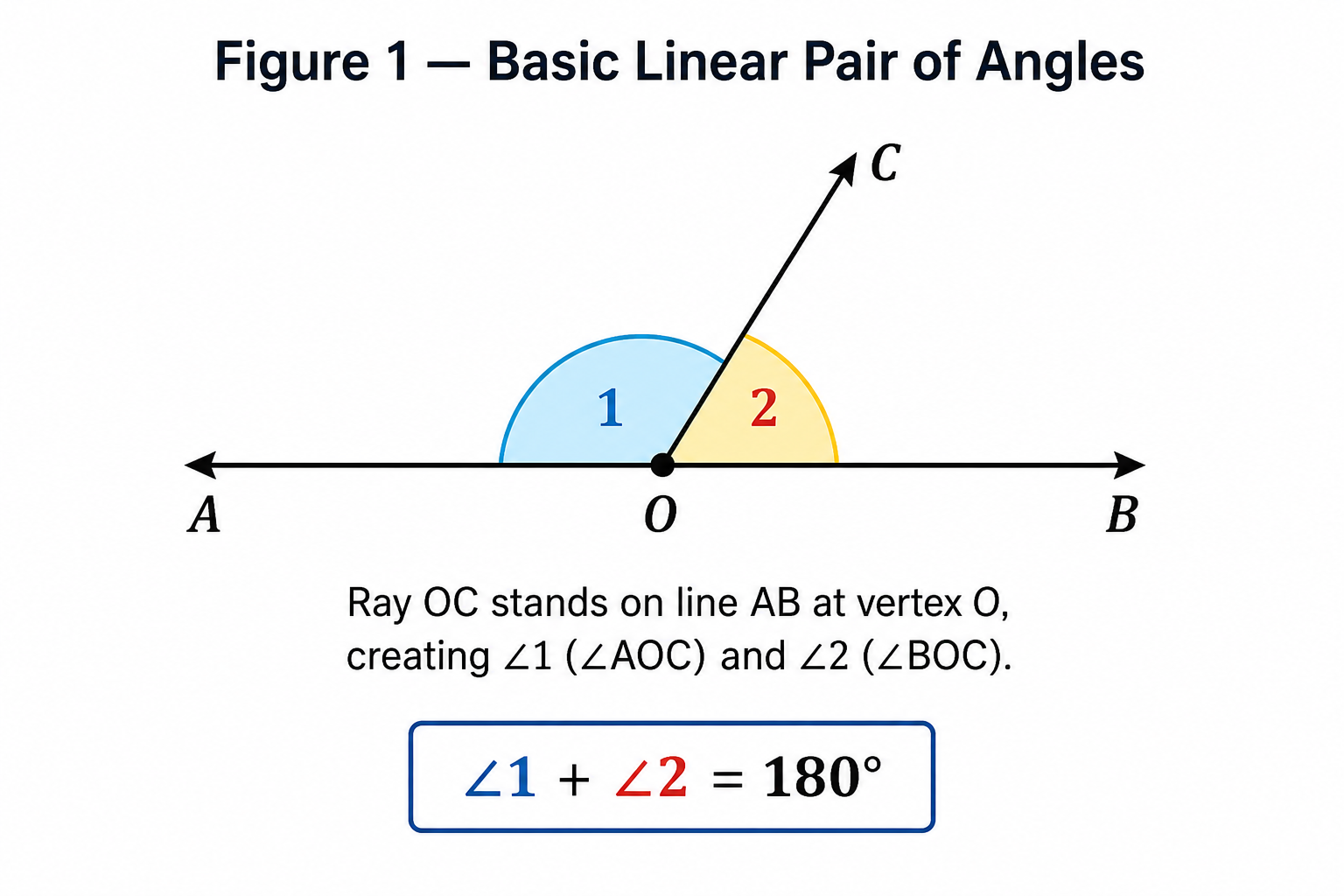
📐 Figure 1 — Basic Linear Pair of Angles
Ray OC stands on line AB at vertex O, creating ∠1 (∠AOC) and ∠2 (∠BOC). ∠1 + ∠2 = 180°
Breaking Down the Term
💡 Memory Trick: Think of a linear pair as a ‘straight angle split in two.’ Any time a ray stands on a straight line, it creates a linear pair — no exceptions. |
If ∠AOC + ∠BOC = 180°, and they are adjacent → Linear Pair ✓ |
Visual Guide to Linear Pair Angles
The diagrams below illustrate the key visual patterns. Use these as a reference when identifying linear pairs in exam figures.
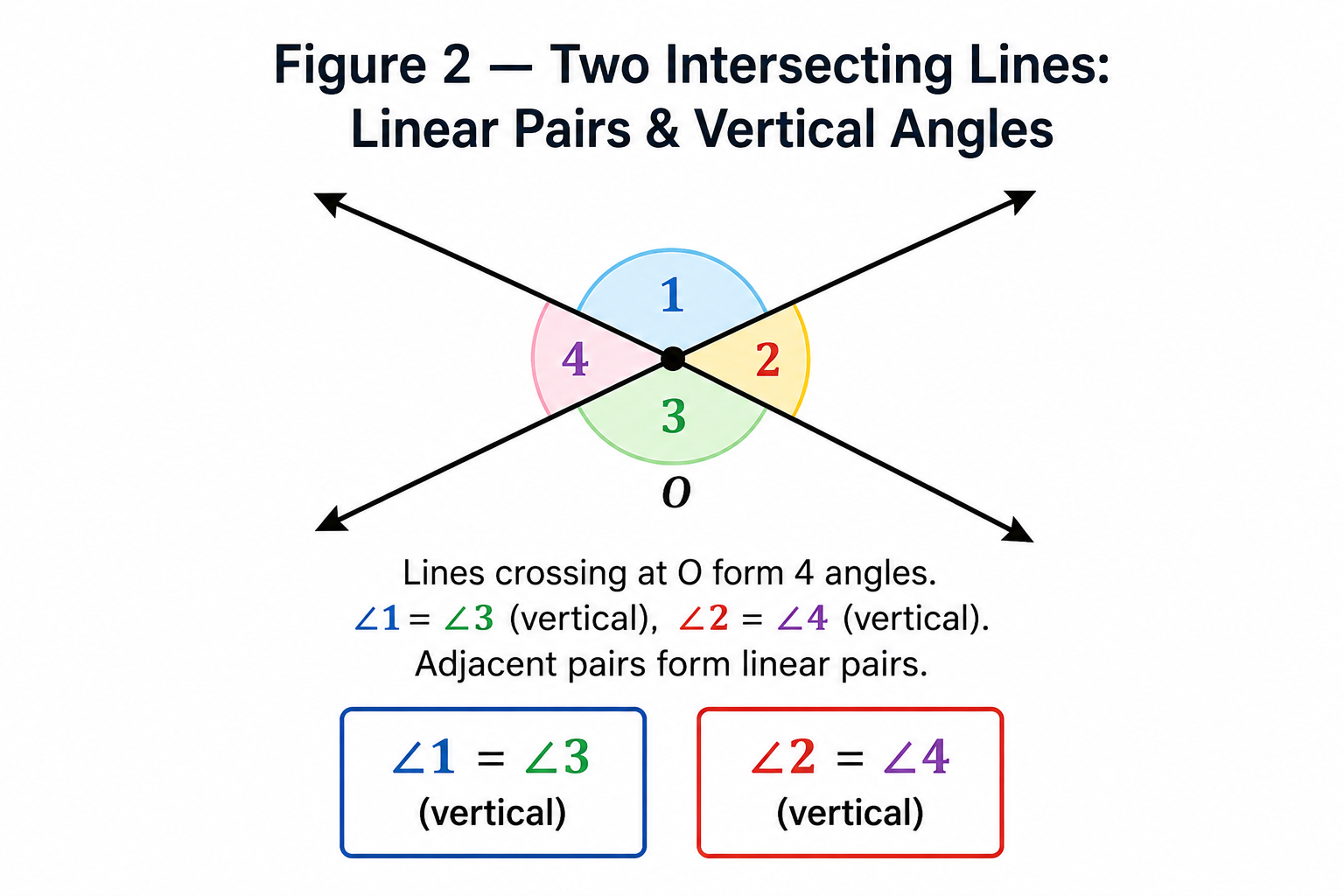
📐 Figure 2 — Two Intersecting Lines: Linear Pairs & Vertical Angles Lines crossing at O form 4 angles. ∠1=∠3 (vertical), ∠2=∠4 (vertical). Adjacent pairs form linear pairs. |
Linear Pair Postulate & Theorem
📜 LINEAR PAIR POSTULATE If two angles form a linear pair, then they are supplementary. That is, if ∠1 and ∠2 form a linear pair, then m∠1 + m∠2 = 180°. |
This postulate is a foundational assumption in geometry — it does not require proof. It is accepted as true based on the definition of a linear pair and the properties of a straight angle (180°).
📐 CONVERSE THEOREM If two adjacent angles are supplementary (sum = 180°), then they form a linear pair. The converse is also true — making this a biconditional relationship. |
Vertical Angles Connection
When two lines intersect, they form two pairs of linear pairs AND two pairs of vertical angles. If you know one angle, you can find all four.
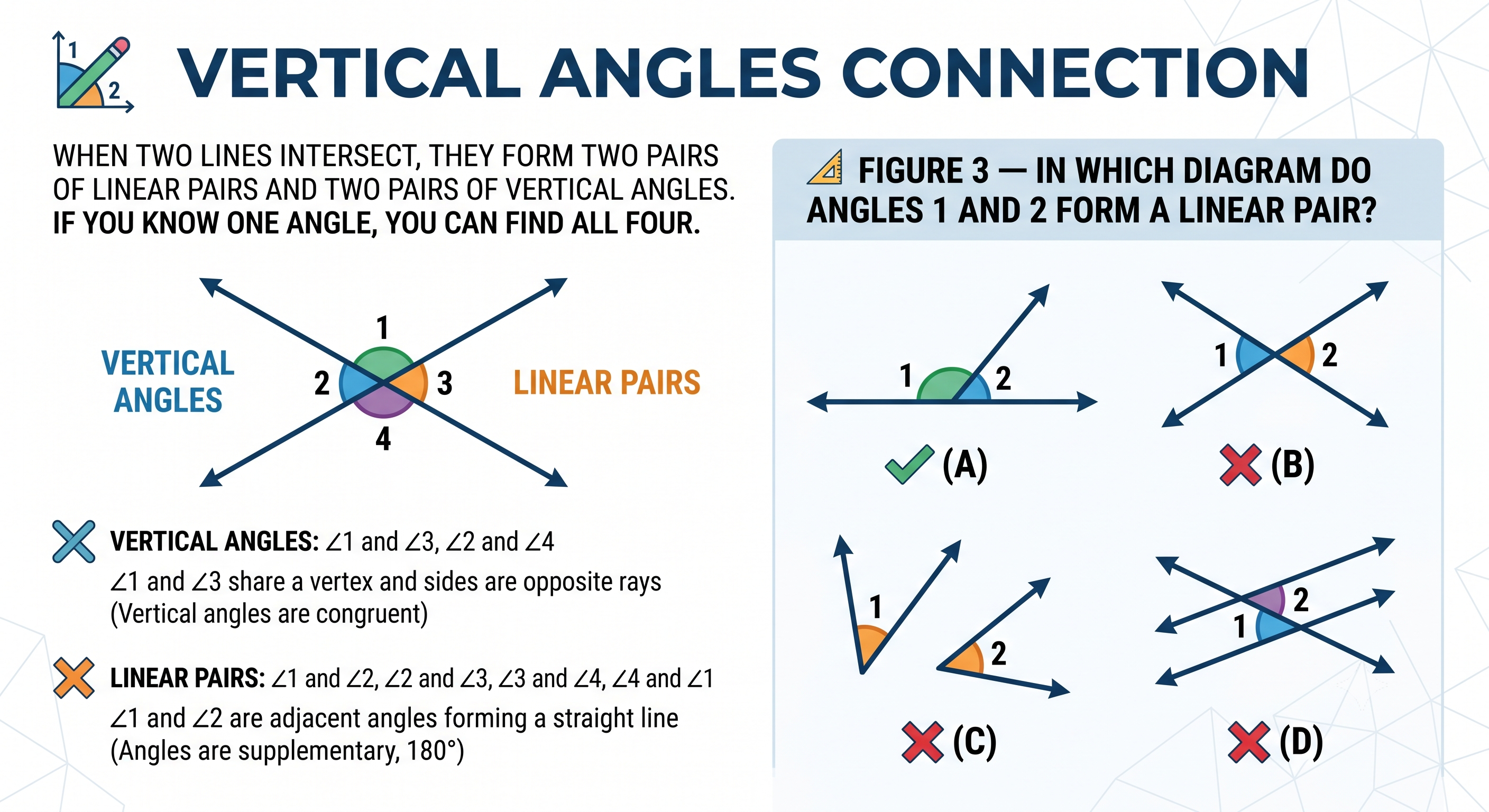
📐 Figure 3 — In Which Diagram Do Angles 1 and 2 Form a Linear Pair? Four diagrams: (A) Ray on a line ✅ | (B) Two rays, no straight line ❌ | (C) Different vertices ❌ | (D) Transversal ✅ |
🔍 Key Answer: Angles 1 and 2 form a linear pair in diagrams where they share a vertex + side AND their outer rays form a straight 180° line. Diagrams with different vertices or non-collinear outer sides do NOT qualify. |
Recommended Reading: How to Use the Sridharacharya Formula to Solve Quadratic Equations
Linear Pair Angles — Worked Examples
Full Walkthrough: ∠1 = (2x + 15)°, ∠2 = (x + 45)°
Linear Pair vs. Supplementary vs. Adjacent Angles
These three concepts are closely related but NOT interchangeable. This is a high-frequency exam confusion point.
| Property | Linear Pair | Supplementary | Adjacent |
|---|---|---|---|
| Sum | Always 180° | Always 180° | Any value |
| Adjacent? | ✅Yes | ❌No | ✅Yes |
| Outer sides = line? | ✅Yes | ❌No | ❌No |
| Common vertex? | ✅Yes | ❌No | ✅Yes |
| Always supplementary? | ✅Yes | ✅Yes (def.) | ❌No |
| Example ▼ | 60°+120° on line | 30° + 150° apart | 45°+35°=80° |
💡 Key Insight: Every linear pair is supplementary. But NOT every pair of supplementary angles is a linear pair. A linear pair has the added requirement that the angles must be adjacent AND their non-common sides must be collinear. |
Real-World Applications of Linear Pair Angles
🏗️ Architecture Roof pitches & rafter cuts use linear pair calculations for structural integrity. | 🛣️ Road Engineering Traffic intersections use linear pair relationships for sight lines. | 🎨 Graphic Design Diagonal elements and UI layouts depend on supplementary angle logic. |
📐 Carpentry Miter cuts: both angles of a cut on a straight piece of wood form a linear pair. | 🔭 Physics & Optics Law of reflection uses linear pairs formed at a reflecting surface. | 🚀 Navigation Bearing calculations in aviation and marine navigation use supplementary angle pairs. |
The L.I.N.E. Framework for Linear Pair Problems
Use this 4-step framework for any linear pair problem — from basic identification to complex algebraic problems.
FAQs: Linear Pair of Angles
The most commonly searched questions about linear pair angles, optimized for AI Overview and featured snippets.
Q1: What is a linear pair of angles?
A linear pair of angles is formed when two adjacent angles share a common vertex and a common ray, with their non-common sides forming a straight line. The two angles are always supplementary, summing to exactly 180°. Example: if one angle is 60°, its linear pair partner is 120°.
Q2: In which diagram do angles 1 and 2 form a linear pair?
Angles 1 and 2 form a linear pair in a diagram where (1) both angles are adjacent — sharing a vertex and a common side — and (2) their non-shared sides lie on the same straight line. This occurs when a ray stands on a line, dividing it into two angles. A transversal crossing a straight line also creates linear pairs at the intersection.
Q3: Can a linear pair have two equal angles?
Yes! If both angles in a linear pair are equal, each must measure 90° (since 90°+90°=180°). This happens when a perpendicular line meets another line — creating two right angles that form a linear pair.
Q4: Is every supplementary pair also a linear pair?
No. Two angles can sum to 180° without being adjacent or even near each other. Those are supplementary but NOT a linear pair. A linear pair requires the additional conditions of adjacency and collinearity of the outer sides.
Q5: What is the linear pair postulate?
The Linear Pair Postulate states: ‘If two angles form a linear pair, then they are supplementary.’ So if ∠1 and ∠2 are a linear pair, then m∠1 + m∠2 = 180°. This is a postulate — accepted without proof — following from the definition of a straight angle.
Q6: How do you identify a linear pair in a figure?
Check three things: (1) Find two angles sharing the same vertex. (2) Check they share exactly one common ray. (3) Verify the two non-shared rays form a straight 180° line. Quickest visual: does a single ray stand on a straight line at that vertex? If yes — linear pair.
Q7: Can three angles form a linear pair?
Strictly speaking, a ‘linear pair’ refers to exactly two angles. When two or more rays stand on a straight line, they create multiple adjacent angles summing to 180°. Individual adjacent pairs among them are each linear pairs, but three together are not called a single linear pair.
You can opt for our Advanced Math or Vedic Math+Mental Math courses. Our Math Quiz for grades 3rd, 4th, 5th, and 6th helps in further exciting and engaging in mathematics with hands-on lessons.