Attend our in-person Robotics & Math


If you’ve ever had to split a restaurant bill among friends or share a box of donuts, you have performed division. But in the world of mathematics, every number in a division problem has a specific identity and a dedicated job to do.
One of the most critical components of this process is the dividend math concept. Understanding what is a dividend in math is the foundational stepping stone to mastering long division, fractions, algebra, and beyond.
Want to ace your next math assignment or teach the concept with absolute confidence? Let’s narrow down the topic dividend definition math rules, formulas, and real-world examples.
What is a Dividend in Math?
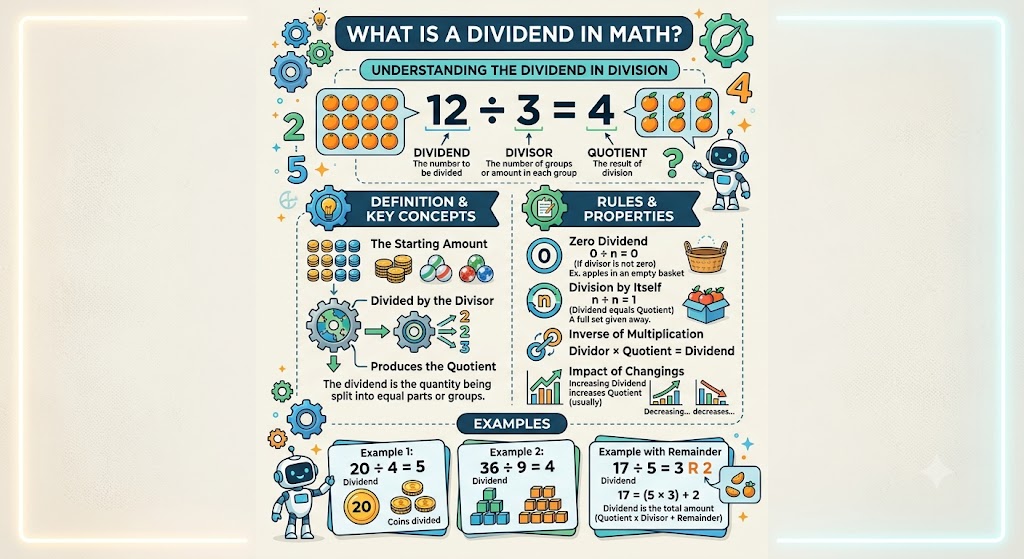
The term dividend in mathematics always refers to the total number or monetary value split into equal parts amongst a group or groups. It is basically the sum of the quantity being divided in the division process. Say you have 15 apples and want to divide them among 3 friends; hence, 15 apples in this case can be termed as the dividend since it is the total number of apples that would be divided in this case.
The Core Parts of Division
To get what the dividend in math is, it helps to see how it interacts with its three partners. These four elements are present in every standard division problem:
Dividend: The starting number (the number being divided).
Divisor: The number you are dividing by (the number of equal groups you are making).
Quotient: The final answer ( how much or how many wind up in each group ) .
Remainder: The amount left over if the dividend cannot be divided evenly into a whole number.
The Ultimate Division Formula & Formats
The dividend will be in different places depending on how a math problem is written. The fundamental relationship between these parts, however, is always the same. The dividend will be in different places depending on how a math problem is written. The fundamental relationship between these parts, however, is always exactly the same.
Division Representation Styles
This is how the dividend is written and identified in standard mathematical structures. Here’s a formatted table you can easily copy and paste into your blog:
| Format Type | Structure | Example (12 ÷ 3 = 4) |
|---|---|---|
| Linear (Inline) | Dividend ÷ Divisor = Quotient | 12 ÷ 3 = 4 |
| Fractional | Dividend / Divisor = Quotient | 12 / 3 = 4 |
| Long Division Box |
3 ) 12
|
3 ) 12
|
The Verification Formula
What happens if your division doesn’t split evenly and leaves you with a remainder? You can easily check if your math is correct by using the universal verification formula:
Dividend = (Divisor × Quotient) + Remainder
Crucial Rules of Dividend Math
| Rule | Description |
|---|---|
|
1. The Zero Rules
|
|
|
2. The Rule of One
|
If the divisor is 1, the quotient will always be exactly the same as the dividend.
Example: 25 ÷ 1 = 25 |
|
3. Size Limitations (Or Lack Thereof!)
|
In elementary arithmetic with whole numbers, the dividend is usually larger than or equal to the divisor.
However, when working with decimals and fractions, the dividend can be smaller than the divisor. Example: 2 ÷ 4 = 0.5 |
Step-by-Step Examples
Let's look at two clear examples to solidify your understanding of how dividends function in real problems.
| Example 1: Perfect Division (No Remainder) | Example 2: Division with a Remainder |
|---|---|
|
Problem: 45 ÷ 9 = 5
|
Problem: 23 ÷ 4
Checking the Work:
(Divisor × Quotient) + Remainder = Dividend
(4 × 5) + 3 = 23
20 + 3 = 23 ✓
The math checks out perfectly! |
Conclusion
When it comes to mathematics, grasping the meaning of the word ‘dividend’ is one of the basic steps of understanding how division as a mathematical operation works. A dividend is the number that must be divided into groups, which know how many groups must be made, and what the result of the division will be, which is expressed in the quotient. Whether you deal with simple numeric problems or have to use decimals, fractions, or long division, the right interpretation of the meaning of the dividend will help you accomplish the calculations you have to perform easily and accurately.
To learn the meaning of dividend in math, students should practice by solving examples and have thorough knowledge about the connections between the terms dividend, divisor, and the result of the division process, quotient, and the remainder.
You can opt for our Advanced Math or Vedic Math+Mental Math courses. Our Math Quiz for grades 3rd, 4th, 5th, and 6th helps in further exciting and engaging in mathematics with hands-on lessons.