Attend our in-person Robotics & Math


The fraction 1/16 written as a decimal is 0.0625.
To convert 1/16 as a decimal, simply divide the numerator (1) by the denominator (16). Since 16 goes into 1.0000 exactly 0.0625 times with no remainder, it results in a terminating decimal value.
What is 1/16 as a Decimal?
Converting between fractions and decimals is a fundamental math skill used in engineering, woodworking, cooking, and daily measurements. If you are looking for 1/16 as a decimal, the exact answer is 0.0625.
Understanding what is 1/16 as a decimal allows you to make precise digital calculations without rounding errors.
Step-by-Step: How to Convert 1/16 as a Decimal
Every fraction represents a division problem where the top number (numerator) is divided by the bottom number (denominator).
To calculate what is 1/16 as a decimal, set up the division: 1 ÷ 16.
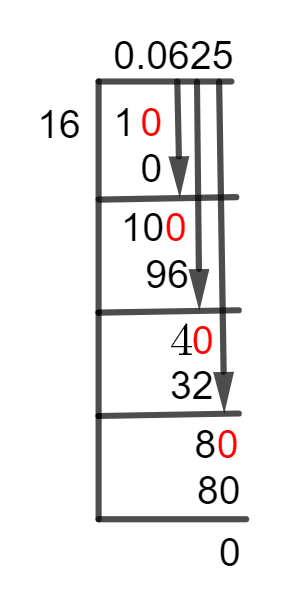
Long Division Method:
- Set Up the Dividend: Place 1 inside the division bracket and add decimal zeros (1.0000).
- First Division Step: 16 cannot go into 1, so write 0. Place the decimal point directly above.
- Second Step (10): 16 cannot go into 10, so add another 0 after the decimal point (0.0).
- Third Step (100): 16 goes into 100 six times (16 × 6 = 96). Write 6. Subtract 96 from 100 to get a remainder of 4. Bring down a zero to make 40.
- Fourth Step (40): 16 goes into 40 two times (16 × 2 = 32). Write 2. Subtract 32 from 40 to get a remainder of 8. Bring down a zero to make 80.
- Final Step (80): 16 goes into 80 exactly five times (16 × 5 = 80). Write 5.
Common 16ths Fraction-to-Decimal Conversion Chart
When working with fractions and decimals, memory aids like conversion charts save time. Here is how common sixteenth-inch and unit fractions translate:
Recommended Reading : 6th Grade Math Quiz: 10 Practice Questions With Answers
| Fraction | Calculation | Decimal Value |
|---|---|---|
| 1/16 | 1 ÷ 16 | 0.0625 |
| 3/16 | 3 ÷ 16 | 0.1875 |
| 5/16 | 5 ÷ 16 | 0.3125 |
| 7/16 | 7 ÷ 16 | 0.4375 |
| 9/16 | 9 ÷ 16 | 0.5625 |
| 11/16 | 11 ÷ 16 | 0.6875 |
| 13/16 | 13 ÷ 16 | 0.8125 |
| 15/16 | 15 ÷ 16 | 0.9375 |
Alternative Method: Converting Using Scale Factors
Another way to bridge fractions and decimals without long division is to convert the denominator into a power of 10 (such as 100, 1,000, or 10,000).
Since 16 × 625 = 10,000, multiply both the numerator and the denominator by 625:
Now, divide 625 by 10,000 by moving the decimal point 4 places to the left:
This confirms that what is 1/16 as a decimal equals 0.0625.
Conclusion
And if you already know the decimal equivalent of 1/16, then it is easy and helpful to convert fractional values to decimals. Or if we use a denominator of 10,000, then we divide 1 by 16, and we see 0.0625. 1/16 is a terminating decimal because it terminates with no remainder.
You can opt for our Advanced Math or Vedic Math+Mental Math courses. Our Math Quiz for grades 3rd, 4th, 5th, and 6th helps in further exciting and engaging in mathematics with hands-on lessons.
Frequently Asked Questions
Is 1/16 a terminating decimal?
Yes. When converting 1/16 as a decimal, the division ends with a remainder of zero, resulting in a terminating decimal (0.0625) rather than a repeating one.
How do you convert 1/16 to a percentage?
To convert a decimal to a percentage, multiply by 100. Take 0.0625 × 100, which equals 6.25%.
Why do we convert between fractions and decimals?
Working with fractions and decimals depends on the application. Imperial measurement tools (like tape measures) typically use sixteenth-inch fractions, whereas digital tools, spreadsheets, and CAD software require decimals for accurate computation.