If you are a student preparing for the SAT, AP Calculus, or competitive exams like the JEE, you know the feeling of dread when you see a trig function raised to a massive power inside an integral. Imagine seeing \(\displaystyle \int_{0}^{\pi/2} \sin^{-7}(x)\,dx\) and thinking you have to use integration by parts or reduction formulas over and over again. It’s exhausting!
But what if I told you there’s a “magic” formula that lets you solve these in seconds? It’s called the Wallis Formula, named after the great mathematician John Wallis. This isn’t just a shortcut; it’s a game-changer for your math toolkit.
The Golden Rule: Check Your Boundaries
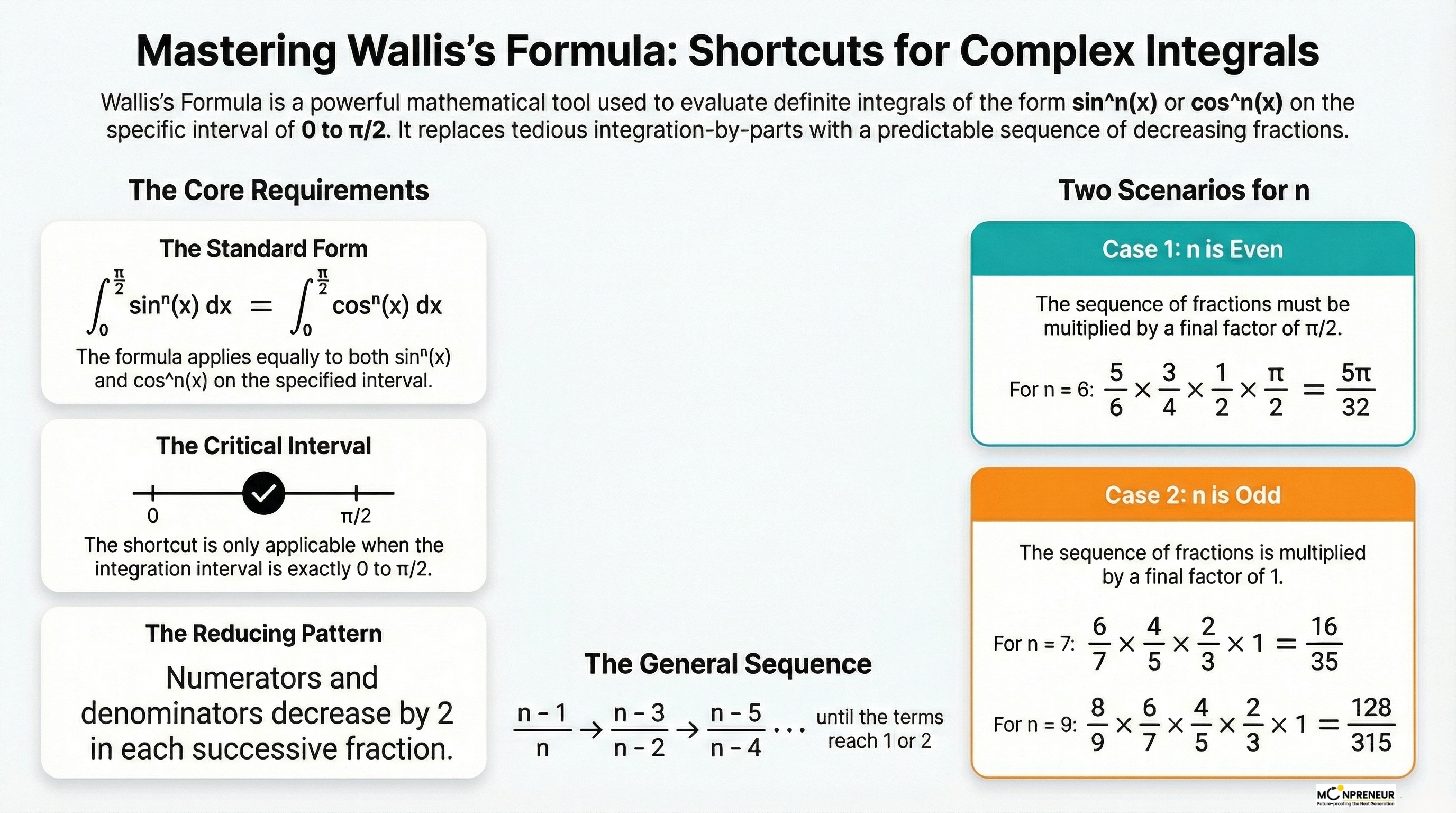
Before we dive into the math, there is one non-negotiable rule. The Wallis Formula only works if your integration interval is from 0 to π/2. If you see those limits and a power of sine or cosine, you’re ready to use the hack.
Interestingly, the formula works exactly the same for both \(\displaystyle \sin^{n}(x)\) and \(\displaystyle \cos^{n}(x)\) .\
The Wallis Formula allows for the instant evaluation of definite integrals of \(\displaystyle \sin^{n}(x)\) or \(\displaystyle \cos^{n}(x)\) from 0 to π/2 without standard integration techniques. For a non-negative integer n, the integral is \(\displaystyle \frac{(n – 1)!!}{n!!}\) ⋅ k, where k = π/2 if n is even and k = 1 if n is odd.
The core Formulas
For an integer n ≥ 0, the integral is defined as:
\(\displaystyle I_n = \int_{0}^{\pi/2} \sin^{n}(x)\,dx
= \int_{0}^{\pi/2} \cos^{n}(x)\,dx\)
The result depends entirely on whether n is odd or even:
Even power Case(n is even):
\(\displaystyle
\int_{0}^{\pi/2} \sin^{n}(x)\,dx
= \frac{n-1}{n} \cdot \frac{n-3}{n-2} \cdots \frac{1}{2} \cdot \frac{\pi}{2}
\quad \text{(for even } n\text{)}
\)
Odd Power Case (n is odd):
\(\displaystyle
\int_{0}^{\pi/2} \sin^{n}(x)\,dx
= \frac{n-1}{n} \cdot \frac{n-3}{n-2} \cdots \frac{2}{3} \cdot 1
\quad \text{(for odd } n\text{)}
\)
How It Works: Even vs. Odd Powers
The beauty of this formula is its symmetry. You just need to look at the exponent (n) and decide if it is even or odd.
Case 1: The Exponent is Odd (e.g., n=3,5,7,9…)
The pattern is simple: start with (n−1) in the numerator and n in the denominator. Then, keep subtracting 2 from both until you hit the end of the line.
The Pattern: \(\displaystyle
\frac{n-1}{n} \times \frac{n-3}{n-2} \times \frac{n-5}{n-4}
\) ending at \(\displaystyle \frac{2}{3} \times 1\)
Example: Let’s Solve \(\displaystyle \int_{0}^{\pi/2} \sin^{7}(x)\,dx\)
- Start with n = 7.
- Numerator: 7 − 1 = 6 and Denominator: 7. Fraction = 6/7.
- Subtract 2: 6 − 2 = 4. 7 − 2 = 5. Fraction = 4/5.
- Subtract 2 again: 4 − 2 = 2. 5 − 2 = 3. Fraction = 2/3.
- Multiply them: (6/7) × (4/5) × (2/3) = 16/35
Case 2: The Exponent is Even (e.g., n=2,4,6…)
The pattern is almost the same, but with one “special ingredient” at the end: multiply by π/2.
- The Pattern: \(\displaystyle
\frac{n-1}{n} \times \frac{n-3}{n-2} \cdots \frac{1}{2} \times \frac{\pi}{2}
\)
Example: Let’s Solve \(\displaystyle \int_{0}^{\pi/2} \cos^{6}(x)\,dx\)
- Start with n = 6.
- Follow the pattern: (5/6) × (3/4) × (1/2).
- Add the special ingredient: multiply by π/2.
- Result: (5/6) × (3/4) × (1/2) × (π/2) = 5π/32
Wait, why does this work?
For the curious minds who want to know the “why” behind the magic: this formula is derived using integration by parts. The formula is derived using a reduction formula. By applying integration by parts, you can prove that: \(\displaystyle I_n = \left(\frac{n-1}{n}\right) I_{n-2}\)
The “tail” of the Wallis Formula exists because the recursion eventually hits either I1( which is \(\displaystyle \int_{0}^{\pi/2} \sin(x)\,dx = 1\) ) or I0(which is \(\displaystyle \int_{0}^{\pi/2} 1\,dx = \frac{\pi}{2}\))