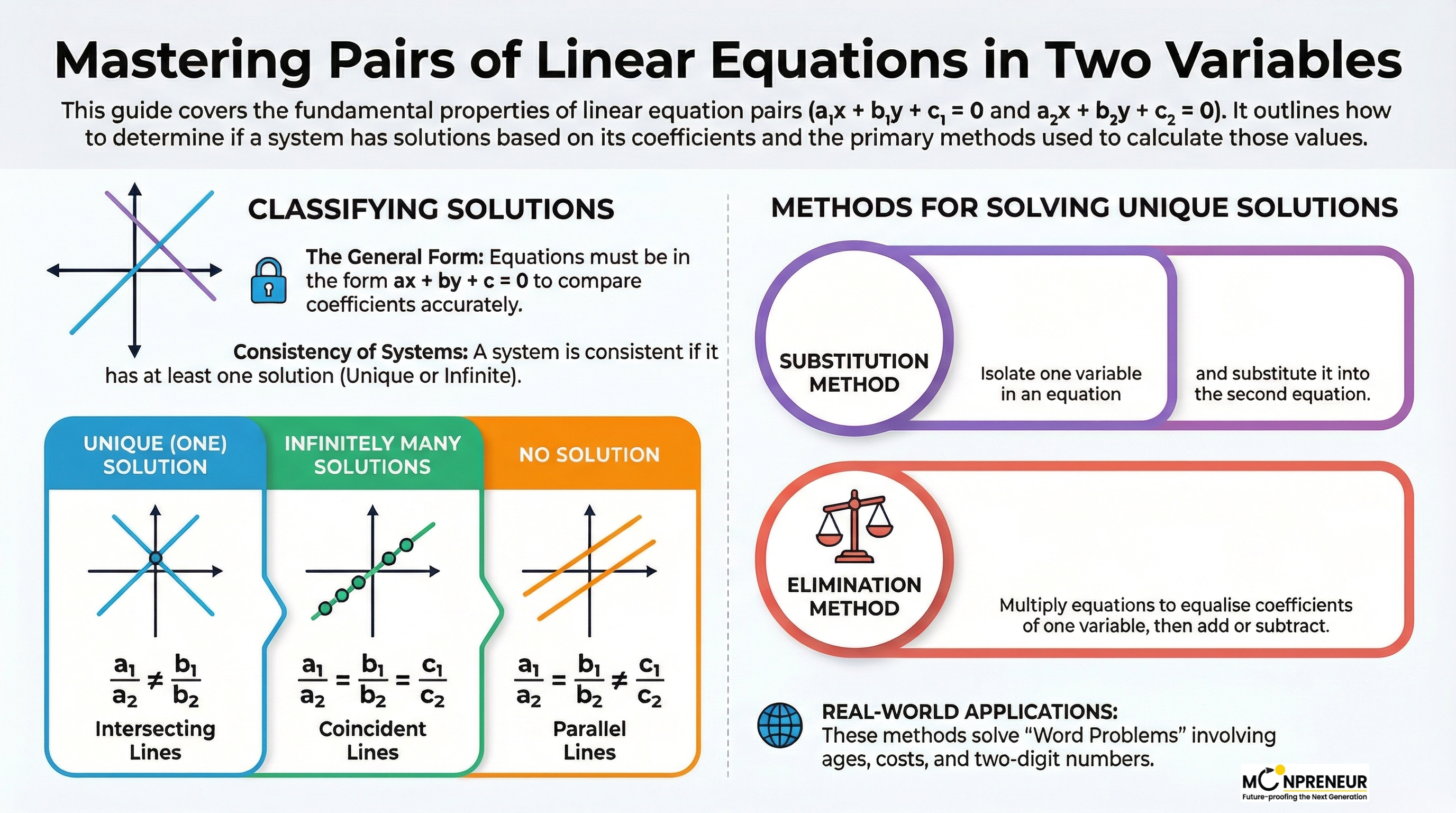
Algebra can often feel like a puzzle with too many pieces, but when it comes to pairs of linear equations in two variables, it is all about finding common ground. Whether you are prepping for your board exams or tackling the SAT, understanding how two lines interact is a superpower. Let’s break down the essentials from the sources to help you master this core topic.
What is a Pair of Linear Equations in Two Variables?
A Pair of Linear Equations in Two Variables is a set of two equations, each of the first degree, involving two unknowns (typically x and y).
These equations represent straight lines when plotted on a graph. The solution to the pair is the set of values (x, y) that satisfy both equations at the same time. You’ll find this concept applied in areas such as simultaneous equations, graphical representation, and solving word problems based on ages, money, speed, and more.
Think of a single equation like x + y = 2. This has infinitely many solutions because there are endless combinations of x and y that make it true. However, in this chapter, our goal is to find a specific solution—a set of values for x and y that satisfies both equations at the exact same time
Key Formula
Here’s the standard formula:
\(\displaystyle a_{1}x + b_{1}y + c_{1} = 0\) ……(i)
\(\displaystyle a_{2}x + b_{2}y + c_{2} = 0\) ……(ii)
where \(\displaystyle a_{1}, a_{2}, b_{1}, b_{2}, c_{1}, c_{2}\) are real numbers and x & y are variables. The aim is to find a common solution (x,y) that satisfies both equations simultaneously.
The Three Possibilities: Will They Ever Meet?
1. Unique Solution (The Intersection): The lines cross at exactly one point. This happens when the ratios of the coefficients of x and y are not equal, you have one unique solution.
Condition: \(\displaystyle \frac{a_{1}}{a_{2}} \ne \frac{b_{1}}{b_{2}}\)
Example: x + y = 5 and x – y = 1. They meet at (3,2).
2. Infinite Solutions (The Overlap): The two equations are actually describing the same line. They sit right on top of each other (coincident lines), meaning every point is a solution. This occurs when all ratios are equal.
Condition: \(\displaystyle \frac{a_{1}}{a_{2}} = \frac{b_{1}}{b_{2}} = \frac{c_{1}}{c_{2}}\)
Example: x = y = 5 and 2x + 2y = 10.
3. No Solution (The Parallel Tracks): The lines are parallel and will never meet. This happens when the x and y ratios match, but the constant ratio is different.
Condition: \(\displaystyle \frac{a_{1}}{a_{2}} = \frac{b_{1}}{b_{2}} \ne \frac{c_{1}}{c_{2}}\)
Example: x + y = 2 and x+ y = 8 (a number cannot add up to 2 and 8 at the same time.)
SAT Tip: If a question asks for a value of a constant (like ‘k‘) that results in “no solution,” you can quickly set up these ratios to find your answer
How to Solve: The Algebraic Methods
There are two main ways to solve these without drawing a graph. Let’s use the same example for both: Find x and y.
x + y = 7 (i)
2x – y = 8 (ii)
The Substitution Method
This is a three-step dance: pick one equation, solve for one variable (like x), and then “plug” that value into the other equation.
- Isolate: From (i), we get x = 7 – y.
- Substitute: put this x value into eq(ii): 2(7 – y) – y = 8
- Solve for y:
- 14 – 2y – y = 8
- 14 – 3y = 8
- -3y = -6
- Y = 2
Find x: plug y = 2 back into x = 7 – y. So x = 5.
The Elimination Method
This is often the fastest for SAT students. You manipulate the equations (using the LCM of the coefficients) so that one variable “cancels out” when you add or subtract the equations together.
- Line them up:
- Add them: since we have +y and -y, adding the equations eliminates y immediately.
- (x + 2x) + (y – y) = 7 + 8
- 3x = 15
- X = 5
- Find y: Substitute x = 5 into the first equation: 5 + y = 7, So y = 2.
The Graphical Method
Plot both lines on a graph. The coordinates (x,y) of the point where they intersect are your solution.
Real-World Example: The Ticket Booth
Imagine you bought 5 tickets to a movie. Adult tickets (x) cost $10, and child tickets (y$) cost $5. If you spent $40 total, how many of each did you buy?
Equation 1 (Total tickets): x + y = 5
Equation 2 (Total cost): 10x + 5y = 40
Using Substitution:
x = 5 – y
10(5 – y) + 5y = 40
50 – 10y + 5y =40
-5y=-10
y=2 Children)
x = 3 (Adults)
For a more detailed walkthrough, you can watch this video: