Imagine you’re sitting in the SAT exam hall. You’ve just bubbled in “B” for three questions in a row. As you move to the fourth question, you feel a slight pang of anxiety. It can’t be “B” again, right? You think. The odds of four “B”s in a row must be tiny. A “D” or an “A” is definitely “due.”
If this sounds familiar, you’ve just met one of the most common “glitches” in the human brain. Whether you’re staring at an OMR sheet or a roulette wheel, your intuition is likely falling for the Gambler’s Fallacy. Today, we’re going to deep dive into why our brains crave patterns—and how the Law of Large Numbers is the cold, hard math that actually rules the world.
The Night Millions Vanished: The Monte Carlo Story
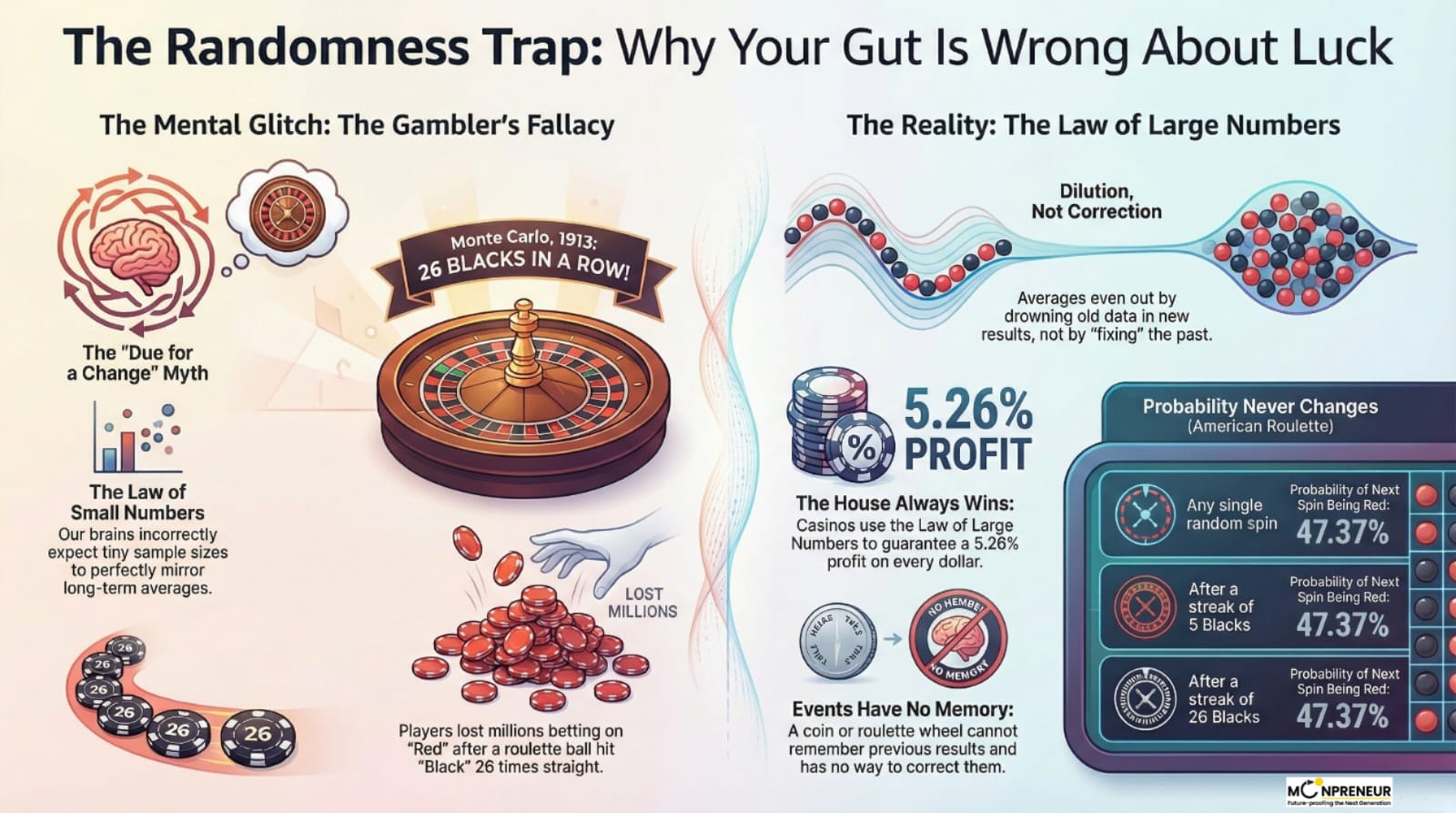
To understand these concepts, we have to go back to a hot summer night in 1913 at the Monte Carlo Casino. A roulette ball landed on black. Then black again. Then black a third time. By the time it happened ten times in a row, the air was electric.
The crowd was certain: Red was “due.” They started shoveling money onto red, convinced the universe had to balance things out. But the ball landed on black again. And again. It happened 26 times in a row. By the time the streak finally broke, millions of francs had vanished into the casino’s vaults.
The players weren’t stupid; they were just human. They were victims of the Gambler’s Fallacy: the deep-seated belief that past random events can somehow affect future ones.
The Gambler’s Fallacy (The “Memory” Myth)
If observing a series of random events, say the flipping of a fair coin, and we note that the last two tosses resulted in heads, we may expect ( incorrectly due to a misinterpretation of the law of large numbers) that the next flip of the coin will result in tails. As we know, a fair coin has a 50% chance on each flip to land on heads or tails; therefore, for any given set of trials, the results should be evenly split between the two outcomes.
The issue is that no one told the coin. The coin flip result is the result of the many small variations that occur to find it’s landing position. It has no memory or does not consider the tally of previous flips. It is just flying through the air and landing on one side or the other based on this one trial.
With a run of say 5 tosses resulting in heads, there is a 1/32 chance of that occurring. The chance of the next toss being heads or tails remains unchanged; it is 1/2 heads and 1/2 tails. We may wish the result to be tails given the run of 5 heads, yet that is only our belief, not the probability.
If we repeat the experiment of tossing a coin five times many times (many being a large number – say thousands or millions of 5-toss experiments), the result on average would be 2.5 heads per group of five tosses. For any single toss, the result is unknown with an equal chance of a head or tails, whether the first toss or the 1 millionth. None of the many trials provides any information about the results of the sixth toss other than that it remains 50/50.
Why do we fall for it?
Psychologists like Daniel Kahneman and Amos Tversky found that humans are “pattern-seeking machines”. We use something called the representativeness heuristic—a mental shortcut where we think a small sample (like 5 coin flips) should perfectly mirror the 50/50 long-term average. Tversky called this the “Law of Small Numbers,” which is actually a sarcastic name for our brain’s mistaken belief that tiny samples represent the whole.
The Law of Large Numbers (The Long Game)
The law of large numbers is a theorem in probability theory that states that as the number of trials in an experiment increases, the average of the results will get closer and closer to the expected value. In other words, the law of large numbers says that if you repeat an experiment many times, the results will tend to average out.
For Example: If you flip a coin 10 times, you might get 8 heads (80%). But if you flip it 10,000 times, you are almost guaranteed to be very close to 5,000 heads (50%)
What People Get Wrong:
The most common misconception here is that the law of large numbers guarantees that you will eventually get the expected value. This is not true. The law of large numbers only says that the average of the results will converge towards the expected value as the number of trials increases. It does not guarantee that you will ever get the expected value, especially for any finite number of trials (even if that finite number of trials is extremely high). This is what leads to the Gambler’s Fallacy. The law of large numbers only makes predictions on the convergence of infinitely many experiments- it can’t be used to make predictions about a specific experiment.
If you start with 10 tails in a row, the universe doesn’t “force” 10 heads to happen next to even things out.
Instead, the LLN works through dilution, not correction. Those 10 initial tails become a “totally insignificant little blip” when they are drowned out by a million future flips that behave normally. The past isn’t balanced; it’s just overwhelmed by an ocean of new data.
Example:
Scenario: 10 consecutive coin tosses land on heads.
- Gambler’s Fallacy: Believing tails is “due” on the 11th toss. This is false; the probability remains 50/50.
- Law of Large Numbers: The 10 heads represent a small, extreme sample. Over 10,000 more tosses, the 10 heads will become statistically insignificant, and the total ratio will move toward 50/50.