Attend our in-person Robotics & Math


The Quick Answer
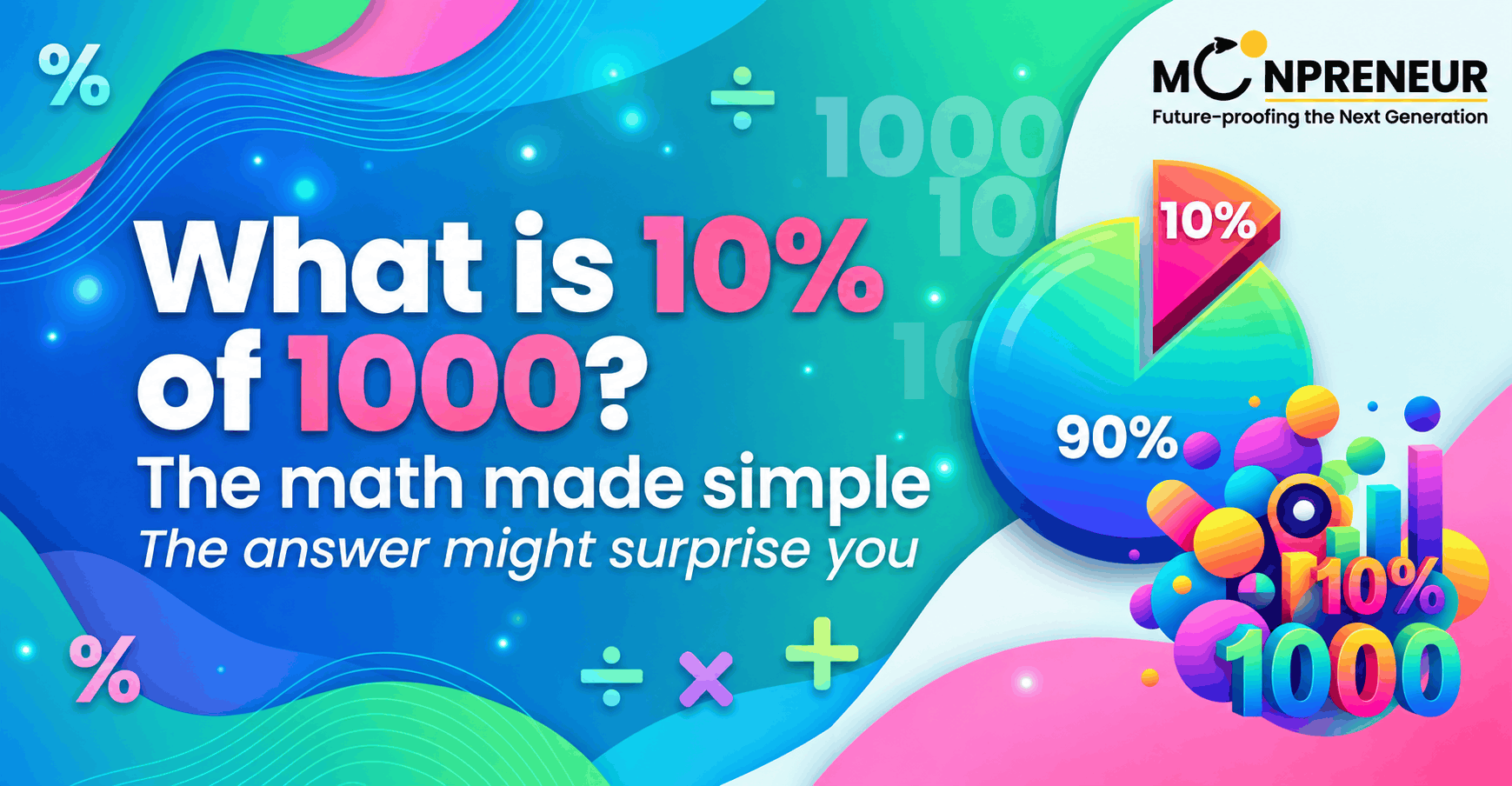
Let’s not keep you waiting. 10% of 1000 is 100.
That’s it. If you typed “what is 10 percent of 1000” or “whats 10 percent of 1000” into a search bar, you now have your answer. But if you’re curious about why it works, and how you can use the same trick to do mental math like a pro, keep reading. This little calculation is a gateway to a skill you’ll use for the rest of your life.
Why 10% of 1000 Equals 100
The word “percent” comes from the Latin per centum, meaning “by the hundred.” So 10% literally means 10 out of every 100.
Now think about 1000. How many hundreds fit inside it? Exactly ten. And if you take 10 from each of those ten hundreds:
10 × 10 = 100
There’s your answer, built from first principles. Finding 10 percent of 1000 is really just asking, “If I split 1000 into 100 equal pieces, what do 10 of those pieces add up to?” Each piece is worth 10, and ten pieces make 100.
Why Prime Numbers Deserve a Spotlight
Imagine every whole number as a LEGO creation. Some are built from smaller bricks: 12 is 2 × 2 × 3, and 30 is 2 × 3 × 5. But a few numbers refuse to be broken down. They are the bricks themselves. These are the prime numbers, and they quietly power everything from your online banking password to the way mathematicians understand the universe of numbers.
If you are a student cramming for an exam, a teacher building a worksheet, or just a curious mind, this guide gives you everything you need about prime numbers up to 150: the full list, a quick-reference chart, the total count, and some fun patterns you can use to impress your friends.
What Is a Prime Number? (Quick Refresher)
A prime number is a whole number greater than 1 that has exactly two factors: 1 and itself. That is it. No other number divides it evenly.
- 7 is prime, because only 1 and 7 divide it.
- 9 is not prime, because 3 also divides it (9 = 3 × 3).
- 1 is not prime, because it has only one factor.
- 2 is the only even prime, and the friendly oddball of the family.
List of Prime Numbers Up to 150
Here is the complete list of prime numbers up to 150:
2, 3, 5, 7, 11, 13, 17, 19, 23, 29, 31, 37, 41, 43, 47, 53, 59, 61, 67, 71, 73, 79, 83, 89, 97, 101, 103, 107, 109, 113, 127, 131, 137, 139, 149
Copy it, screenshot it, or stick it on your study wall. This is the full list of prime numbers up to 150, with nothing missing and nothing extra.
Number of Prime Numbers Up to 150
How many are there? The number of prime numbers up to 150 is 35.
- Primes up to 100: 25
- Primes between 101 and 150: 10 (101, 103, 107, 109, 113, 127, 131, 137, 139, 149)
- Total up to 150: 25 + 10 = 35
That means roughly 23% of the numbers from 1 to 150 are prime. As numbers grow larger, primes become rarer, which is one reason they fascinate mathematicians.
Quick Chart: Prime Numbers by Range
Use this table for fast lookups.
| Range | Prime Numbers | Count |
|---|---|---|
| 1 to 10 | 2, 3, 5, 7 | 4 |
| 11 to 20 | 11, 13, 17, 19 | 4 |
| 21 to 30 | 23, 29 | 2 |
| 31 to 40 | 31, 37 | 2 |
| 41 to 50 | 41, 43, 47 | 3 |
| 51 to 60 | 53, 59 | 2 |
| 61 to 70 | 61, 67 | 2 |
| 71 to 80 | 71, 73, 79 | 3 |
| 81 to 90 | 83, 89 | 2 |
| 91 to 100 | 97 | 1 |
| 101 to 110 | 101, 103, 107, 109 | 4 |
| 111 to 120 | 113 | 1 |
| 121 to 130 | 127 | 1 |
| 131 to 140 | 131, 137, 139 | 3 |
| 141 to 150 | 149 | 1 |
| Total | 35 | |
How to Find Prime Numbers Up to 150 Yourself
Skip memorizing the list! Use these two simple methods to identify prime numbers with confidence.
The Sieve of Eratosthenes
This 2,000-year-old method is one of the best ways to find prime numbers. Follow these steps for numbers up to 150:
- Write all the numbers from 2 to 150 in a grid.
- Keep 2 and cross out every other multiple of 2, such as 4, 6, 8, and 10.
- Move to the next uncrossed number, 3, and cross out its multiples.
- Repeat the process with 5, 7, and 11.
- Stop at 11 because the square root of 150 is about 12.25. You only need to check prime divisors up to 11.
- Every number greater than 1 that remains uncrossed is prime.
The Trial Division Shortcut
To check whether a number is prime, test whether it is divisible by any prime number up to its square root.
For example, to check 143, test the prime divisors 2, 3, 5, 7, and 11.
Since 143 = 11 × 13, it has factors other than 1 and itself. Therefore, 143 is composite, not prime.
Tricky Numbers That Fool Everyone
Some numbers look prime but are actually composite. Here are a few numbers below 150 that have hidden factors:
Fun Patterns Hidden in the List
Prime numbers are more than just a list. Discover the fascinating patterns hiding in numbers up to 150!
Twin Primes
Twin primes are pairs of prime numbers that differ by exactly 2. Up to 150, there are 11 twin prime pairs.
The Lonely Even Prime
Every prime number except 2 is odd. All other even numbers are divisible by 2, which means they have more than two factors.
The only even prime number!
Its only positive factors are 1 and 2.
The Last Digit Rule
Every prime number greater than 5 must end in 1, 3, 7, or 9. If a larger number ends in 0, 2, 4, 5, 6, or 8, it cannot be prime.
Palindromic Primes
A palindromic number reads the same forwards and backwards. Among the prime numbers up to 150, these are:
Conclusion
Prime numbers are the DNA of mathematics. Every whole number greater than 1 is either a prime or a unique product of primes, and that single idea unlocks factoring, fractions, cryptography, and much more. With the full list, the count of 35, and the quick chart above, you now have a complete toolkit for prime numbers up to 150.
Bookmark this page, share it with a classmate, and next time someone asks whether 91 is prime, you can smile and say, “Nice try, it is 7 times 13.”
Want to excite your child about math and sharpen their math skills? Moonpreneur’s online math curriculum is unique because it helps children build math skills through hands-on lessons, supports real-world applications, and sparks excitement about learning math.
You can opt for our Advanced Math or Vedic Math+Mental Math courses. Our Math Quiz for grades 3rd, 4th, 5th, and 6th helps in further exciting and engaging in mathematics with hands-on lessons.
Frequently Asked Questions
Everything you need to know about prime numbers up to 150.
1. What are the prime numbers up to 150?
The prime numbers up to 150 are 2, 3, 5, 7, 11, 13, 17, 19, 23, 29, 31, 37, 41, 43, 47, 53, 59, 61, 67, 71, 73, 79, 83, 89, 97, 101, 103, 107, 109, 113, 127, 131, 137, 139, and 149.
2. How many prime numbers are there up to 150?
There are 35 prime numbers from 1 to 150.
3. What is the largest prime number below 150?
The largest prime number below 150 is 149.
4. Is 1 a prime number?
No. A prime number has exactly two distinct positive factors: 1 and itself. The number 1 has only one positive factor, so it is not prime.
5. Is 147 prime?
No. 147 = 3 × 7 × 7, so it has factors other than 1 and itself. Therefore, 147 is a composite number.