

The polynomial remainder theorem states that when a polynomial expression f(x) is divided by a linear factor (x − c), the resulting remainder is equal to evaluating the polynomial directly at that point: R = f(c).
Instead of performing lengthier algebraic calculations like long division or synthetic division, you evaluate the original function at x = c to calculate the remainder.
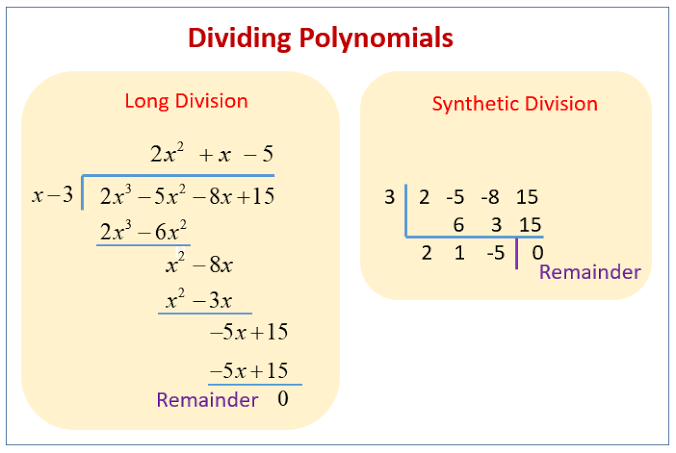
The remainder theorem (often called the polynomial remainder theorem) is an algebraic concept used to find the remainder when a polynomial f(x) is divided by a linear binomial of the form (x − c).
Instead of completing tedious polynomial long division, the remainder theorem shows that evaluating f(c) gives the exact value of the remainder R.
The Remainder Theorem Formula
If a polynomial f(x) is divided by (x − c), then the remainder is:
How the Polynomial Remainder Theorem Works
When dividing a dividend polynomial f(x) by a divisor (x − c), the Division Algorithm gives:
Where:
- f(x) is the original polynomial dividend.
- Q(x) is the quotient polynomial.
- (x − c) is the linear divisor.
- R is the constant remainder.
If we substitute x = c into the equation:
Because multiplying by zero cancels out Q(c), the functional value f(c) always equals the remainder R.
Step-by-Step Example
Let's work through an example to demonstrate what is the remainder theorem in practice.
Step 1: Identify c
From the linear divisor (x − 3), set x − 3 = 0 ⟹ x = 3. So, c = 3.
Step 2: Substitute c into f(x)
Substitute x = 3 directly into the polynomial function:
Step 3: Simplify
f(3) = 54 − 45 + 9 − 7
f(3) = 11
Remainder Theorem vs. Factor Theorem
Factor Theorem and Remainder Theorem
The Factor Theorem is a direct corollary of the Remainder Theorem:
- Remainder Theorem: States that dividing f(x) by (x − c) gives the remainder R = f(c).
- Factor Theorem: States that if f(c) = 0, then the remainder R = 0, meaning (x − c) is an exact factor of f(x).
The Chinese Remainder Theorem: How Does It Differ?
A common point of confusion in algebra and number theory is confusing the polynomial remainder theorem with the Chinese remainder theorem.
While the standard remainder theorem focuses on continuous algebraic polynomials, the Chinese remainder theorem is a fundamental theorem of modular arithmetic and discrete mathematics. It provides a unique solution x for systems of simultaneous linear congruences with coprime moduli:
x ≡ a2 (mod m2)
⋮
x ≡ ak (mod mk)
How to Use a Remainder Theorem Calculator
When checking complex polynomial homework or high-degree functions, a remainder theorem calculator automates these evaluations:
- Enter the Dividend Polynomial: Input f(x) (e.g., 4x4 − 2x2 + 8).
- Input the Divisor: Specify (x − c) or enter the evaluation point c.
- Analyze the Step-by-Step Evaluation: The calculator evaluates f(c) and verifies the result using synthetic division or polynomial long division.
Conclusion
The Remainder Theorem provides a fast and simple way to find the remainder when a polynomial is divided by a linear expression like . You don’t need to do long division of polynomials; you can just plug into the polynomial and calculate . This theorem also helps in testing whether a number is a root of a polynomial and in simplifying polynomial calculations. The Remainder Theorem provides the basis for learning the Factor Theorem, synthetic division, and polynomial equations. Students can develop confidence in applying the theorem to solve polynomial problems accurately and efficiently by practicing with different examples.
You can opt for our Advanced Math or Vedic Math+Mental Math courses. Our Math Quiz for grades 3rd, 4th, 5th, and 6th helps in further exciting and engaging in mathematics with hands-on lessons.
Frequently Asked Questions
What happens if the divisor is in the form (ax − b)?
If the linear divisor is (ax − b), set ax − b = 0 to find x = b/a. According to the theorem, the remainder is R = f(b/a).
Why is the remainder theorem useful?
It allows you to quickly evaluate remainders and test potential roots of high-degree polynomials without performing labor-intensive algebraic long division.
Can the remainder theorem be used for non-linear divisors?
The basic remainder theorem specifically applies to linear divisors of degree 1, such as (x − c). For higher-degree polynomial divisors, polynomial long division or other appropriate polynomial division techniques are required.