Attend our in-person Robotics & Math


Quick Answer
5/8 as a decimal is equal to 0.625.
To convert the fraction five-eighths to its decimal form, simply divide the numerator (5) by the denominator (8):
5 ÷ 8 = 0.625
Understanding Fractions and Decimals
Fractions and decimals are two distinct ways to represent the exact same numerical value:
- Decimal Number: A number made up of a whole number part and a fractional part, separated by a decimal point.
- Fraction: A numerical value that represents a specific part of a whole.
When you need to know what is 5/8 as a decimal, the process requires converting the fraction by dividing the numerator (the top number) by the denominator (the bottom number).
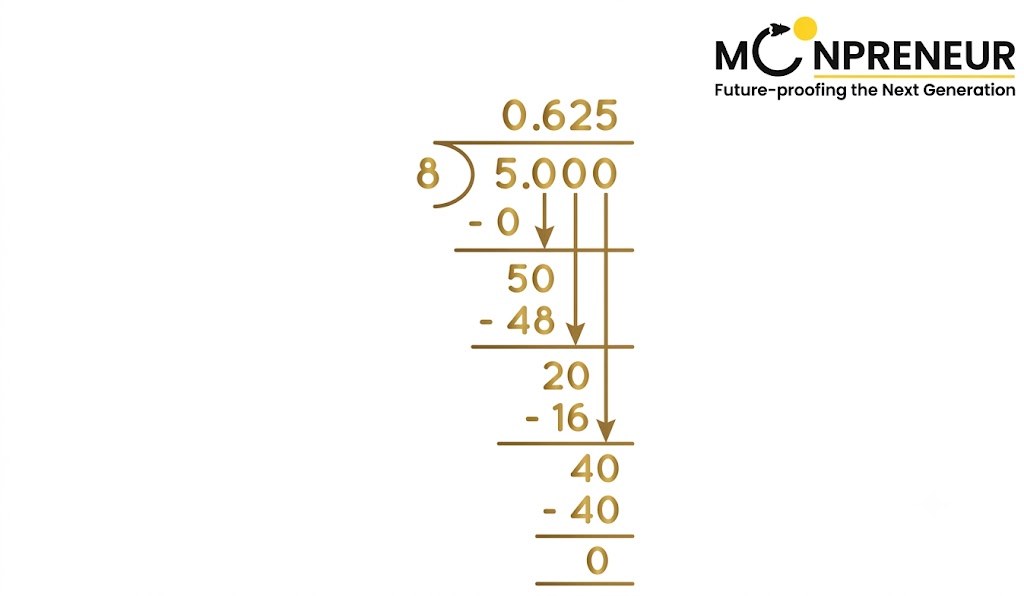
How to Convert 5/8 to a Decimal Using Long Division
How to Convert 5/8 to a Decimal Using Long Division
| Step | Action | Calculation & Explanation |
|---|---|---|
| Step 1 | Identify Terms | Take the numerator (5) and the denominator (8). |
| Step 2 | Set Up Division | Divide the numerator by the denominator (5 ÷ 8). Since 8 cannot divide into 5, place a decimal point after the 5 and add a zero (making it 5.0). |
| Step 3 | First Calculation | 8 goes into 50 6 times (6 × 8 = 48), leaving a remainder of 2. |
| Step 4 | Second Calculation | Bring down another zero to make it 20. 8 goes into 20 2 times (2 × 8 = 16), leaving a remainder of 4. |
| Step 5 | Final Calculation | Bring down a final zero to make it 40. 8 goes into 40 exactly 5 times (5 × 8 = 40), leaving a remainder of 0. |
| Final Result | Quotient | The quotient is 0.625. Therefore, five-eighths expressed as a decimal is 0.625. |
Conclusion
Converting the fraction 5/8 to a decimal is a simple process that will yield 0.625. You can do long division the regular way with 5 divided by 8, and you’ll get a perfect terminating decimal. In math, measurement, and everyday life, converting fractions into decimals makes it easy to compare numbers quickly.
You can opt for our Advanced Math or Vedic Math+Mental Math courses. Our Math Quiz for grades 3rd, 4th, 5th, and 6th helps you get further excited and engaged in mathematics with hands-on lessons.
Frequently Asked Questions
Q: What is 5/8 as a decimal?
A: 5/8 as a decimal is equal to 0.625. To convert the fraction 5/8 to a decimal, divide the numerator (5) by the denominator (8):
Because 8 divides into 5.000 without leaving a remainder, 0.625 is a terminating decimal.
Q: How do you write 5/8 as a decimal using long division?
A: To convert 5/8 into a decimal using long division, follow these steps:
- Set up the division: Place 5 inside the division bracket (dividend) and 8 outside (divisor).
- Add a decimal point: Since 8 cannot go into 5, place a decimal point after 5 and add a zero (5.0).
-
Divide stepwise:
- 8 goes into 50 six times (6 × 8 = 48), leaving a remainder of 2.
- Add another zero to make it 20. 8 goes into 20 two times (2 × 8 = 16), leaving a remainder of 4.
- Add a final zero to make it 40. 8 goes into 40 exactly five times (5 × 8 = 40), leaving a remainder of 0.
Result: The quotient is 0.625.
Q: What is 0.625 as a fraction?
A: 0.625 as a fraction in simplest form is 5/8. To convert the decimal back into a fraction:
1. Write 0.625 over its place value (1,000):
2. Simplify the fraction by dividing both the numerator and denominator by their greatest common divisor (125):
Q: What is 5.8 as a decimal?
A: 5.8 is already a decimal number. It represents a whole number (5) and a fractional part (8 tenths, or 0.8). If you convert the decimal 5.8 into a fraction or mixed number, it equals 5 4/5 (or 29/5 as an improper fraction).
Note: Do not confuse 5.8 with 5/8. 5.8 equals 5 4/5, whereas the fraction 5/8 equals 0.625.