
ANSWER AT A GLANCE
0.6 = 3/5 | 0.6 repeating (0.666…) = 2/3
Why Does 0.6 as a Fraction Matter?
If you have ever asked yourself, “What is 0.6 as a fraction?”, you are definitely not alone. Decimals and fractions are two sides of the same mathematical coin, and knowing how to switch between them is a skill that shows up in school homework, cooking recipes, engineering calculations, and everyday budgeting.
In this guide, we will walk you through everything you need to know, covering the straightforward case of converting 0.6 as a fraction, exploring what happens with 0.6 repeating as a fraction (written as 0.666…), and answering every related question clearly with visuals, tables, and infographics along the way.
Key Takeaway
0.6 as a fraction in its simplest form is 3/5. The repeating version, 0.6 repeating (0.666…), equals 2/3. Both conversions use simple, repeatable steps that anyone can master in minutes.
Understanding the Basics: Decimals and Fractions
Before jumping into the conversion, it helps to understand what decimals and fractions actually represent.
| Concept | Definition | Example |
|---|---|---|
| Decimal | A number expressed in base 10 using a decimal point | 0.6 |
| Fraction | A number expressed as a ratio of two integers (numerator over denominator) | 3/5 |
| Numerator | The top number of a fraction, showing how many parts are taken | 3 in 3/5 |
| Denominator | The bottom number of a fraction, showing the total equal parts | 5 in 3/5 |
| Simplest Form | A fraction where the numerator and denominator share no common factor other than 1 | 3/5 (not 6/10) |
Decimals and fractions are simply two different ways to express the same value. The number 0.6, spoken aloud as “six tenths,” directly tells you its fraction: 6 over 10, which simplifies down to 3/5.
What Is 0.6 as a Fraction? (Step by Step)
Short answer: 0.6 as a fraction is 3/5.
Step-by-Step Conversion Method
Follow these four steps to convert any terminating decimal like 0.6 into a fraction.
| STEP | Action | Result |
|---|---|---|
| 1 | Write as a fraction over 1 | Express 0.6 as 0.6 / 1 |
| 2 | Eliminate the decimal | Multiply the top and bottom by 10 (one decimal place) to get 6 / 10 |
| 3 | Find the GCF | The Greatest Common Factor of 6 and 10 is 2 |
| 4 | Simplify | Divide both numerator and denominator by 2: 6 / 2 = 3, 10 / 2 = 5. Result: 3/5 |
Pro Tip
To verify your answer, simply divide the numerator by the denominator: 3 divided by 5 = 0.6. If you get your original decimal back, the conversion is correct!
What Is 0.6 Repeating as a Fraction?
Short answer: 0.6 repeating (written as 0.666… or 0.6 with a bar over the 6) as a fraction is 2/3.
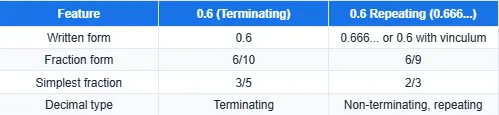
This is an important distinction. 0.6 (terminating) and 0.6 repeating (non-terminating) are two completely different numbers, and they produce different fractions. Here is a quick comparison:
| Decimal | Type | Fraction | Notes |
|---|---|---|---|
| 0.6 | Terminating | 3/5 | Ends after one decimal place |
| 0.6666... (0.6 repeating) | Repeating (Non-terminating) |
2/3 | The digit 6 repeats forever |
How to Convert 0.6 Repeating as a Fraction
Converting a repeating decimal requires a clever algebra trick. Here is the full process:
0.666… = 2/3 |
| Step | Action | Working |
|---|---|---|
| 1 | Assign a variable | Let x = 0.666... |
| 2 | Multiply both sides by 10 | 10x = 6.666... |
| 3 | Subtract the original equation | 10x - x = 6.666... - 0.666... --> 9x = 6 |
| 4 | Solve for x | x = 6/9 |
| 5 | Simplify by GCF | GCF of 6 and 9 is 3 --> 6/9 = 2/3 FINAL ANSWER |
Why multiply by 10?
We multiply by 10 because there is exactly one repeating digit (the digit 6). If two digits are repeated (e.g., 0.363636…), we would multiply by 100. The rule is: multiply by 10 raised to the power equal to the number of repeating digits.
Place Value Chart: Understanding the “Tenths” Column
One of the easiest ways to understand 0.6 as a fraction is to read the place value chart. This gives you the fraction almost instantly.

The digit 6 sits in the tenths column. Reading the decimal aloud gives the fraction directly: “six tenths” = 6/10. Simplifying 6/10 gives 3/5. That is all there is to it!
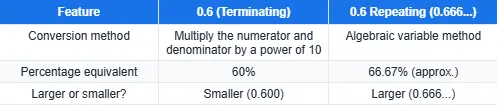
0.6 vs 0.6 Repeating: Side by Side Comparison
Equivalent Fractions of 0.6 (3/5)
Once you know that 0.6 as a fraction = 3/5, you can generate a whole family of equivalent fractions by multiplying both numerator and denominator by the same number.
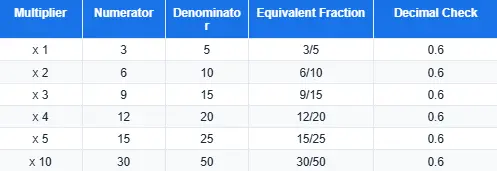
All of the fractions in the table above represent exactly 0.6. They are all equal. The simplest form (where numerator and denominator share no common factor) is 3/5.
Real World Examples of 0.6 as a Fraction
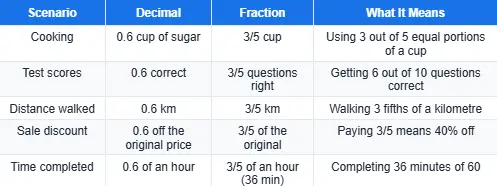
Math concepts stick better when connected to real life. Here are several everyday situations where 0.6 as a fraction (3/5) comes up naturally.
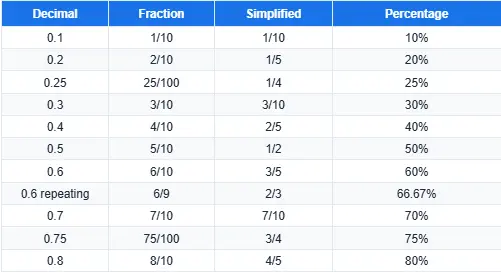
Quick Reference: Common Decimal to Fraction Conversions
Use this cheat sheet to compare 0.6 with other common decimals.

Two Methods to Convert 0.6 to a Fraction: Compared
Method 1: Place Value Method (Recommended for Terminating Decimals)
- Read the place value: 0.6 is six tenths, so write 6/10
- Find the GCF of 6 and 10, which is 2
- Divide: 6 / 2 = 3 and 10 / 2 = 5
- Result: 3/5
Method 2: Algebraic Method (Works for Both Terminating and Repeating)
- Set x = 0.6
- Multiply both sides by 10: 10x = 6
- Subtract: 10x – x = 6 – 0.6 –> 9x = 5.4
- Solve: x = 5.4 / 9 = 0.6
- Or write as 6/10 and simplify to 3/5
Which Method Should You Use?
For terminating decimals like 0.6, the Place Value Method is faster and more intuitive. For repeating decimals like 0.6 repeating, always use the Algebraic Method, as the place value method does not apply to non-terminating decimals.
Common Mistakes to Avoid
| Common Mistake | Correct Approach |
|---|---|
| Confusing 0.6 (terminating) with 0.666... (repeating) | Always check whether the decimal stops or continues forever before converting |
| Leaving the fraction unsimplified at 6/10 | Always divide by the GCF to reach the simplest form: 3/5 |
| Multiplying by 100 instead of 10 for a single decimal digit | Count the decimal places: 0.6 has one, so multiply by 10 (one zero) |
| Forgetting to simplify 6/9 to 2/3 for the repeating decimal | The GCF of 6 and 9 is 3: 6/3 = 2, 9/3 = 3, giving 2/3 |
Everything at a Glance
- 1. Write as 6/10
- 2. GCF of 6 and 10 = 2
- 3. Divide: 3/5
- 1. Let x = 0.666...
- 2. 10x = 6.666..., so 9x = 6
- 3. x = 6/9 = 2/3
Conclusion
Whether you searched for “what is 0.6 as a fraction” or “what is 0.6 repeating as a fraction”, we hope this guide has given you a crystal-clear answer with the working to back it up.
To recap the two key results: 0.6 as a fraction = 3/5, and 0.6 repeating as a fraction = 2/3. These are two distinct numbers with two distinct fractions, converted via two distinct methods. Master the place value method for terminating decimals and the algebraic method for repeating decimals, and you will be able to handle any decimal, to, fraction conversion with confidence.
Remember Always simplify your fraction to its lowest terms using the GCF. A fraction is only truly in its final form when the numerator and denominator share no common factor other than 1. |
You can opt for our Advanced Math or Vedic Math+Mental Math courses. Our Math Quiz for grades 3rd, 4th, 5th, and 6th helps in further exciting and engaging in mathematics with hands-on lessons.