UNLOCK YOUR CHILD'S
POTENTIAL AND CREATIVITY
WITH A FREE TRIAL CLASS
DEVELOP TECHNICAL, SOFT, &
ENTREPRENEURIAL SKILLS
AGE 7-16 YEARS
CLAIM YOUR $10 ROBLOX/AMAZON/MINECRAFT GIFT
CARD BY ATTENDING A FREE TRIAL CLASS
BOOK A FREE TRIAL
Select Your Subject of Choice

    Please enter name

    Please enter email


    Existing knowledge in the chosen stream

    *No credit card required.

    Why Your Integral Isn’t Solving: Common Pitfalls in Applying Calculus Properties

    |

    Whether you are prepping for the SAT or already diving into the “big leagues” of calculus, we’ve all had that moment: you’re staring at an integral, you’ve tried every trick in the book, and the math just isn’t “mathing.” It feels like hitting a brick wall.

    Calculus can feel like a series of complex formulas, but it doesn’t have to be a mystery. As mathematician Alexander Grothendieck suggested, instead of diving into long formulas, we should first make sure the math feels intuitive and reasonable. If your integral isn’t solving, it’s usually because of a few common pitfalls. Let’s break down why integrals are tricky and how to conquer them.

    1. Misapplying u-Substitution (Definite Integrals)

    A frequent, fatal error is using u-substitution in a definite integral without updating the
    boundaries. 
    The Pitfall: Substituting u = g(x) and du = g'(x)dx, but evaluating the result using the original     x-limits, or failing to switch the limits of integration (a and b) to the corresponding u-values (g(a) and g(b)).
    The Result: A numerically incorrect answer, even if the integration method was otherwise sound.

    2. Missing the foundations of previous knowledge 

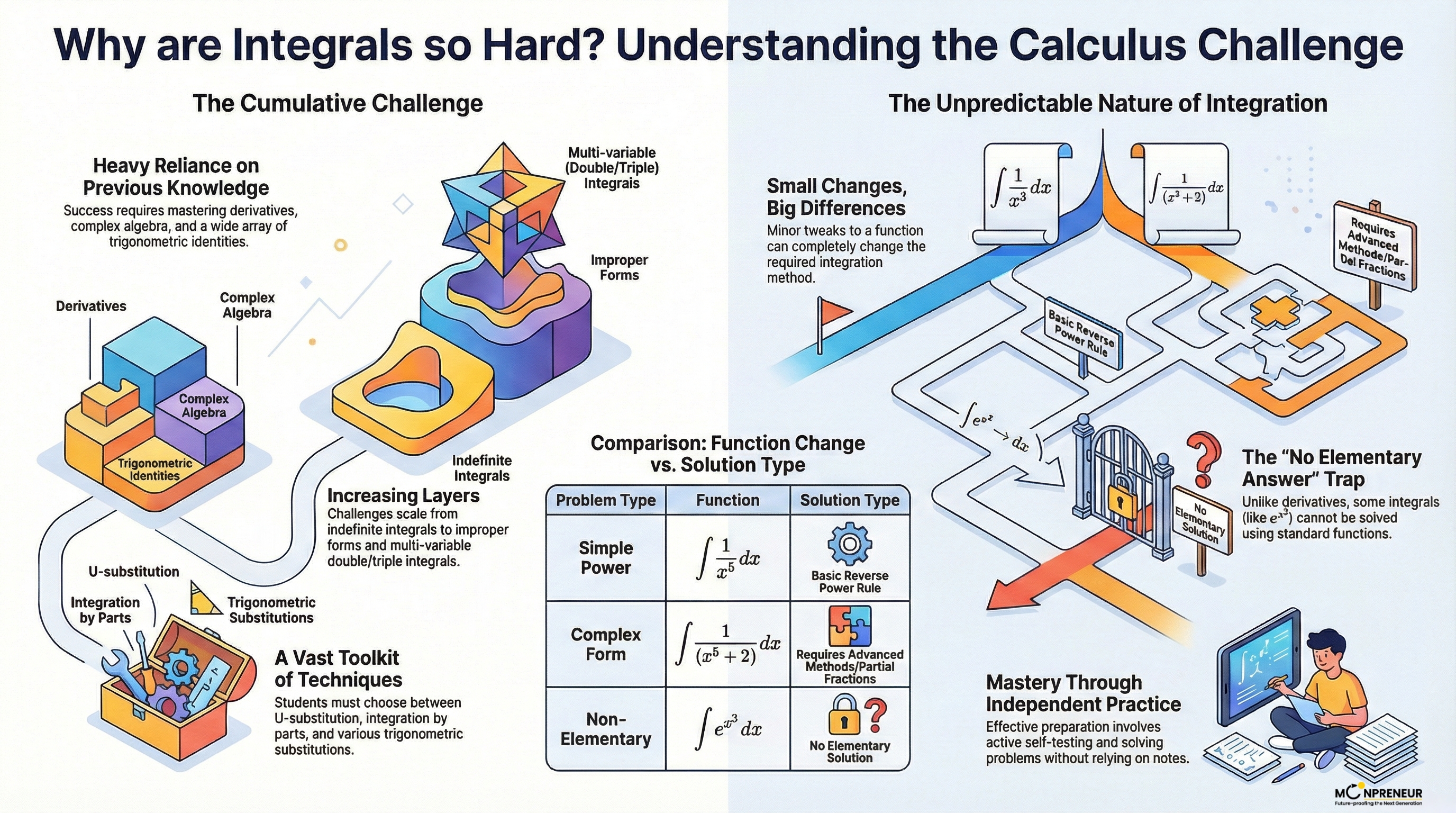
    The biggest reason integrals feel impossible is that they require you to carry a massive amount of previous knowledge into every problem.

    • The Derivative Connection: To find an indefinite integral, you are essentially looking for an anti-derivative. If you don’t have your derivative table memorized or, better yet, if you haven’t tested yourself with a blank one lately, you’re trying to build a house without a foundation.
    • The Algebra Trap: Many “calculus” mistakes are actually algebra mistakes. Solving integrals often requires complex factoring, completing the square, or partial fraction decomposition.
    • Trigonometry Identity Crisis: To make a function “integral-ready,” you frequently have to swap trig expressions using identities. If you aren’t comfortable with your identities, the integral will stay locked.

    3. The “Small Change, Big Difference” Trap

    In calculus, two problems can look almost identical but require completely different universes of math to solve. This is perhaps the most frustrating pitfall for students.

    Consider these two examples: 

    • The “Easy” One:

    \(\displaystyle \int \frac{1}{x^{5}}\,dx\)

    This is a simple power rule problem where you add one to the exponent and divide.

    The “Nightmare” One:

    \(\displaystyle \int \frac{1}{x^{5} + 2}\,dx\)

    By adding a simple “+ 2” to the denominator, the answer transforms from a basic fraction into something vastly more complex. Calculus is sensitive. A tiny change in the problem can mean the difference between a ten-second solution and a ten-minute struggle.

    4. Incorrect Application of the Fundamental Theorem of Calculus

    The Pitfall: Applying the Fundamental Theorem of Calculus (F(b) – F(a)) to functions that are not continuous on the interval [a, b]. Failing to break an integral into smaller, continuous segments when encountering jump discontinuities.
    The Result: Calculating a finite, reasonable-looking number for an integral that actually diverges (e.g., \(\displaystyle \int_{-1}^{1} \frac{1}{x^{2}}\,dx\) )

    5. Searching for a “Ghost” Answer

    Sometimes, the reason you can’t solve an integral isn’t that you aren’t “smart enough”—it’s because the answer doesn’t exist in the way you think it does.

    In algebra, you might have learned that = −1 has “no real answer” until you were introduced to imaginary numbers. Similarly, some integrals have no elementary answer. This means you cannot express the result using standard functions like polynomials, trig functions, or logarithms.

    Common “unsolvable” examples include: 

    • \(\displaystyle \int e^{x^{2}}\,dx\)
    • \(\displaystyle \int \sin(\sin(x))\,dx\)

    If you run into these in a standard Calc 2 class, it is perfectly okay to say they have no elementary solution, though higher-level math eventually creates “advanced” answers like the imaginary error function to fill the gap.

    6. Neglecting the Constant of Integration(+C)

    The Pitfall: Forgetting the “+C” in indefinite integrals.

    The Result: While sometimes considered a minor notation error, in differential equations, this omission results in a totally different (and wrong) function, as the constant accounts for essential vertical shifts.

    How to Get Better (The SAT Mindset)

    The secret to mastering integrals is the same secret to mastering the SAT: active practice. It’s not enough to watch a video or read a textbook. You have to ask yourself, “Can I solve this on my own?” Test yourself with quizzes, try to identify which “type” of integral you are looking at before you start writing, and always keep your algebra and trig skills sharp. Integrals are hard because they are the ultimate test of everything you’ve learned in math so far. 

    Want to excite your child about math and sharpen their math skills? Moonpreneur’s online math curriculum is unique, as it helps children understand math skills through hands-on lessons, assists them in building real-life applications, and excites them to learn math. 

    You can opt for our Advanced Math or Vedic Math+Mental Math courses. Our Math Quiz for grades 3rd, 4th, 5th, and 6th helps in further exciting and engaging in mathematics with hands-on lessons.

    Recommended Reading:

    1. Solving Exponential Equations Using Recursion: A Step-by-Step Guide
    2. Linear Equation – One Solution, No Solution and Many Solutions
    3. Interesting Geometry Problem to Solve For Kids
    4. The Ultimate Guide to Solving SAT Quadratics in Seconds

    5. How to Derive and Use the Quadratic Formula (With Examples)

    6. Application & Proof  of the Sherman-Morrison-Woodbury Identity
    7. The Geometry Problem That Still Defeats ChatGPT, Gemini, and Grok

    FAQs on Pitfalls for Calculus properties

    1. Why is integration often more difficult for students to master than derivatives?

    Ans. Integration is significantly more challenging because it relies heavily on a wide range of previous mathematical knowledge, including derivative tables, complex algebraic factoring, and trigonometric identities.

    2. What is an elementary answer, and can every integral be solved using one?

    Ans. An elementary answer is a solution that can be expressed using standard functions like polynomials, logarithms, or trigonometric expressions, but not all integrals have one. In a standard calculus class, such integrals are often treated as having no solution, although higher-level mathematics may use specialized definitions like the imaginary error function to provide an advanced answer.

    3. How should students practice to ensure they are prepared for calculus exams?

    Ans. The most effective way to prepare is to focus on active practice by ensuring you can solve questions entirely on your own without the help of videos or textbooks.

    4. What should I do if my u-substitution makes the integral look more complicated?

    Ans. If your substitution results in a messier expression or leaves leftover x terms that cannot be converted to u, you likely chose the wrong part of the function. A good rule of thumb is to pick a u, whose derivative (du ) is already clearly visible elsewhere in the integrand. If that fails, you might need to try algebraic manipulation.
    Moonpreneur

    Moonpreneur

    Moonpreneur is an ed-tech company that imparts tech entrepreneurship to children aged 6 to 15. Its flagship offering, the Innovator Program, offers students a holistic learning experience that blends Technical Skills, Power Skills, and Entrepreneurial Skills with streams such as Robotics, Game Development, App Development, Advanced Math, Scratch Coding, and Book Writing & Publishing.
    Subscribe
    Notify of
    guest

    0 Comments
    Inline Feedbacks
    View all comments

    RELATED ARTICALS

    Explore by Category

    MOST POPULAR

    GIVE A GIFT OF $10
    MINECRAFT GIFT
    TO YOUR CHILD

    JOIN A FREE TRIAL CLASS

    FREE PRINTABLE MATH WORKSHEETS

    DOWNLOAD 3rd GRADE MATH WORKSHEET
    Download Now

    DOWNLOAD 4rd GRADE MATH WORKSHEET
    Download Now

    DOWNLOAD 5rd GRADE MATH WORKSHEET
    Download Now

    DOWNLOAD 4rd GRADE MATH WORKSHEET
    Download Now

    MATH QUIZ FOR KIDS - TEST YOUR KNOWLEDGE

    MATH QUIZ FOR GRADE 3

    Start The Quiz

    MATH QUIZ FOR GRADE 4

    Start The Quiz

    MATH QUIZ FOR GRADE 5

    Start The Quiz

    MATH QUIZ FOR GRADE 6

    Start The Quiz