Attend our in-person Robotics & Math


Update: This article was last updated on 12th March 2026 to reflect the accuracy and up-to-date information on the page.
You’re staring at a definite integral packed with sines, cosines, and fractions. It looks impossible. Your first instinct? Reach for a calculator. But before you do, what if there was a two-step royal shortcut that dissolves the entire problem in under a minute?
In the world of calculus, two powerful properties, King’s rule integration and Queen’s rule integration, work as a dynamic duo. Used together, they can turn a nightmare integral into a clean, simple answer. This guide will walk you through both when to use each and exactly why the Queen steps in when the King falls short.
What Is King’s Rule in Integration?
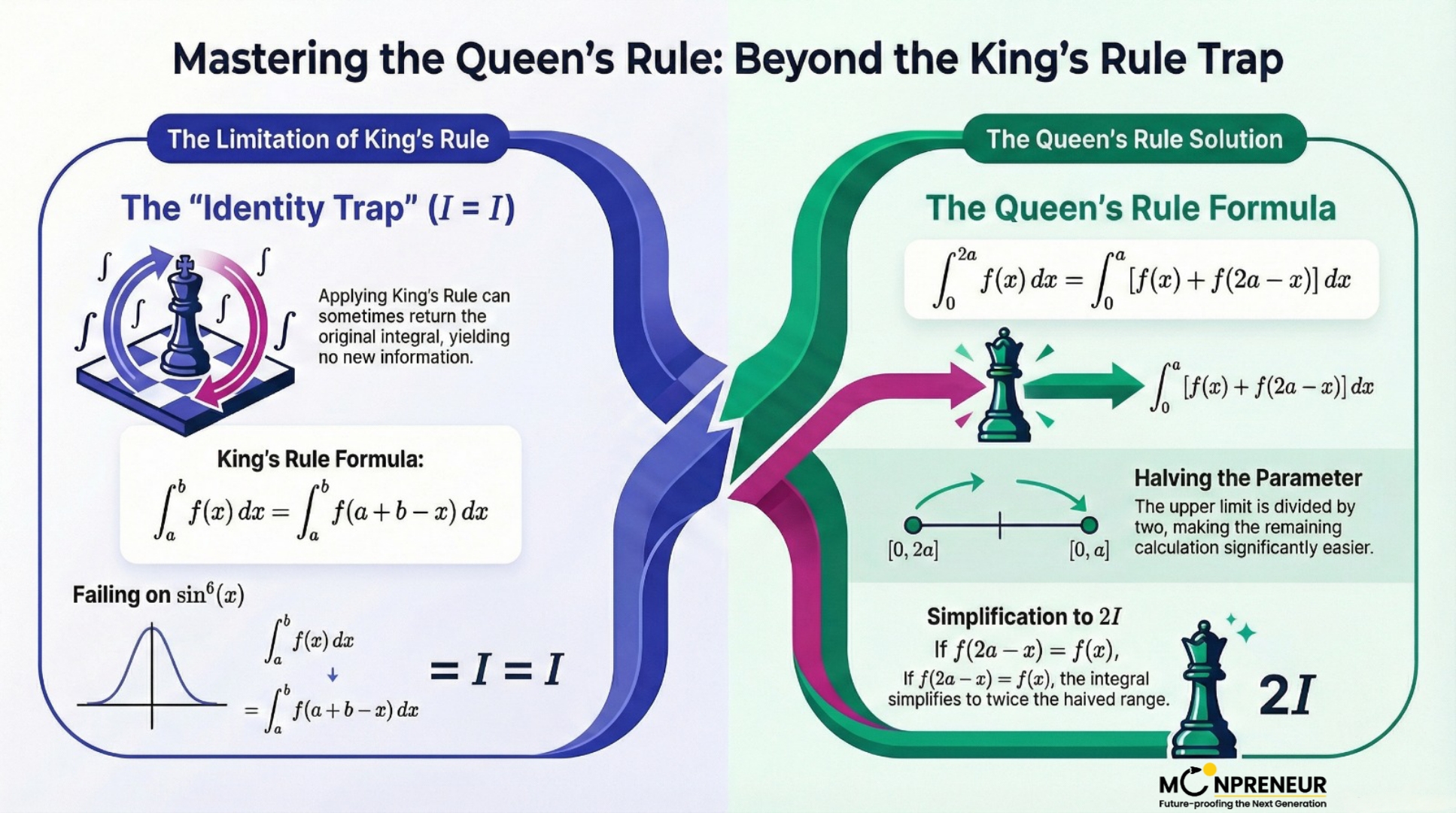
King’s rule integration (also called the King’s property of definite integrals) is one of the most elegant symmetry tricks in calculus. It states that a definite integral from a to b remains unchanged when you substitute x with (a + b − x).
King’s Rule Formula: ∫[a to b] f(x) dx = ∫[a to b] f(a + b − x) dx |
This substitution essentially mirrors the function about the midpoint of the interval without changing the integral’s value. It’s especially powerful for integrals involving trigonometric functions over symmetric intervals like [0, π].
When Does King’s Rule Work Best?
King’s rule integration is your go-to tool when:
- The integrand involves sin(x), cos(x), or tan(x) over [0, π] or [0, π/2]
- Substituting (a + b − x) simplifies or cancels part of the function
- The resulting expression can be added to the original to give a constant integrand
When Does King’s Rule Fail?
Here’s where students get stuck. Sometimes, King’s rule integration loops back on itself. You substitute (a + b − x) and end up proving only that I = I —, which is mathematically true but completely useless.
This loop happens when the substitution doesn’t simplify the fraction but instead recreates the same structure. Example:
∫[0 to π] x · sin(x) / (1 + cos²x) dx
Applying King’s rule integration here gives you a new expression that, when added to the original, doesn’t cancel cleanly. You go in circles. This is the exact moment the Queen’s rule of integration becomes essential.
What Is Queen’s Rule in Integration?
Queen’s property of integration (also known as the Queen’s rule definite integration property) is a specialized tool designed for integrals whose upper limit can be written as 2a. It works by checking the symmetry of the integrand around the midpoint a.
Queen’s Rule Formula: ∫[0 to 2a] f(x) dx = ∫[0 to a] [f(x) + f(2a − x)] dx
The Two Cases of Queen’s Property
The Queen’s property integration formula splits into two powerful outcomes based on the symmetry of f(2a − x):
| Condition | Result |
|---|---|
| f(2a − x) = f(x) [Symmetric] | 2 × ∫0a f(x) dx |
|
f(2a − x) = −f(x) [Anti-symmetric] |
0 |
The key difference: while King’s rule of integration changes the integrand, the Queen’s rule of integration changes the limits, cutting the interval from [0, 2a] down to [0, a].
Solved Example: Using Queen’s Rule to Break the King’s Loop
Let’s solve the exact integral where King’s rule integration fails, and Queen’s rule integration saves the day.
Evaluate: I = ∫[0 to π] x / (1 + sin x) dx |
Step 1 — Attempt King’s Rule (and See Why It Loops)
Applying King’s rule integration with a = 0, b = π, substitute x → (π − x):
I = ∫[0 to π] (π − x) / (1 + sin(π − x)) dx = ∫[0 to π] (π − x) / (1 + sin x) dx |
Adding I + I gives 2I = π × ∫[0 to π] 1/(1 + sin x) dx. This does work in this case, but for harder variants (like x·sin(x)/(1 + cos²x)), the King loops. This is where the Queen’s property of integration takes over.
Classic Queen’s Rule Example: ∫[0 to π] x·sin(x)/(1 + cos²x) dx
I = ∫[0 to π] x · sin(x) / (1 + cos²x) dx |
Step 1: Identify the Structure
Upper limit = π, so 2a = π → a = π/2. The integrand is f(x) = x · sin(x) / (1 + cos²x).
Step 2: Apply King’s Rule First
Substitute x → (π − x) using King’s rule integration:
I = ∫[0 to π] (π − x) · sin(π − x) / (1 + cos²(π − x)) dx |
Since sin(π − x) = sin x and cos(π − x) = −cos x → cos²(π − x) = cos²x:
I = ∫[0 to π] (π − x) · sin(x) / (1 + cos²x) dx |
Step 3: Add Both Forms of I
2I = π · ∫[0 to π] sin(x) / (1 + cos²x) dx |
Step 4: Now Apply Queen’s Property (Halve the Limit)
Since sin(π − x)/1+cos²(π − x) = sin(x)/1+cos²(x) (i.e., f(2a − x) = f(x)), the Queen’s rule definite integration doubles it:
2I = 2π · ∫[0 to π/2] sin(x) / (1 + cos²x) dx |
Step 5: Evaluate with Substitution
Let u = cos x → du = −sin x dx. When x = 0, u = 1; when x = π/2, u = 0:
I = π · ∫[0 to 1] du / (1 + u²) = π · [arctan u] from 0 to 1 = π · π/4 = π²/4 |
✓ Answer: I = π²/4
King’s Rule vs Queen’s Rule: Key Differences
| Feature | King's Rule Integration | Queen's Rule Integration |
|---|---|---|
| What it changes | The integrand (substitutes x) | The limits (halves the interval) |
| Key substitution | x → a + b − x | Checks f(2a − x) symmetry |
| Best used when | Integrand simplifies with substitution | King's rule loops; limit is 2a |
| Outcome | Adds two forms of I | Doubles or zeroes the integral |
| Interval | Any [a, b] | Must be [0, 2a] |
Step-by-Step Decision Framework
When you face a complex definite integral, use this mental checklist:
- Identify the limits — is the upper limit of the form 2a (like π, 2, 4)?
- Try King’s rule integration first — substitute x → (a + b − x) and see if the sum simplifies.
- Check if it loops — if adding the two forms gives I = I or doesn’t resolve, stop.
- Switch to Queen’s rule of integration — test f(2a − x) for symmetry.
- If f(2a − x) = f(x): double and halve the limit. If f(2a − x) = −f(x): the answer is 0.
- Apply King’s rule again on the reduced integral if needed — now it often works perfectly.
Common Mistakes to Avoid
- Skipping the symmetry test: Always verify whether f(2a − x) equals f(x) or −f(x) before applying Queen’s rule for definite integration.
- Forgetting to halve the limit: Queen’s property integration doubles the integral AND halves the upper limit. Both changes happen together.
- Applying Queen’s rule when limits aren’t [0, 2a]: This property only works for integrals starting at 0.
- Using King’s rule when the substitution creates an unsolvable loop: Recognize the loop early and switch strategies.
A Tip for SAT prep
For those of you currently grinding through SAT prep, remember: math isn’t just about memorizing one way to do things. It’s about building a “toolbox.” The King’s Rule is great, but the Queen’s Rule is the specialized tool you pull out when things get really interesting.
Recommended Reading:
- Solving Exponential Equations Using Recursion: A Step-by-Step Guide
- Linear Equation – One Solution, No Solution and Many Solutions
- Interesting Geometry Problem to Solve For Kids
- Application & Proof of the Sherman-Morrison-Woodbury Identity
- The Geometry Problem That Still Defeats ChatGPT, Gemini, and Grok
FAQs on Queen’s Property
Q1. What is the main purpose of Queen's rule integration?
Q2. When should I use Queen's rule instead of King's rule integration?
Q3. How does Queen's rule change the limits of integration?
Q4. Can King's rule and Queen's rule be used together?
Q5. Is Queen's rule the same as the property for even/odd functions?
Pro Tip for Exam Day
Think of King’s rule integration and Queen’s rule integration as a team. The King transforms the integrand; the Queen transforms the limits. When one hits a wall, the other opens a door. Mastering both, and knowing when to switch, is what separates students who struggle from students who solve any integral with confidence.
Want to excite your child about math and sharpen their math skills? Moonpreneur’s online math curriculum is unique as it helps children understand math skills through hands-on lessons, assists them in building real-life applications, and excites them to learn math.
You can opt for our Advanced Math or Vedic Math+Mental Math courses. Our Math Quiz for grades 3rd, 4th, 5th, and 6th helps in further exciting and engaging in mathematics with hands-on lessons.