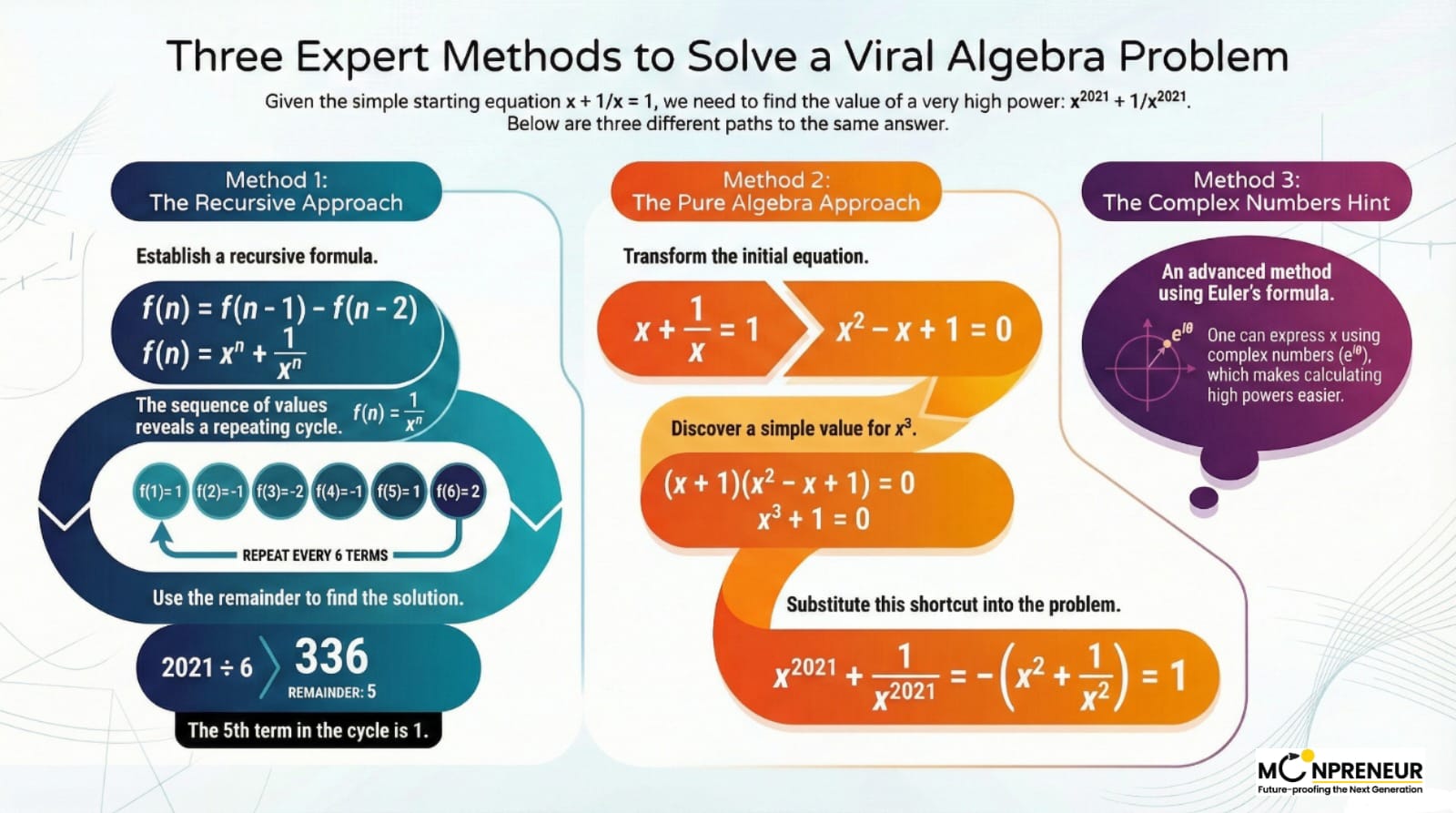
We’ve all been there: You’re staring at an SAT practice test, and suddenly you see a problem like x+ 1/x = 1. Find the value of \(\displaystyle x^{2021} + \frac{1}{x^{2021}}\)
At first glance, you might think. How are you supposed to calculate something to the power of 2021 without a supercomputer? But today, in this blog, we are going to solve this without a supercomputer, using two brilliant approaches.
Method 1: The Power of Patterns (The Recursive Approach)
When you see a massive exponent, there is almost always a hidden pattern. Instead of jumping to 2021, let’s start small and see what happens when we increase the power of x step by step.
- Starting Point: We know x+ 1/x =1. Let’s call this f(1).
- Squaring it: If we square both sides, we get x² + 1/x + 2 = 1². Subtracting 2 gives us x² + 1/x² = −1. Let’s call this f(2).
- Cubing it: By multiplying these two results together, we can find x³ +1/x³. After some quick algebra, we find that x³ + 1/x³ = −2.
Recommended Reading: American Mathematics Competitions (AMC) Guide
The Decisive Moment: If you keep going, you’ll discover a recursive formula: each step can be found using the ones before it. The relationship is f(n) = f(n−1) −f (n−2). Using this, we can list the values:
- f(1)=1
- f(2)=−1
- f(3)=−2
- f(4)=−1
- f(5)=1
- f(6)=2
- f(7)=1 … wait, it’s repeating.
The values repeat every six steps. To find the value for 2021, we just divide 2021 by 6. The remainder is 5, which means the value of \(\displaystyle x^{2021} + \frac{1}{x^{2021}}\) is the same as f(5), which is 1.
Method 2: The “Algebraic method (The x³ Shortcut)
If recursion feels too long, there is a faster algebraic way that often appears on advanced math competitions and the SAT.
If you take the original equation x+1/x=1 and rearrange it into a quadratic equation, you get x² – x + 1 = 0.
Now, here is the trick:
If you multiply that equation by (x+1), you get a very famous identity: x³ + 1 = 0.
This tells us that for this problem, x³ = −1 , We can rewrite \(\displaystyle x^{2021}\) using x³.
- 2021 = (3×673) + 2
- So, \(\displaystyle x^{2021} = (x^{3})^{673} \times x^{2}\)
- Since, x³ = -1 this becomes \(\displaystyle (-1)^{673} \times x^{2} = -x^{2}\)
Doing the same for \(\displaystyle \frac{1}{x^{2021}} \) gives us -1/x². The whole problem simplifies to −(x² +1/x²).
Since we already found that x² + 1/x² = −1, the final answer is −(−1) = 1.
For a more detailed walkthrough, you can watch this video: