Attend our in-person Robotics & Math


Today, we are going to solve a classic geometry problem that even the Gemini of ChatGPT sometimes fails. The trick to solve it is easy, but needs a little bit of attention. Lets look at the Problem.
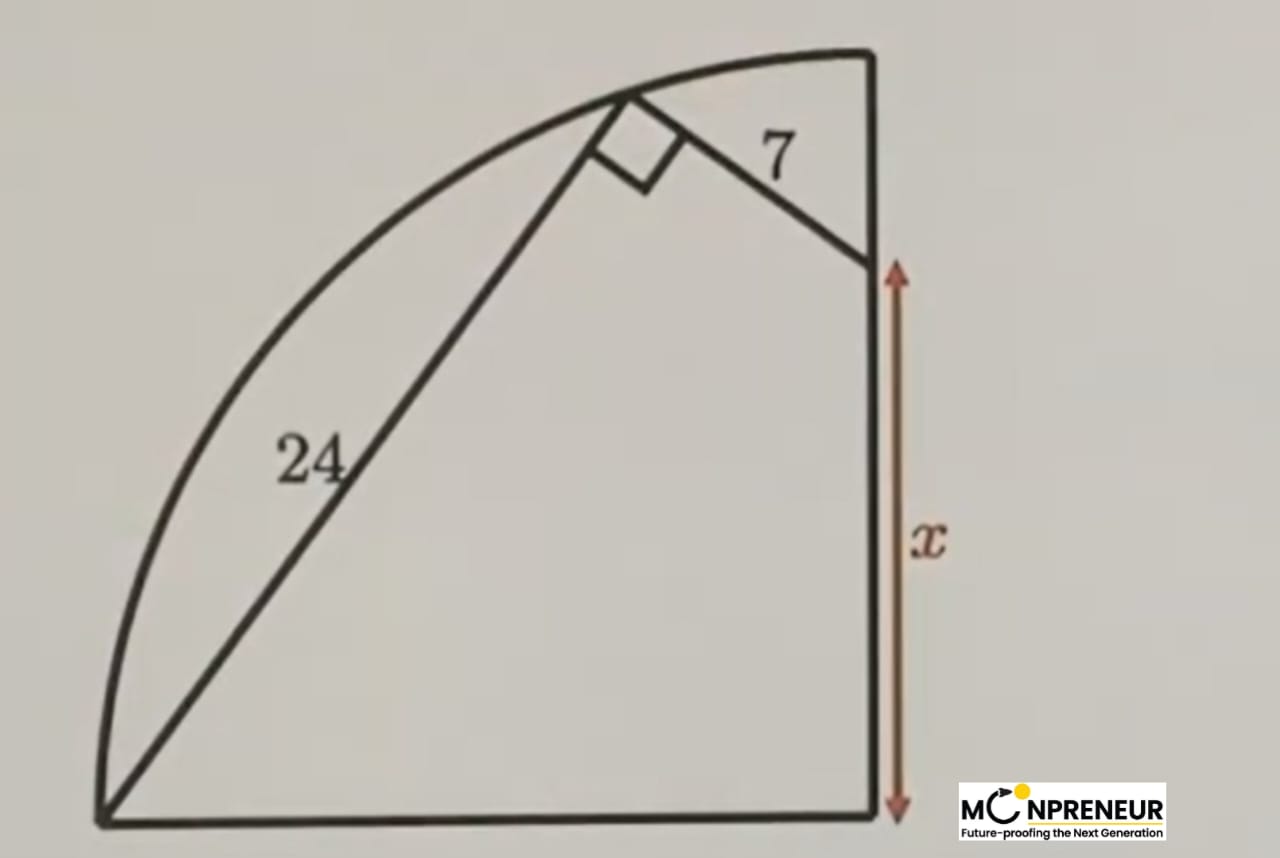
Find the value of x
Step 1: Find the Missing Link
We start with a right-angled triangle with sides of 24 and 7. Your first instinct should always be the Pythagorean theorem!
By calculating \(\displaystyle \sqrt{24^{2} + 7^{2}}\) we get, \(\displaystyle \sqrt{576 + 49}\) which equals \(\displaystyle \sqrt{625}\).
So, our first unknown line is 25.
Recommended Reading: An overview of the SAT Math Test Sections
Step 2: Think Outside the (Semi) Circle
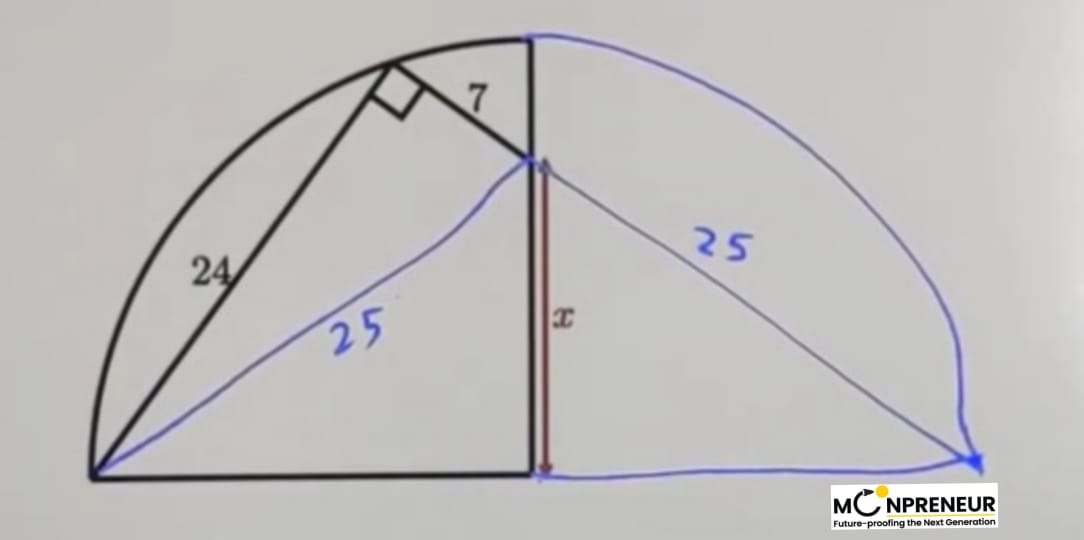
Here is where the “magic” happens. To find x, the trick is to extend the semicircle into a full circle. By doing this and connecting the lines, we create similar triangles that reveal a much larger right-angled triangle.
Recommended eading The Ultimate Guide to Solving SAT Quadratics in Seconds
Step 3: The SAT “Pro-Tip” (The 3-4-5 Trick)
In this new, larger triangle, the height is still 24, but the base is now 7+25, giving us 32. Now, you could spend time squaring 32, or you could use a shortcut. Notice that 24 and 32 are both multiples of 8:
- 8×3=24
- 8×4=32
This is just a massive 3-4-5 triangle! Therefore, the hypotenuse is 8×5, which is 40. Since this 40 represents the diameter of our circle, the radius is 20.
Step 4: The Final Stretch
We are almost there! We now have a final right-angled triangle where the hypotenuse is 25 and one side (the radius) is 20. To find x, we calculate:
\(\displaystyle \sqrt{25^{2} – 20^{2}} = \sqrt{625 – 400} = \sqrt{225}\)The square root of 225 is 15, which is our final answer.
Therefore, the value of x is 15.
Recommended Reading: How to Derive and Use the Quadratic Formula (With Examples)
Let us take another example:
A right triangle with sides 9 and 12. Find x.
Step 1. Find the Hypotenuse: \(\displaystyle \sqrt{9^{2} + 12^{2}} = 15\)
Step 2. Extend the Circle: New base = 9+15=24
Step 3. Find the Diameter: \(\displaystyle \sqrt{12^{2} + 24^{2}} = \sqrt{720}\)
Step 4. Find the Radius: \(\displaystyle \sqrt{\frac{720}{2}} = \sqrt{180}\)
Step 5. Solve for X: \(\displaystyle \sqrt{15^{2} – 180} = \sqrt{225 – 180} = \sqrt{45} = 3\sqrt{5}\)
For a more detailed walkthrough, you can watch this video: