
Your child is heading into 7th grade, and suddenly, it’s not just fractions and multiplication tables anymore. It’s ratios, proportional relationships, negative numbers, and probability. If you’re homeschooling, choosing the right curriculum can feel overwhelming. The good news? Research gives us some clear direction.
What the Research Actually Says
A 2023 report by the RAND Corporation found that curriculum quality is one of the strongest predictors of math achievement, more influential than instructional time alone. And a meta-analysis published in the Journal of Research in Mathematics Education found that curricula aligned to Common Core State Standards (CCSS) consistently produce stronger outcomes in middle school math, particularly when they emphasize real-world application alongside procedural fluency.
That matters for homeschoolers. A curriculum that checks the right content boxes — but buries concepts in drill-and-repeat practice without context — won’t serve your child as well as one that builds genuine understanding.
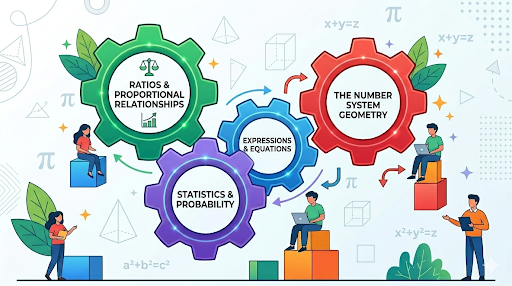
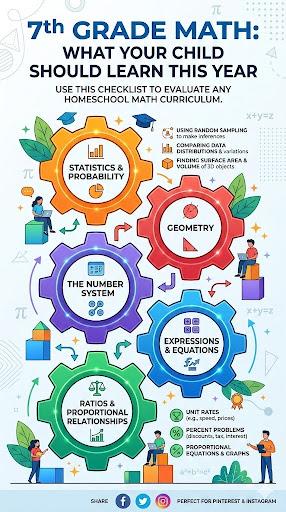
What does a strong 7th-grade math curriculum cover? According to the CCSS framework, the core domains include:
- Ratios and Proportional Relationships — This is the backbone of 7th-grade math. Students move beyond simple ratios (“2 apples for every 3 oranges”) into more complex territory — like computing unit rates when both numbers are fractions, or figuring out a 15% tip on a restaurant bill. They also learn to recognize when two quantities are proportional by looking at tables, graphs, and equations. A big idea here is the constant of proportionality — the “k” in y = kx — which becomes foundational for algebra later on.
- The Number System — This is where students fully enter the world of negative numbers and fractions, working together. They learn to add, subtract, multiply, and divide rational numbers (any number that can be written as a fraction), and they build intuition for why a negative times a negative is a positive. They also explore how fractions convert to decimals — some terminate (like 1/4 = 0.25), others repeat forever (like 1/3 = 0.333…). It’s less about memorizing rules and more about understanding the logic behind them.
- Expressions and Equations — Students start thinking algebraically here. They learn to simplify and rewrite expressions — for example, understanding that a + 0.05a is the same as 1.05a (which is exactly how sales tax works). They solve two-step equations like 2x + 3 = 11 and move into inequalities, learning to graph solution sets on a number line. The real skill being built is translating a word problem into math and solving it systematically.
- Geometry — 7th-grade geometry has a nice mix of hands-on and conceptual work. Scale drawings teach students to compute real-world distances from a map — practical stuff. Constructing triangles gets them thinking about when a unique shape is even possible (not every set of three side lengths forms a triangle). And slicing 3D shapes is genuinely fun — if you cut a rectangular prism with a horizontal plane, what 2D shape do you get? A rectangle. Cut it diagonally? Something different entirely. It builds strong spatial reasoning.
- Statistics and Probability — Students learn that you don’t need to survey every person in a city to understand the whole population; a well-chosen random sample does the job. They study what makes a sample representative and how to draw valid inferences from data. On the probability side, they move from simple events (“what’s the chance of rolling a 3?”) to compound events (“what’s the chance of rolling a 3 and flipping heads?”), learning to organize outcomes using tables, lists, and tree diagrams. They also run simulations to test whether their predictions hold up in practice.
A well-designed curriculum will move through all five domains — not just the ones that are easiest to teach.
What This Means for Your Homeschool
Here’s where it gets practical. Research from the What Works Clearinghouse (U.S. Department of Education) consistently shows that students learn math more deeply when they encounter concepts through multiple representations — visual models, real-world contexts, equations, and verbal reasoning — rather than through abstract rules alone.
Look for a curriculum that teaches why, not just how. For example, when covering proportional relationships, a strong program won’t just have students solve equations. It will ask them to graph those relationships, identify the constant of proportionality in a table, and connect the math to something real — like calculating unit rates at a grocery store.
The same applies to probability. Simply memorizing formulas isn’t enough. Strong curricula help students develop probability models, compare predicted outcomes to real data, and work through compound events using sample spaces and tree diagrams.
Emerging evidence also supports spaced practice (returning to concepts over time) and interleaving (mixing problem types) as more effective than massed repetition — though this is still an active area of research in K–12 settings.
4 Concrete Steps to Take Next
- Download the CCSS Grade 7 Math standards (free at corestandards.org) and use them as your baseline checklist when evaluating any curriculum.
- Request a sample unit from any curriculum you’re considering. Look at how a concept like proportional relationships is introduced — is it just formulas, or does it build from tables, to graphs, to equations?
- Check for alignment reviews at EdReports.org, a nonprofit that rates K–12 curricula for rigor and standards alignment — including homeschool-friendly options.
- Plan for assessment — build in short quizzes or problem sets at the end of each unit to catch gaps before they compound across the year.
The right curriculum won’t do the teaching for you — but it will give you and your child a solid, research-backed foundation to build on.
Want to excite your child about math and sharpen their math skills? Moonpreneur’s online math curriculum is unique as it helps children understand math skills through hands-on lessons, assists them in building real-life applications, and excites them to learn math.
You can opt for our Advanced Math or Vedic Math+Mental Math courses. Our Math Quiz for grades 3rd, 4th, 5th, and 6th helps in further exciting and engaging in mathematics with hands-on lessons.