
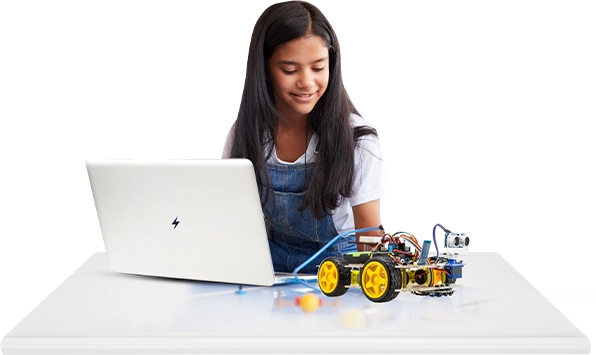
Robotics programming has traditionally required strong knowledge of coding languages like C++, Python, and Java. But today, a new trend is changing the game — no-code and low-code robotics platforms.
Are these beginner-friendly tools the future of robotics programming? Let’s explore how no-code platforms are transforming STEM education, innovation, and accessibility.
What Are No-Code Robotics Platforms?
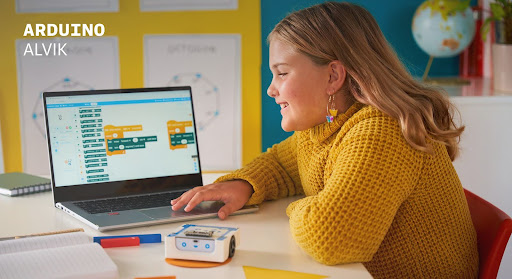
No-code robotics platforms allow users to program robots using visual, drag-and-drop interfaces instead of complex syntax.
Instead of writing lines of code, users connect logical blocks such as:
- Move Forward
- Turn 90 Degrees
- If Object Detected
- Repeat Loop
Platforms like VEXcode, Scratch, and beginner-friendly robotics tools have made programming accessible to students as young as 8 years old.
These systems reduce technical barriers while still teaching core programming logic.
Why No-Code Platforms Are Growing Fast
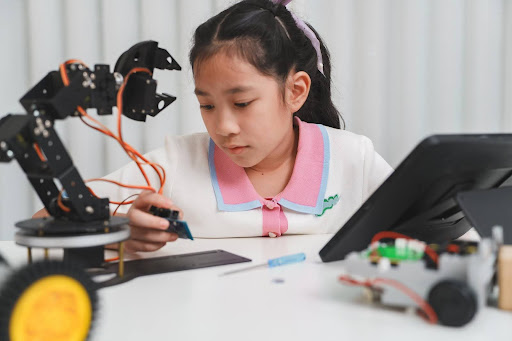
1. Accessibility for Beginners
Traditional programming can feel intimidating. No-code tools remove the fear factor and make robotics more inclusive for:
- Young students
- Parents with no technical background
- Teachers new to coding
This accessibility is one of the biggest drivers of growth.
- Faster Learning Curve
With visual programming:
- Students see instant results
- Errors are easier to identify
- Learning becomes interactive and fun
This encourages experimentation and creativity.
- Strong Foundation in Logic
Even though it’s “no-code,” students still learn:
- Sequencing
- Loops
- Conditional logic
- Problem-solving
These are the exact same computational thinking skills required in advanced programming.
4. Growing Demand for STEM Education
As industries adopt AI, automation, and robotics, schools are introducing robotics earlier than ever.
No-code platforms allow educational institutions to:
- Integrate robotics into curriculum
- Train teachers quickly
- Provide scalable learning programs
This makes them ideal for schools, robotics academies, and STEM labs.
Are No-Code Platforms Replacing Traditional Coding?
Not exactly.
No-code platforms are best viewed as a gateway, not a replacement.
They:
- Introduce beginners to programming concepts
- Build confidence
- Prepare students for advanced languages
Many robotics platforms allow students to transition from block-based coding to text-based programming like Python or C++ when ready.
This hybrid approach ensures long-term growth.
Benefits for Kids and Parents
For Kids:
- Easier entry into robotics
- Faster project completion
- Boosted confidence
- Creative experimentation
For Parents:
- Productive screen time
- Early exposure to future technologies
- Structured STEM learning
No-code platforms make robotics less overwhelming and more enjoyable.
Challenges of No-Code Robotics
While powerful, no-code systems have limitations:
- Less flexibility for complex applications
- Limited customization in advanced robotics
- May require transition to text coding for professional-level development
However, for beginners and educational environments, these limitations are rarely a barrier.
The Future of Robotics Programming
The future likely lies in a blended approach:
- Start with no-code visual platforms
- Progress to low-code systems
- Transition into advanced programming
As robotics becomes part of everyday industries — from healthcare to manufacturing — accessible programming tools will play a major role in preparing the next generation.
No-code robotics platforms are not just a trend. They are a powerful educational shift that makes innovation accessible to everyone.
Final Thoughts
No-code robotics programming is opening doors for millions of students worldwide.
It lowers entry barriers, builds confidence, and strengthens STEM foundations — without removing the depth of learning.
Are no-code platforms the next big thing?
Yes — especially in education and early robotics training.
They are shaping the future by making robotics programming simpler, smarter, and more inclusive.
FAQ Section
No-code robotics programming uses visual drag-and-drop tools to control robots without writing complex code.
Yes, it simplifies programming concepts and is ideal for students and STEM beginners.
Yes, most platforms allow transition from block-based coding to text-based languages like Python or C++.