



You’re managing your ESA account carefully, spending on curriculum and tutoring. But by June, you still have $2,000 left. Does it disappear? Can you save it for high school expenses or even college? Understanding Arizona’s ESA rollover policy is one of the program’s most valuable features, and one of its most misunderstood. Families can accumulate funds over time and even use them for post-secondary education, but there are specific rules you need to follow.
The Rollover Reality: Your Funds Don’t Expire
Unlike traditional school budgets that operate on “use it or lose it” principles, Arizona’s ESA program allows unused funds to roll over from year to year. If you receive $7,000 in ESA funding but only spend $5,500 during the school year, the remaining $1,500 carries forward to the next contract year automatically. This rollover feature allows families to build savings over multiple years for expensive educational investments like specialized therapies, advanced coursework, or post-secondary education.
The scale of rollover across the program is significant. As of July 2025, Arizona families had accumulated $444 million in unused ESA funds, a sharp increase from $360 million reported just one year earlier. While critics argue these unused funds should return to the state general fund, the reality is that these dollars remain legally available for families to spend on qualified educational expenses. Some families with long-standing accounts have accumulated over $100,000 in rollover funds.
However, accumulation alone doesn’t guarantee you’ll keep those funds forever. Arizona law establishes specific conditions under which unused funds eventually return to the state, particularly after your child graduates.
The Four-Year Window for College and Post-Secondary Education
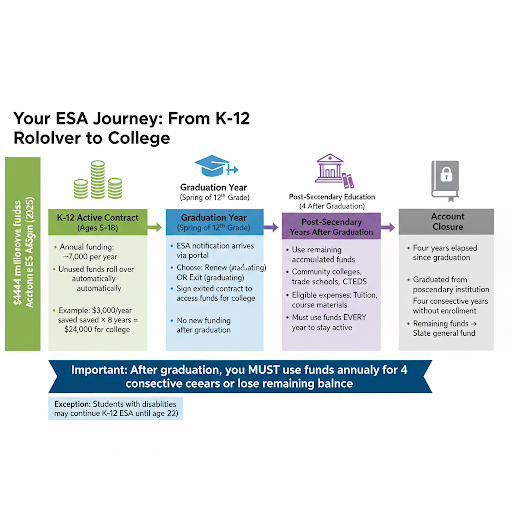
Once your child graduates from high school or obtains a GED, the ESA program transitions from a K-12 education account to a post-secondary education account through what’s called an “exited contract”. In the spring of your child’s 12th-grade year, the Arizona Department of Education will notify you through the ESA Portal asking whether your child will graduate that year. If you answer “yes,” you’ll sign an existing contract that allows continued access to any remaining ESA funds.
This is where the clock starts. After graduation, your child has four consecutive years to use the remaining funds for eligible post-secondary expenses. The keyword is “consecutive”—you cannot take a gap year and expect the account to remain active indefinitely. To keep the account in good standing, you must use some funds for eligible expenses each year. If your child isn’t enrolled in an eligible post-secondary institution for four consecutive years, the ESA account closes, and any remaining funds return to the state general fund.
No additional funding is provided after you sign the existing contract. The existing contract only gives you access to funds already accumulated in your account during your child’s K-12 years. This makes strategic saving during high school particularly valuable for families planning to use ESA funds for college.
What College Expenses Qualify Under ESA
Arizona’s ESA program allows post-secondary funds to be used for a broader range of educational options than many families realize. Eligible institutions include community colleges, four-year colleges and universities (both public and private in-state institutions), trade schools, vocational programs, Joint Technical Education Districts (JTEDs), and Career and Technical Education Districts (CTEDs).
Qualified post-secondary expenses mirror many of the K-12 allowables: tuition and fees at eligible institutions, textbooks and required course materials, dual enrollment courses (while still in high school), educational services and therapies from licensed practitioners, and standardized testing fees, including college admission exams and AP tests. Arizona’s program is particularly generous in allowing dual enrollment expenses, high school students can use ESA funds to take college courses and earn credits that count toward both high school graduation and a future college degree.
However, there are important limitations. Room and board expenses are generally not covered under Arizona’s ESA post-secondary provisions, unlike federal 529 plans or Coverdell ESAs. The focus remains on direct educational expenses rather than living costs. Additionally, if you’ve already graduated from high school and are fully enrolled as a post-secondary student, certain expense categories become ineligible.
Strategic Planning: Building Your College Fund
The rollover feature creates a strategic opportunity for long-term educational planning. If your child is in elementary school and you’re spending $4,000 annually on homeschool curriculum and activities but receiving $7,000 in ESA funding, you could theoretically accumulate $3,000 per year. Over eight years, that’s $24,000 available for high school Advanced Placement courses, dual enrollment, or college tuition.
Some Arizona families have successfully used this strategy to accumulate substantial post-secondary reserves. The program’s design allows families with modest K-12 expenses to build college savings using public education dollars, a feature that has sparked policy debates about whether ESA funds should be spent more actively on current educational needs.
However, accumulation also carries risk. Nearly $49 million sits in inactive accounts—accounts that haven’t been renewed but still contain funds. Twenty-three inactive accounts contain $100,000 or more. These represent families who left the program without properly managing their remaining funds, and the state may eventually recoup these dormant dollars.
What You Can Do Right Now
- Check your current rollover balance: Log in to your ESA Portal and review your available funds. If you’re carrying over significant amounts year after year, assess whether you’re maximizing educational opportunities during your child’s K-12 years or strategically saving for post-secondary expenses.
- Plan for graduation transitions: If your child is in high school, understand that the four-year post-secondary window begins at graduation. Discuss with your family whether college, trade school, or vocational education is the goal, and budget accordingly.
- Respond to ESA graduation notifications promptly: When you receive the spring notification asking whether your child will graduate, respond accurately and on time. Selecting “yes” triggers the exited contract; selecting “no” when your child is actually graduating can result in account suspension.
- Use funds annually after graduation: Once you have an existing contract, make sure to spend at least some funds each year on eligible post-secondary expenses. The consecutive four-year requirement means you cannot skip years without risking account closure and forfeiture of remaining funds.
Moonpreneur is on a mission to disrupt traditional education and future-proof the next generation with holistic learning solutions. Its Innovator Program is building tomorrow’s workforce by training students in AI/ML, Robotics, Coding, IoT, and Apps, enabling entrepreneurship through experiential learning.