

You signed up for the Arizona ESA expecting around $7,000 to $8,000. But a parent in your child’s therapy group mentioned they get closer to $30,000. Same program. Very different amounts.
That’s not a glitch. It’s by design, and understanding how it works could meaningfully change how you plan your child’s education.
The Baseline: What Most Families Receive
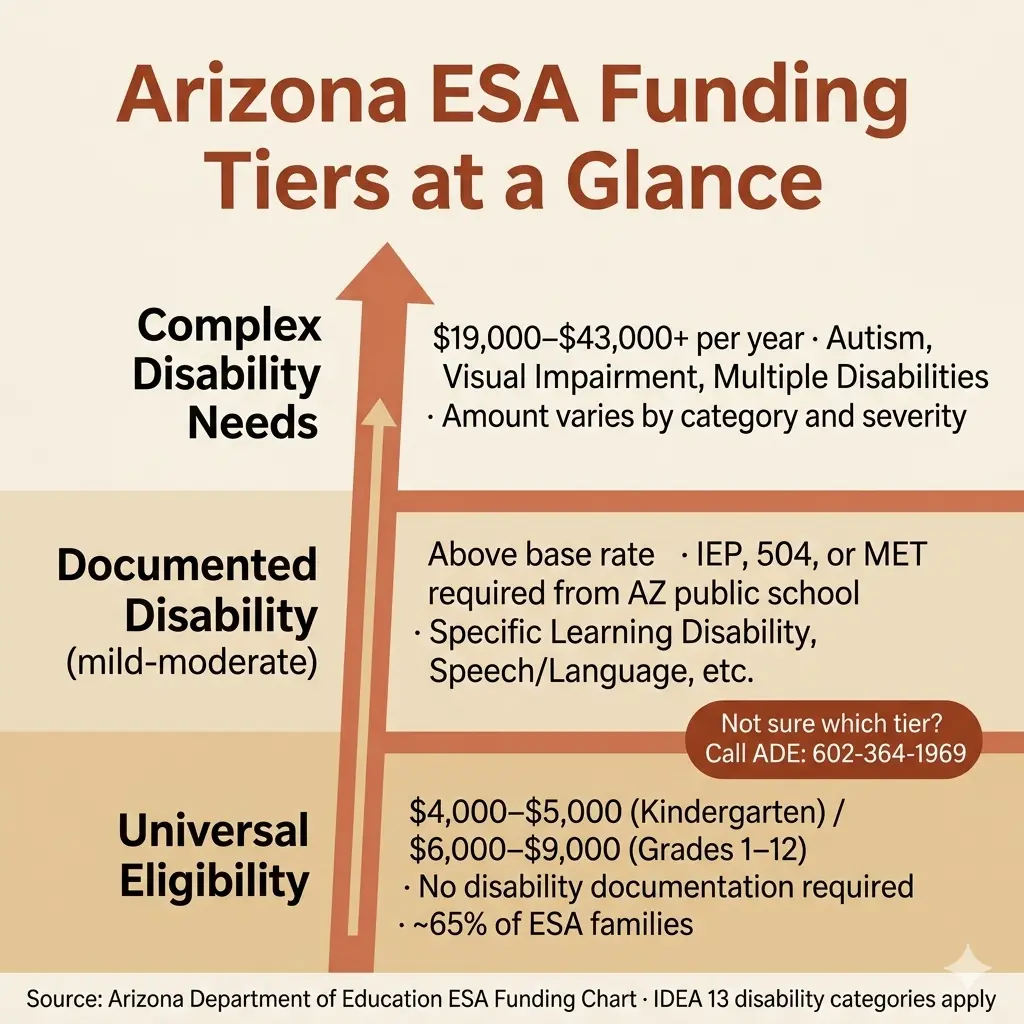
The ESA is funded at 90% of what the state would have spent educating your child in their assigned public school. For most families, that lands between $6,000 and $9,000 per year for students in grades 1–12, and between $4,000 and $5,000 for kindergarteners.
According to EdChoice’s program data (updated December 2025), about 65% of Arizona ESA participants fall into that $7,000–$8,000 range. These are the “universal eligibility” students — kids without a documented disability who qualified simply by living in Arizona.
That’s your baseline. But it’s not the ceiling.
Recommended Reading: Arizona ESA Spending Rules: What Parents Need to Know Before They Buy
When Disability Documentation Changes the Calculation
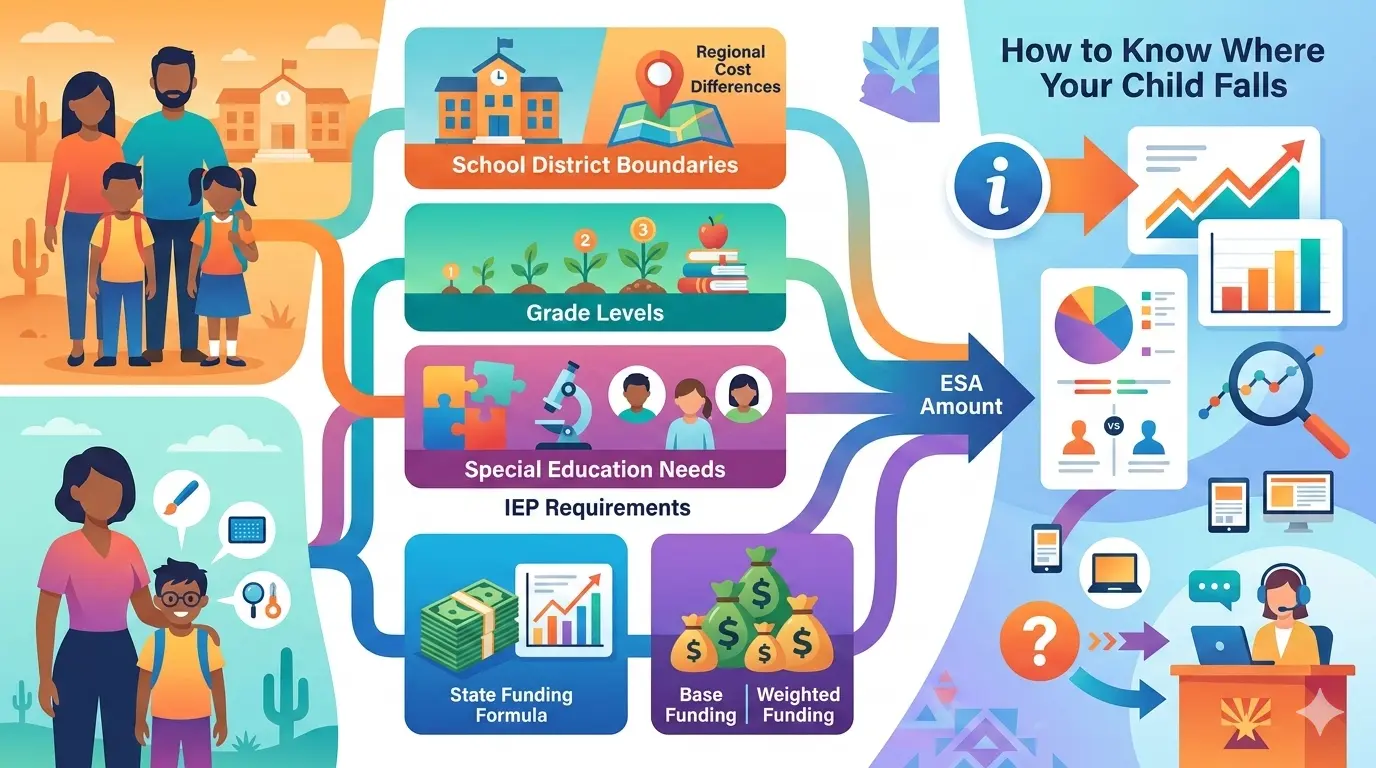
If your child has a current IEP (Individualized Education Program), 504 Plan, or MET (Multidisciplinary Evaluation Team) report from an Arizona public school, their ESA funding is calculated differently. The state layers in additional funding on top of the base rate, and that additional amount depends on the specific disability category.
The Individuals with Disabilities Education Act (IDEA) recognizes 13 disability categories, and Arizona’s ESA mirrors those distinctions. Here’s why that matters in dollars:
- Specific Learning Disability (dyslexia, dyscalculia, etc.): Funding is modestly above the base rate, typically in the lower end of the disability range
- Autism Spectrum Disorder: Students can receive $30,000–$43,000 per year, reflecting the intensive support often needed
- Visual Impairment: Approximately $19,000–$38,000 annually, depending on severity
- Multiple Disabilities: When a child has more than one qualifying condition (e.g., autism and a speech impairment), they are categorized under “Multiple Disabilities” — you cannot stack two categories to combine their rates
These figures come from the Arizona Department of Education’s own funding chart, which the ADE ESA office makes available to families upon request.
What the Research Says About Disability-Specific Funding
The funding design isn’t arbitrary. Federal data from the National Center for Education Statistics consistently shows that educating a student with a disability costs substantially more than educating a student without one. The IDEA mandate for a “free and appropriate public education” (FAPE) reflects decades of research showing that targeted early intervention and specialized support measurably improve long-term outcomes for children with learning differences.
It’s worth noting: once a family accepts ESA funding, IDEA protections no longer apply through the public school system. That’s a real trade-off. Private schools are not required to follow an IEP, even if your child has one. What you gain in flexibility, you may give up in legal protection. Disability Rights Arizona maintains a clear parent-friendly guide on this topic if you want to understand it fully before signing.
One Thing That Catches Parents Off Guard
Even with a disability diagnosis, not all documentation qualifies. Arizona requires that your child’s IEP, 504, or MET report come from an Arizona public school, not a private school, nor an independent provider. And it must be current at the time of application.
If your family has always homeschooled or used a private school, you may need to request a public school evaluation before applying for the disability-level funding rate.
Four Steps to Make Sure You’re Getting the Right Amount
- Pull your child’s current documentation. Check whether their IEP, MET, or 504 is current and issued by an Arizona public school. Expired documents will default your application to the general funding rate.
- Look up your child’s specific disability category. The ADE ESA eligibility page lists each category. Matching your child’s documented category to the funding chart is how you confirm what to expect.
- Request the current funding chart directly from ADE. Call the ESA office at 602-364-1969. Funding amounts shift each year slightly based on the state’s per-pupil base rate, so last year’s chart may be outdated.
Weigh the ESA against other options if your child has significant needs. For some families with children who have complex disabilities, remaining in public school with full IDEA protections, or pursuing an IEP-based private placement, may provide more targeted support than the ESA funding alone can buy. It’s worth a conversation with a special education advocate before deciding.
The ESA program has more financial range than most parents realize. Whether $7,000 or $40,000 is the right number for your family depends entirely on your child’s documented needs, and knowing how to find that number is the first step.
Moonpreneur is dedicated to transforming conventional education, preparing the next generation with comprehensive learning experiences. Our Innovator Program equips students with vital skills in AI/ML, Robotics, Coding, Game Development, and App Development, fostering entrepreneurship through hands-on learning. This initiative aims to cultivate the workforce of tomorrow by integrating innovative technologies and practical skills in school curriculums.
Register for a 60-minute free workshop today!