


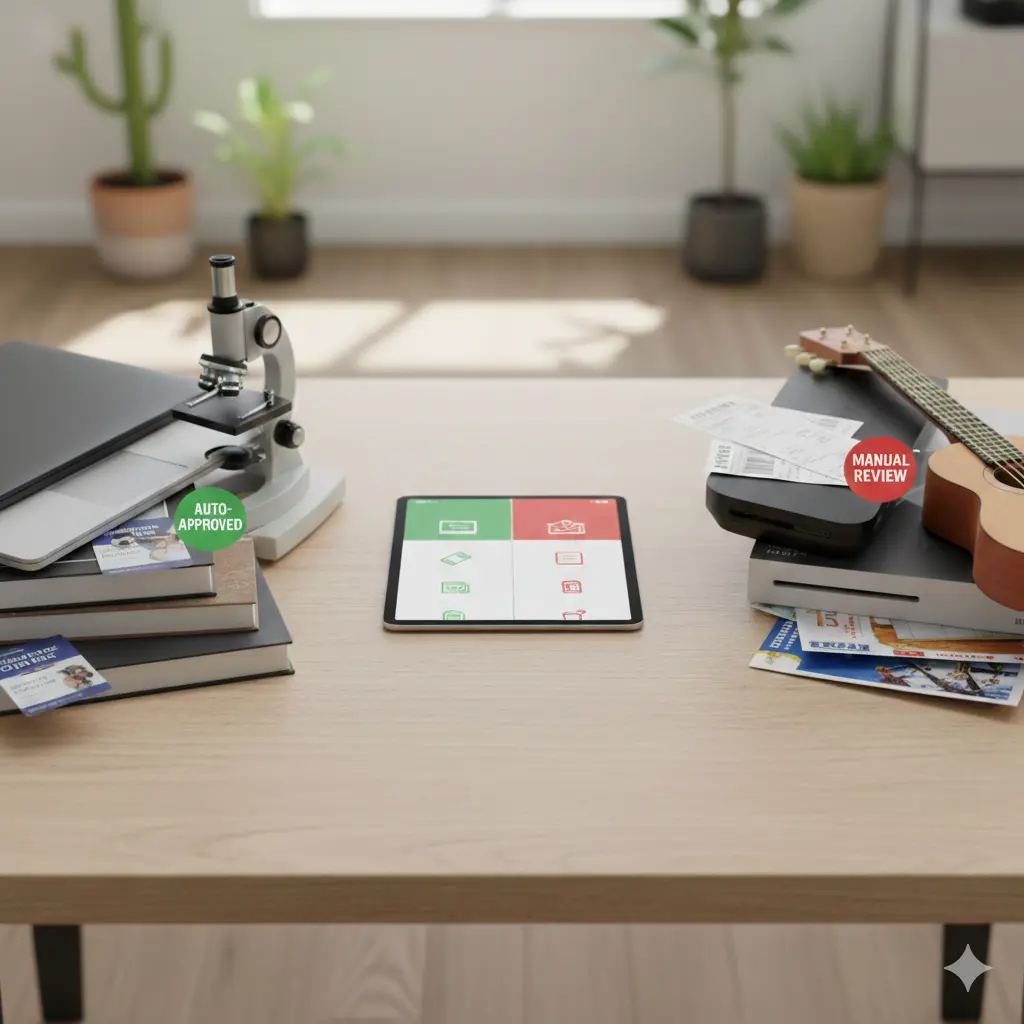
Most Arizona ESA purchases now go through instantly, but only a small slice still needs pre-approval or deeper manual review later. Understanding that line—auto-approved vs. scrutinized—is the key to avoiding surprise repayments or account holds.
Why auto‑approval matters
Since late 2024, Arizona ESA moved to a “pay first, audit later” model for most transactions. That cleared backlogs but shifted more responsibility onto parents to spend correctly.
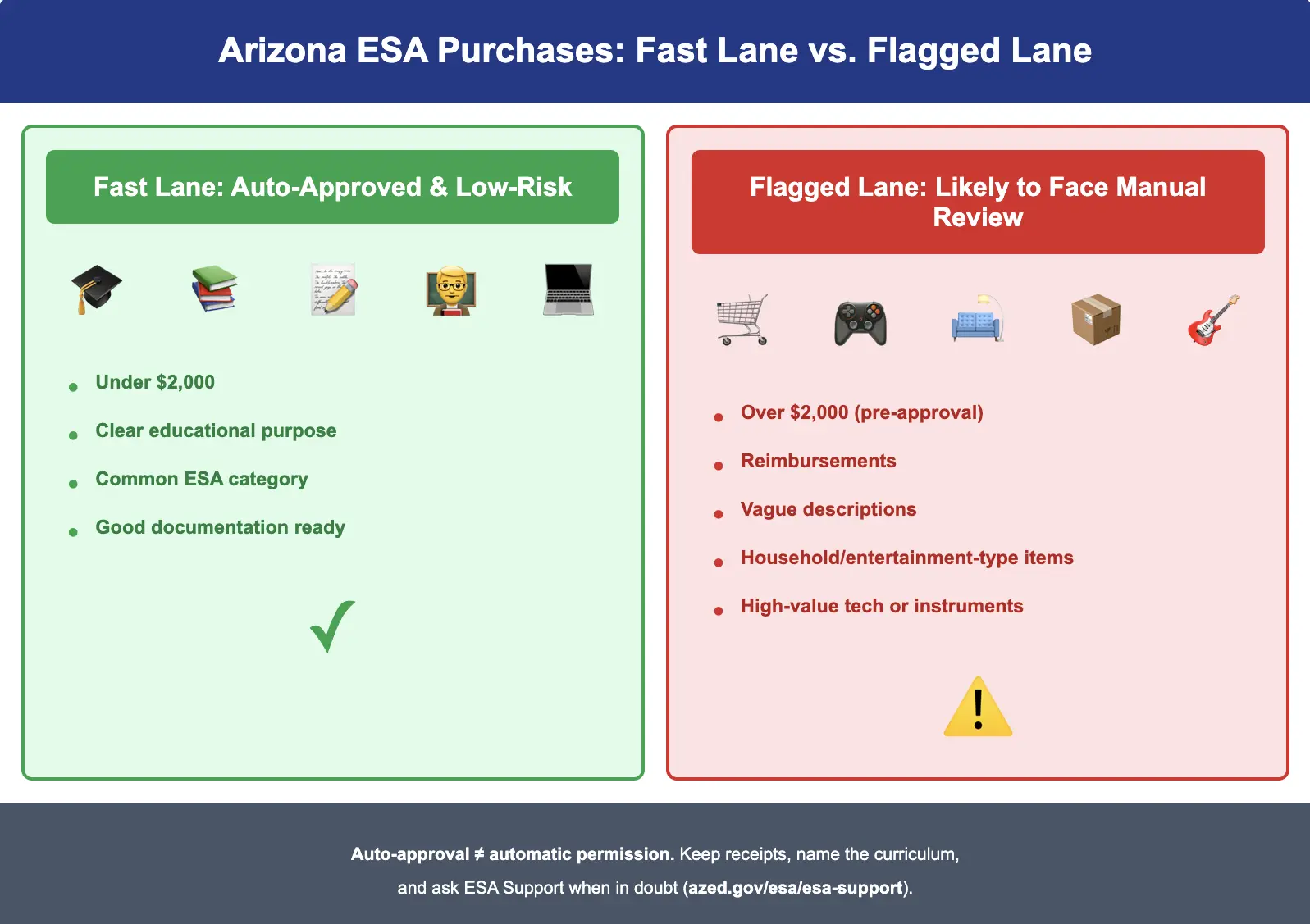
- Any purchase under $2,000 is auto‑approved in ClassWallet.
- That threshold covers 99.998% of all ESA transactions and about 99.95% of the dollars spent.
- More than 1.2 million purchases totaling $124.3 million were auto‑fulfilled in the first months after the change.
The transaction goes through. The judgment about whether it was allowable comes later.
What is truly auto‑approved
“Auto‑approved” only means no human checks your order before payment; it does not mean “always allowed.” Still, some purchases rarely trigger trouble when they clearly fit ESA rules.
Low‑risk, commonly allowed categories when clearly described:
- Private school tuition, fees, and required textbooks.
- Curriculum and workbooks that list a recognizable curriculum title.
- Tutoring and approved educational therapy from qualified providers.
- Standard educational supplies and basic technology used mainly for instruction (for example, a Chromebook for coursework).
For these under $2,000 purchases:
- ClassWallet processes the payment automatically.
- ESA staff may sample or audit later, especially if descriptions are vague or quantities are high.
Recommended Reading: Waiting for Arizona ESA Funds? Here’s the Real Scoop on Quarterly Disbursements
What triggers manual review
Some spending patterns are more likely to be pulled out of the fast lane and reviewed closely, either before or after payment.
Situations that can trigger manual review:
- Any purchase over $2,000 generally requires pre‑approval and represents far less than 0.01% of transactions.
- Reimbursements you pay out‑of‑pocket first; these are slower and more labor‑intensive to review.
- Vague cart descriptions like “learning tools,” “supplies,” or “miscellaneous.”
- Higher‑risk categories (electronics, furniture‑like items, PE gear, musical instruments, video games) where ESA has proposed or set tighter limits.
- Purchases that look like entertainment, décor, clothing, or general household upgrades rather than education.
Recent reports show staff still manually review hundreds of thousands of orders and reimbursements in a single quarter—even after auto‑approval became the norm. That is where borderline items sit the longest.
What triggers manual review
The goal is not just to get your purchase through today, but to make sure it survives the audit months from now.
Use this simple sequence before you buy:
- Check the rules first: Start with the ESA Parent Handbook and the official “Allowable / Unallowable” lists at azed.gov/esa.
- Label the purchase clearly: In ClassWallet, describe what it is and how your child will use it for education or vocational training.
- Attach or keep documentation: Save curriculum titles, invoices, service agreements, or therapist licenses for anything beyond basic books and supplies.
- Slow down for edge cases: If the item could be seen as entertainment, décor, or general household use, email or call ESA Support before ordering.
If an expense is later ruled disallowed, ESA can require repayment and may suspend the account until the issue is resolved.
Where parents can get help
You do not have to guess alone.
- ESA Parent Handbook (latest version): https://www.azed.gov/esa/esa-parent-handbook
- Allowable / Unallowable Expenses page: https://www.azed.gov/esa/esa-allowable-expenses
- ESA Support (questions or repayment letters): https://www.azed.gov/esa/esa-support (Phone and mailing address are listed on the page.)
- ClassWallet tutorials for Arizona ESA: https://www.azed.gov/esa/classwallet
A five‑minute check with ESA Support is almost always cheaper than repaying a “fast” purchase later.
At this point, the real question is not whether your ESA purchase will go through—it almost always will—but whether it will hold up when someone reviews it later. When you slow down for edge‑case items, label purchases clearly, and keep your documentation in one place, you shift the odds in your favor. A quick check of the handbook or a short call to ESA Support can be the difference between a smooth school year and a repayment letter you did not see coming.
Moonpreneur is on a mission to disrupt traditional education and future-proof the next generation with holistic learning solutions. Its Innovator Program is building tomorrow’s workforce by training students in AI/ML, Robotics, Coding, IoT, and Apps, enabling entrepreneurship through experiential learning.