

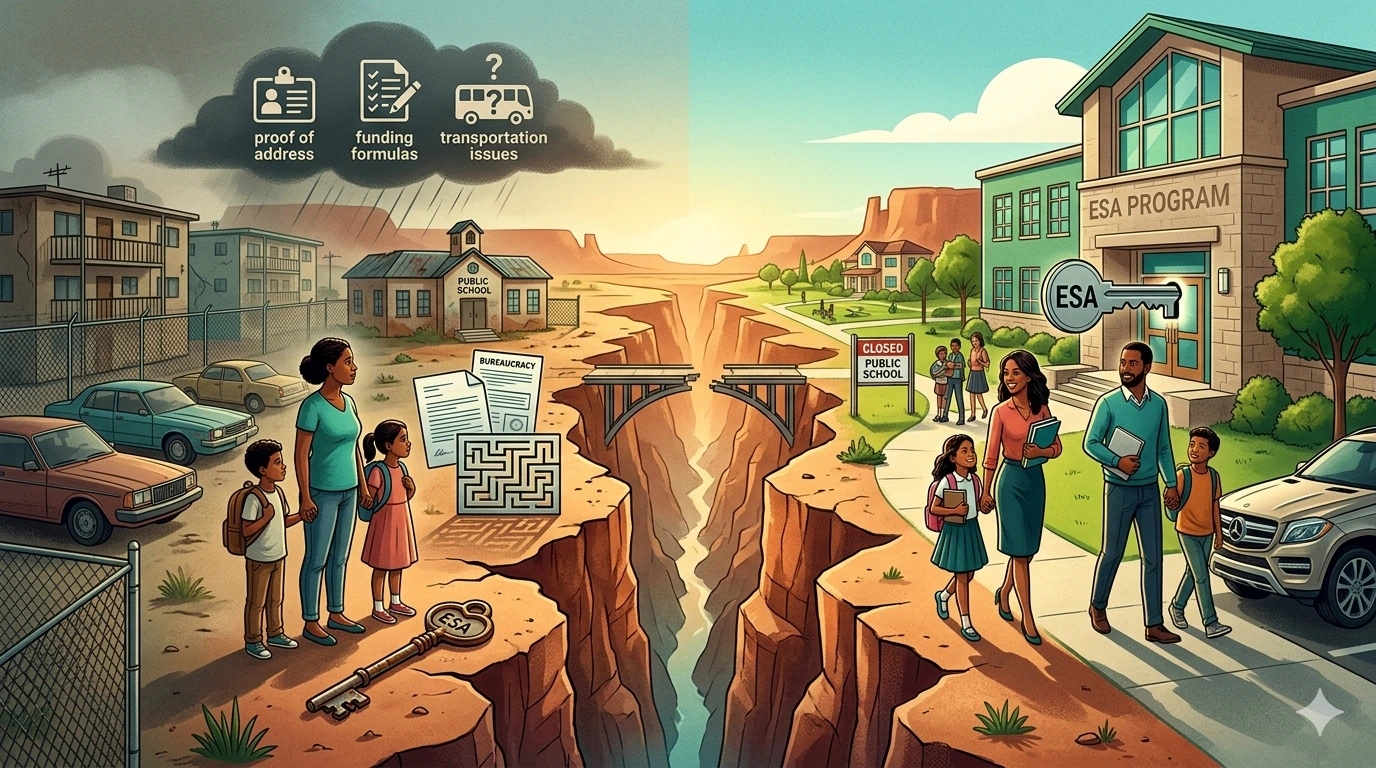
You qualify for Arizona’s ESA. The application is free. The money, somewhere between $7,000 and $9,000, is technically yours to use. So why are families in wealthier neighborhoods using the program at far higher rates than families in lower-income ones?
It’s a question worth understanding before you decide whether the ESA is a realistic option for your household.
What the Data Actually Shows
This isn’t speculation. It’s documented across multiple independent analyses.
In May 2024, researchers at the Brookings Institution analyzed Arizona Department of Education data on ESA enrollment by zip code. Their finding was direct: as poverty rates in a neighborhood increased, ESA participation decreased. A follow-up analysis by ProPublica in October 2024 found the same pattern using median household income as the measure.
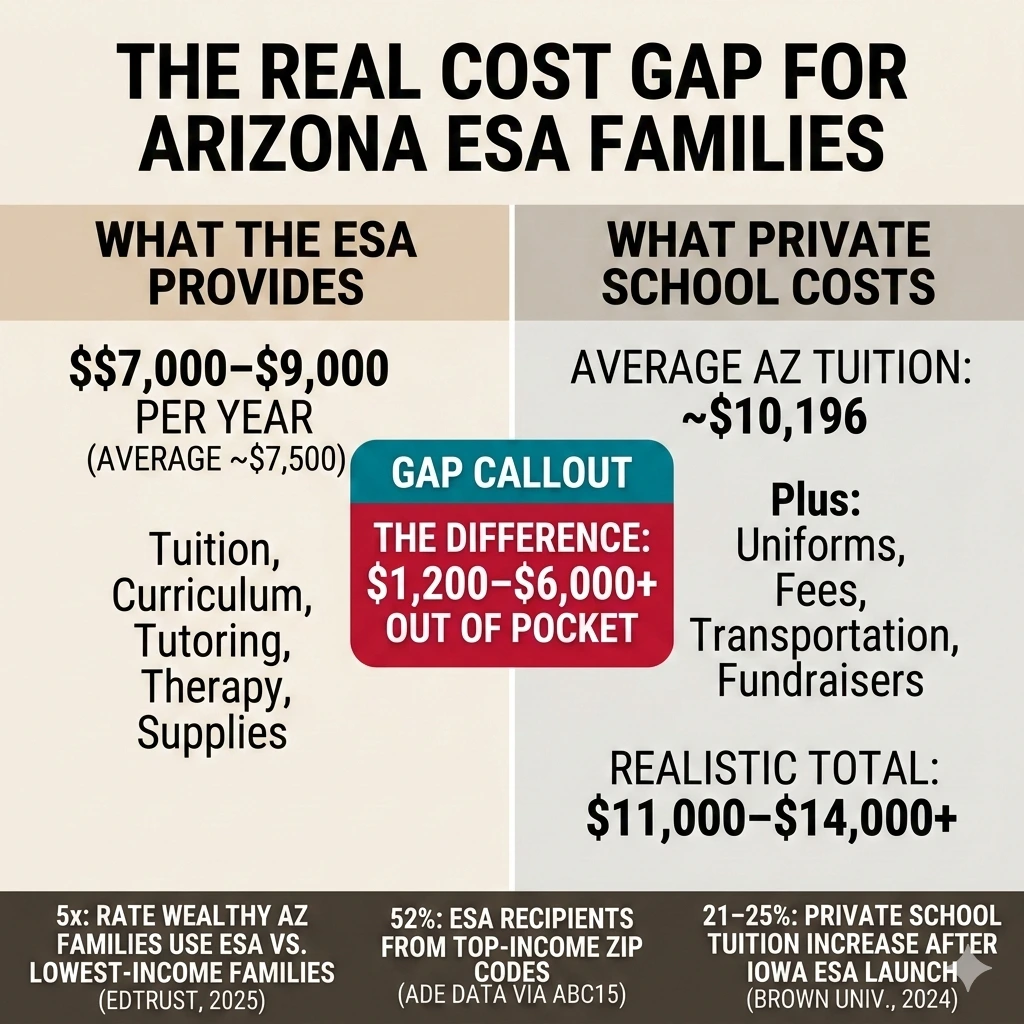
The gap is significant. According to an analysis of ADE data cited by EdTrust in 2025, Arizona’s wealthiest families use ESAs at five times the rate of the state’s poorest families. ABC15’s breakdown of the same data found that 52% of all ESA recipients come from zip codes in the top quarter of household incomes, while only 5% come from the lowest-income zip codes.
To be fair, some school choice advocates, including researchers at the Heritage Foundation, argue that this picture is incomplete. They point out that Arizona also has a separate Tax Credit Scholarship (TCS) program that does serve more lower-income families, and that combining both programs paints a more balanced picture of who benefits from Arizona’s school choice landscape. That’s a legitimate point worth knowing. But the ESA program itself, as currently structured, does show a strong tilt toward higher-income households.
Recommended Reading: Arizona ESA Spending Rules: What Parents Need to Know Before They Buy
Why the Voucher Alone Isn’t Enough for Many Families
The gap between what the ESA provides and what private schools actually cost is the single biggest barrier.
The average private school tuition in Arizona runs around $10,196 per year. The average ESA award is $7,000–$9,000. That leaves a gap of roughly $1,200 to $3,000, before uniforms, activity fees, transportation, and school fundraisers are factored in.
For families with two working parents, a cash gap of even $1,500 per year can be the difference between enrolling and not enrolling. And for single-parent households or those working hourly jobs, the math doesn’t add up.
Transportation is its own issue. Lower-income families pointed to private school locations and additional costs, including transportation and meals, as key reasons they didn’t use their voucher. Many Arizona private schools are concentrated in suburban areas, far from the neighborhoods where lower-income families live. Unlike public schools, most private schools don’t provide bus routes.
Then there are less tangible barriers. Some families worried whether they’d be received the same way at private schools as at public ones, and whether they’d have the same ability to advocate for their children. Those concerns don’t show up in data, but they’re real.
One More Factor: Tuition Is Rising
A 2024 study from Brown University’s Annenberg Institute found that when Iowa launched a universal ESA program, private school tuition for eligible kindergarteners rose by 21–25%. Arizona has seen similar dynamics since its universal expansion in 2022. When voucher funds flood a market, some schools raise prices to capture that new revenue, which further widens the gap for families who were already stretching to make it work.
What This Means If You’re Considering the ESA on a Tight Budget
None of this means the ESA is off the table for lower-income families. But it does mean going in with eyes open.
Here are four concrete things to check before applying:
- Get the real cost of tuition, not the advertised one. Call the school’s admissions office and ask for the total annual cost, including fees, uniforms, required devices, and any expected fundraising contributions. Compare that to your likely ESA award.
- Ask whether the school offers financial aid or tuition assistance. Some Arizona private schools have separate scholarship funds that can bridge the gap for families whose ESA doesn’t cover full tuition. This isn’t advertised; you have to ask directly.
- Look into Arizona’s Tax Credit Scholarship (TCS) program. The TCS is a separate, income-targeted program that can sometimes be combined with other funding. The Arizona Department of Education can provide more information, and organizations like Love Your School Arizona maintain parent-friendly guides to both programs.
- Map the commute before you commit. Use Google Maps to calculate the real daily travel time from your home to the school, in both directions, in morning traffic. If the school doesn’t provide transportation, factor in the annual cost of driving or rideshare before finalizing your decision.
The ESA program is genuinely accessible on paper. Whether it’s accessible in practice depends on several factors that don’t show up in the headline amount, and knowing those factors in advance is how you make a clear-eyed decision for your family.
Moonpreneur is dedicated to transforming conventional education, preparing the next generation with comprehensive learning experiences. Our Innovator Program equips students with vital skills in AI/ML, Robotics, Coding, Game Development, and App Development, fostering entrepreneurship through hands-on learning. This initiative aims to cultivate the workforce of tomorrow by integrating innovative technologies and practical skills in school curriculums.
Register for a 60-minute free workshop today!